PICK OF THE WEEK
Fjord (selected cinemas)
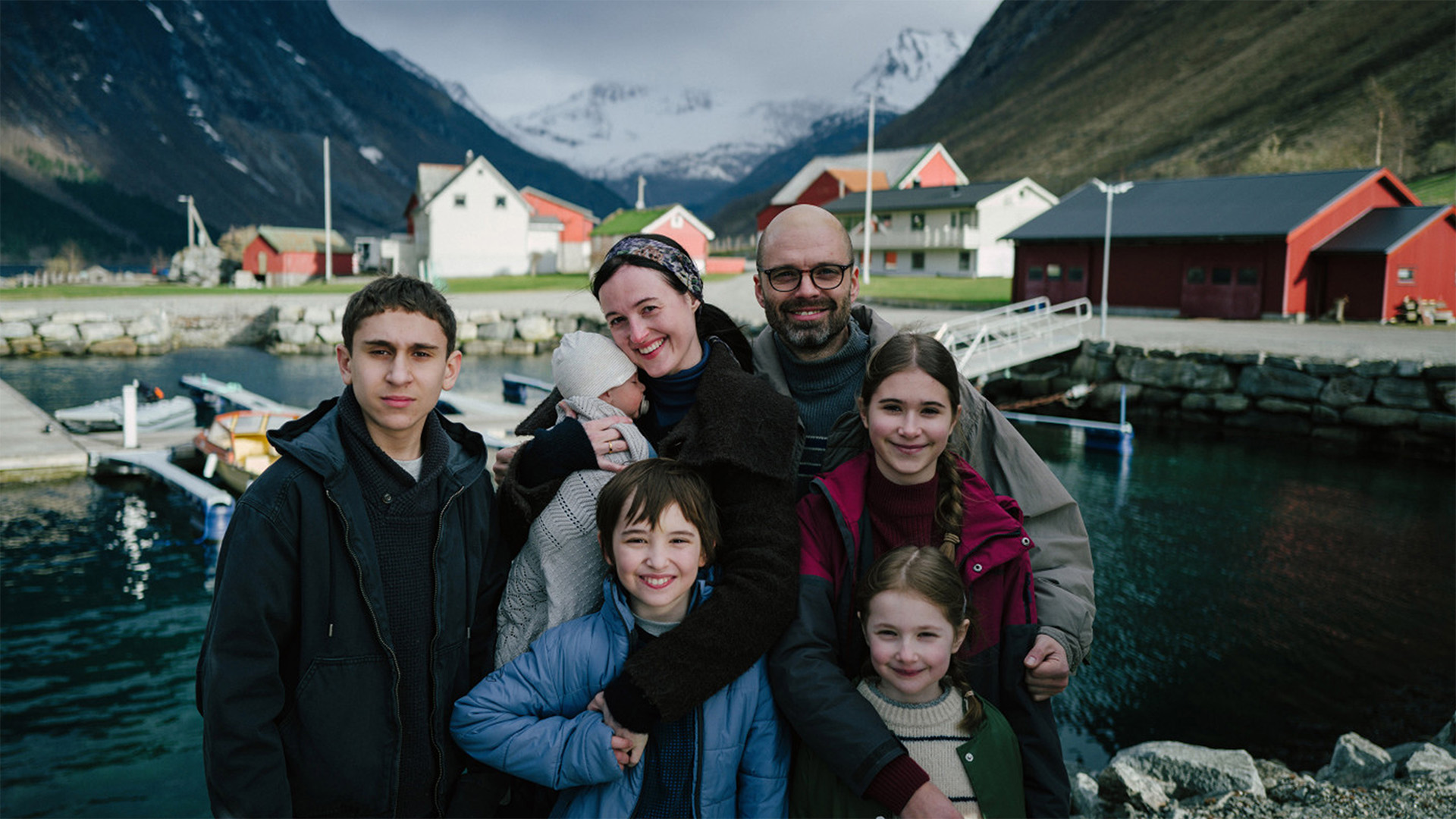
When Mihai and Lisbet Gheorghiu (Sebastian Stan and Renate Reinsve, both magnificent) move with their five children from Bucharest to a small fjordside village in western Norway, they have high hopes of making a fresh start. “We’re all neighbours here,” says Mats (Markus Scarth Tønseth), who lives next door with his family and also happens to be headteacher at the local school where Mihai, who is Romanian, secures a post as an IT technician.
Meanwhile, Lisbet, glad to be back in her native country, finds work as a nurse at a residential care home and is pleased that Mats and his attorney wife Mia (Lisa Carlehed) are so welcoming. Yet the idyll is short-lived for the Gheorghius, who are devout Evangelical Christians.
When bruises are spotted on their eldest daughter Elia (Vanessa Ceban) and the school’s child services liaison Frida overhears her talking with her brother Emmanuel (Jonathan Ciprian Breazu) about their parents’ strict discipline at home, the state authorities are notified. With little preamble, all five of the Gheorghius’ children – including their baby who is still being breast-fed – are swept into state custody. “We don’t need your permission,” social worker Gunda (Ellen Dorrit Petersen) says to the baffled Mihai and Lisbet.
What follows in Cristian Mungiu’s seventh feature – for which he won his second Palme d’Or at Cannes in May – is a masterly exploration of what Rowan Williams calls “argumentative pluralism”. Well aware that his core arthouse audience will instinctively side with the secular authorities against the supposedly atavistic Christians, the director initially encourages the impression that the Gheorghius have only themselves to blame for their predicament. Most such viewers – this one included – recoil sharply and instinctively from any form of corporal punishment.
But then, in a majestic bait-and-switch, the director subverts this default response. Are the bruises the consequence of smacking or a tussle which we see in the Gheorghius’ kitchen where a panicked Lisbet awkwardly tries to protect her baby from being scalded?
More to the point: is the liberal state not guilty of a quasi-religiosity at least as rigid as the faith of the sundered family? All too rapidly, the case escalates into a civil action, with the prospect of criminal proceedings looming on the horizon.
In court, the foster mother assigned to the children says with horror they hadn’t been allowed to “watch YouTube! They didn’t have mobile phones, for example!” Gunda claims that social services always believe what children tell them – and yet doesn’t believe them when they say they want to go home.
Before agreeing to send Lisbet’s expressed breast milk to her baby, she says: “We need to check with mother – I mean, foster mother.” And, in a very revealing choice of language, she declares of Mihai and Lisbet: “They didn’t repent.”
Thus does liberalism become a sacred order like any other, with its own inquisitions, heresies and inflexible demands for public contrition. It is inclusive – until it isn’t. Defining itself by its supposed tolerance, it has created a new form of intolerance, with the added element of sanctimonious self-congratulation.
Then again: Fjord does not make the error of presenting the Gheorghius as saintly martyrs to bureaucratic modernity. There is a queasy moment when it emerges that Elia’s younger sister has said in class that homosexuality is a sin. In his rage, Mihai posts intemperate videos online and invites a hardline Christian group into the town to turbocharge the campaign, turning a complex ethical issue into a three-ring circus.
Mungiu is a director who ticks no boxes, appeases no constituency and has no interest whatsoever in soothing the ideologically needy viewer with a tidy moment of catharsis. After so many years of Hollywood virtue-signalling and red-carpet soundbites, Fjord is a cultural inflexion point that interrogates cosy assumptions instead of lazily affirming them. Superb.

EXHIBITION
Vanessa Bell & Duncan Grant: Inside Bloomsbury (Tate Britain until April 11)
The Bloomsbury Group has never been short of detractors. In 1915, DH Lawrence wrote that they made him “dream of beetles”. In The Pilgrim’s Regress (1933), CS Lewis scorned them as “the Clevers”. FR Leavis later accused them of “undergraduate immaturity”.
Still: their grip upon the nation’s cultural imagination is undiminished. Already this year, Tina Gharavi has successfully brought Virginia Woolf’s second novel Night and Day (1919) to the big screen, while Nicholas Hytner’s acclaimed production of James Graham’s latest play The Standard of Living (Theatre Royal Haymarket, until December 12) dramatises the centrality of John Maynard Keynes – an aesthete as much as an economist – to the life of the group.
Its retreat in East Sussex was Charleston, home from 1916 to Vanessa Bell (wife of the art critic Clive Bell and sister of Virginia Woolf) and Duncan Grant (lover of Keynes, Lytton Strachey and the novelist David Garnett). Though the love between Bell and Grant was only occasionally sexual – their daughter Angelica, born in 1918, grew up believing Clive Bell was her father – they were fiercely devoted to one another and lifelong artistic collaborators.
What makes Tate Britain’s exhibition of more than 300 works so rewarding is its focus upon this partnership as the two painters feasted upon the possibilities of modernism and post-Impressionism. Consider Bell’s Roger Fry (1912) alongside Grant’s George Mallory (1913); or compare her Abstract Composition (1914) with his In Memoriam: Rupert Brooke (1915) to see how intimate was their aesthetic experimentation.
In 1913, Fry declared: “It is time that the spirit of fun was introduced into furniture and into fabrics” – the inspiration of the Omega Workshops in Fitzroy Square of which Bell and Grant were directors. They decorated Keynes’s rooms in King’s College, Cambridge. They worked together on stage sets and costumes.
While Charleston is being refurbished, the studio Grant and Bell created with the help of Fry – an Aladdin’s cave of paintings, fabric and ceramics – has been painstakingly reconstructed in the final gallery, a dazzling capstone to the show.
Suggested Reading

Wild Horse Nine is a darkly funny buddy movie with a body count
STREAMING
12 12 12 (Apple TV)
“A high-asset robbery, professionally conceived, is 12 months in planning, 12 hours in execution. A bank robber who is not caught within 12 days is not caught at all”: so says FBI special agent Jack Strickland (Anthony Mackie) at the start of all eight episodes of this slick thriller series, created by Jim Keeble and Dudi Appleton.
The multiple-timeline heist story is a familiar movie structure – think Stanley Kubrick’s The Killing (1956), Quentin Tarantino’s Reservoir Dogs (1992) and Bryan Singer’s The Usual Suspects (1995) – and here it migrates successfully to the small screen as Strickland, a discredited G-man mourning a dead partner, plays cat and mouse with master criminal Paul Galvin (Jamie Dornan).
All roads lead to Zurich where a Russian mob family is cashing out its colossal fortune into 1,000-Swiss-franc notes, hard cash to be stashed in the high-security vault of an obscure bank. Paul’s reckless and resentful brother Bobby (Jack Kesy) is in serious debt and needs a fast score if he is to avoid a nasty end – forcing Paul, living in Marseille with his pregnant girlfriend Severine (Agathe Rousselle), out of retirement.
A pleasingly eccentric crew is assembled, including train expert Kira (Kali Reis), contortionist Alberich (Julius Feldmeier), drill expert Serge (José Garcia) who is also Severine’s father, bank insider Gunda (Hildegard Schroedter), and logistics guy Blasius (Ólafur Darri Ólafsson). Strickland’s only true ally is Swiss cop Lena (Sallie Harmsen). But then when it’s Mackie playing the part, you’d be a fool to bet against him. “Only one of us can win – you gotta feel it,” he warns Paul when they meet on the icy streets of Zurich. “Everything you’ve built… I’m going to take it from you.”
There are some nice twists along the way, a wonderfully bonkers sequence in the mountains involving a Swiss SWAT team on snowmobiles and an avalanche triggered by C5 detonations, and a time-hopping duel of avarice, vengeance and rough justice between Mackie and Dornan to keep you watching until the end.
Texts for our time…
First published in 1975, Medusa’s Laugh by Hélène Cixous is one of the most important postwar essays about literature and the art of reading, as well as a founding text of second-wave feminism – especially influential on American campuses, though not only there.
Now published as a standalone Penguin Modern Classic, the new translation by Eric Prenowitz (in collaboration with the author) should introduce a fresh generation of readers to its theory of écriture féminine (or “feminine writing”) as a force of emancipation. “The past must no longer determine the future,” Cixous insists. “I don’t deny that the effects of the past are still here. But I refuse to consolidate them by repeating them.” Her magnificent defiance could hardly be more topical.
Also outstanding among new titles is Jamie Gianoutsos’ In Rome’s Long Shadow: How the Classical Tradition Shaped the Modern World (Allen Lane). The proposition that ancient Rome was a model for early modern state builders – not least the American Founding Fathers – is not a new one. But what Gianoutsos, a history professor at Mount St Mary’s University in Maryland, shows in this sparkling account of the republican legacy, full of pacy narrative detail, is how much we still owe today to the lessons of Lucretia, Lucius Junius Brutus, the Gracchi, Spartacus, Julius Caesar and Marcus Brutus.
The challenge, she argues, is to acknowledge and dwell in “Rome’s shadow without being eclipsed by its darkness.” In which context: her chapter on “The Mixed Constitution”, which I read after the Democrats’ conquest of both houses of Congress, felt thrillingly contemporary.
“The long republican tradition suggests across the generations that liberty requires both a sound constitutional structure and citizens willing to participate in its unfolding to ensure its virtue,” Gianoutsos writes. “Republics without good laws and good humans will fall to ruin.” Well, exactly.
 Most popular

The reckoning I thought Russell Brand would never face

The Spectator’s brazen hypocrisy over Russell Brand

Why does everyone hate Laura Kuenssberg?
Slavoj Žižek: Beating Trump isn’t the wild triumph you all seem to think