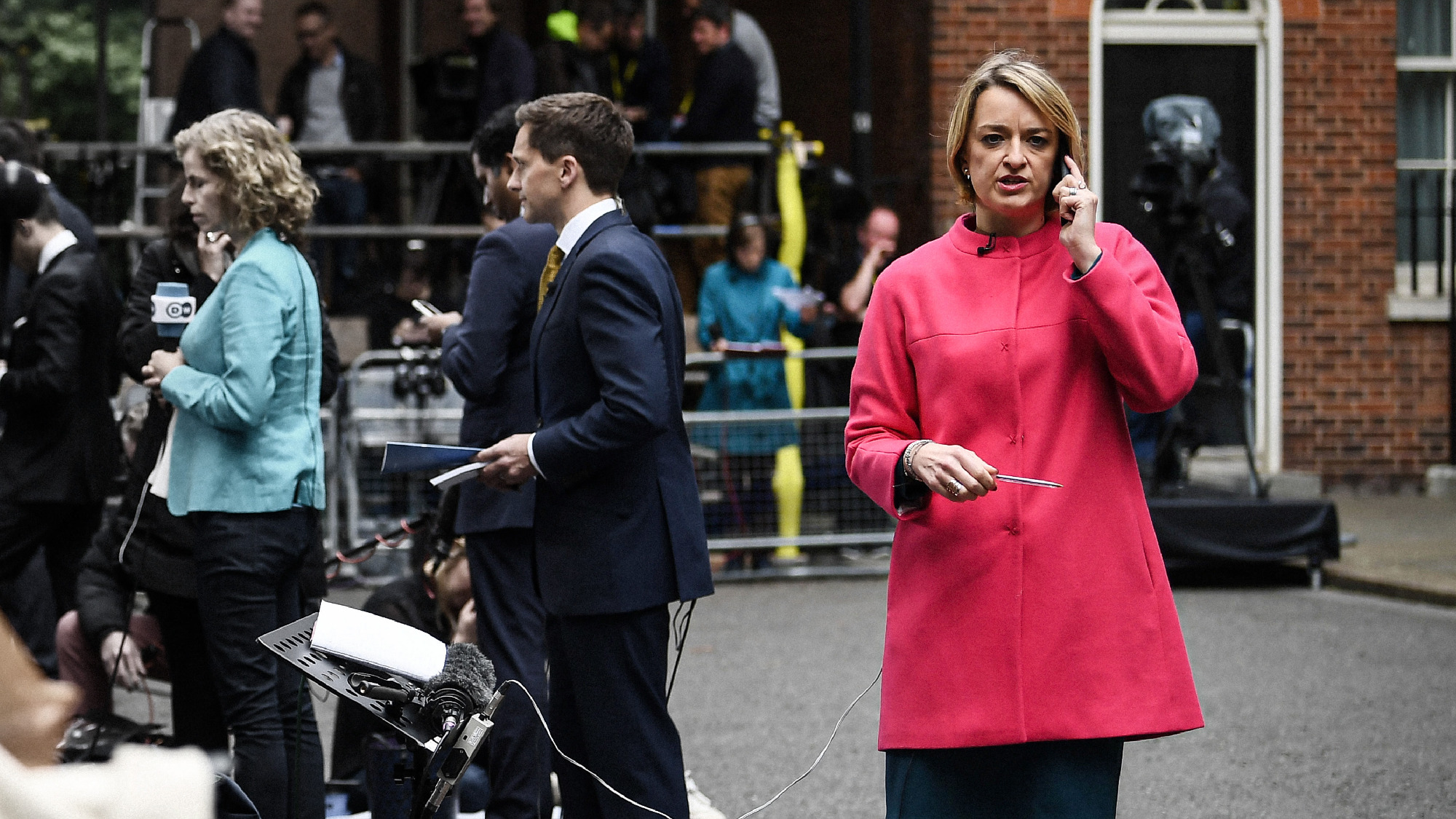
A lot of people hate Laura Kuenssberg. Perhaps hate is too mild a word. On Bluesky, a site that likes to think of itself as a refuge from the sewage on X, almost every post mentioning her drips with loathing. Sack her. Muzzle her.
“I didn’t become a journalist to make friends or be popular,” she writes in her new book Pay Attention, “but nor did I become a journalist thinking that one day I would be sent a message online saying: ‘Why don’t you fuck off and die of ovarian cancer, you bitch.’”
Not just any cancer, note: the abuser wanted Kuenssberg’s ovaries to kill her, presumably because this would be a lesson for a woman who has pursued a career rather than motherhood.
Kuenssberg makes no special plea on behalf of her sex, perhaps because she feels lucky to have made it to the top. She belongs to the first generation of women to break into the highest levels of political journalism. Even now, they know their time at the top is shorter than men’s.
“I’m going to have to get off telly soon, because I’ll be too old,” Beth Rigby of Sky News said in 2020. Like Kuenssberg, she has now reached the age of 50. The broadcasters, to their credit, have kept them on.
Kuenssberg reveals in her book that she has had her share of unwanted advances from male politicians, including what sounds like an invitation to join a threesome with a cabinet minister who was “revealing some chest I’d never wanted to see” in a conference hotel room. But in each case she deals pragmatically with it, not replying to messages and merely regretting that a useful contact has turned sour.
Most female political journalists could tell similar stories. What is new – thanks to social media – is the torrent of public abuse, much of it now tolerated as just another part of the job. Along with it has come a tolerance of racism and bigotry that was unimaginable when she began reporting on politics.
It is Kuenssberg’s misfortune to be a public face of the BBC, which now attracts contempt from both left and right. (“BBC – spokespeople for terrorists” reads a fresh sticker on a lamppost near me in north London. It is anyone’s guess which terrorists it refers to, or whether they are really terrorists at all.)
Her successor as BBC political editor, Chris Mason, is also pulled apart on social media – he is reckoned to be too Reform-friendly, just as she was pilloried for her supposed closeness to Boris Johnson’s Conservatives. Images of her chatting with him on a bench and grinning during a Johnson Q&A became memes (Robert Peston, who was grinning too, didn’t get the same treatment). The noise levels rose again after he left office, when Kuenssberg confessed to being “embarrassed” after accidentally emailing Johnson her briefing notes for a primetime interview to promote his autobiography, leading to the show’s cancellation.
Suggested Reading
What would a National Care Service actually look like?
Pay Attention, which is Kuenssberg’s first book, is an attempt to explain why she is a journalist and how she does her job in an era in which, she says, “normal politics has unravelled”. It is also her chance to make the case for why the BBC should continue to exist.
Politicians have always complained about the BBC. But, as she notes, Jeremy Corbyn was the first British politician to tell his supporters not to trust the “mainstream media”, preferring to appear on Russia Today.
This meant covering Corbyn’s events became increasingly difficult. In Salford in 2017, she and the camera crew were forced to flee after his supporters made it impossible for the BBC to film, and furiously rejected attempts to interview them.
Kuenssberg devotes space to the most consequential politicians of the past decade – Boris Johnson, Corbyn, Nigel Farage and Keir Starmer – and is quietly scathing about all of them. She is acute on what it is actually like to try to hold Farage to account: his whataboutery, his “how very dare you” move, undermining the premise of the question.
She scorns his attempts to portray himself as an outsider, writing, “He has been an elected politician for decades. He went to one of the best schools in the country, then worked in the City of London, and was a member of the Conservative Party before falling out with them over the direction of travel regarding Europe. He’s as much of an outsider as I’m a giraffe.”
She once extracted a very Farage admission from him: “The problem with being a leader is that people think you are responsible for everything.” Following the rules, she says, “is something of an inconvenience to him.”
Regularly blamed by her detractors for her and the BBC’s supposed leading role in feeding Farage’s rise, she quietly notes that it was after his appearance on ITV’s I’m a Celebrity in 2023 that voters started to warm to the instigator of Brexit. (The surge in small boats at that time no doubt contributed, too.)
The book is an implicit rebuke to the charge that the BBC is too soft on Reform. Often, she says, Farage was available to speak his mind when politicians with actual responsibilities did not want to defend themselves on the Sunday morning interview shows. And now that he faces questions over his finances, he too is retreating from scrutiny.
At the same time, she explains how utterly relentless the life of a minister is, and how even fulfilling the duties expected of a backbencher is exhausting, the criticism constant, the demands impossible to satisfy.
Pay Attention is not really about Kuenssberg. There are moments, such as her description of the day Jo Cox was murdered, when she allows herself to show emotion. But her life before and beyond Westminster remains hidden.
The book’s message is something bigger than herself: the struggle of the BBC to be trusted in the social media era. Kuenssberg was an early adopter of Twitter and used it on broadcast mode, thinking that it enabled her to reach a wider audience.
But her determination to remain impartial was at odds with Twitter’s purpose to stir up the wrath of the crowd. She did not engage, and a lack of engagement provokes two responses on social media: boredom or contempt.
The irony is that Kuenssberg has written a far livelier, more readable book than most people working in politics manage to do. Despite its impartiality, Pay Attention is an easy read. Now and then her Scottish upbringing comes out in a turn of phrase.
She explains how her job gives her access to what politicians are really thinking, and the frustration of watching them dissemble on a subject they have railed about in private. Off-the-record chats are the currency of Westminster, but they provoke anger among ordinary people because they make journalists complicit in the system.
The chief executive of one think tank, Ryan Shorthouse, recently described them as “cowardly, and unverifiable”, calling for political editors to be replaced by policy editors. Politicians, he argues, ought to be able to hold the line to the press, keeping internal spats a party matter. Anything else is “not in the public interest”.
Kuenssberg does as fierce a job as she can in defending the value of knowing what is really going on and producing better-informed journalism as a result. Andrew Marr did something similar in his 2004 memoir My Trade, but that era now feels complacent, wholly unaware of what was about to hit it.
Kuenssberg has been at the centre of the wreckage and grasps how much has changed. As she says, Westminster is, and always was, “deeply weird”. Scrutiny does not flatter it.
The privileged access lobby journalists enjoy jars with the spirit of the age, a Traitors culture where the audience wants to watch the show in full awareness of what is going on. But Kuenssberg warns that what looks like openness, especially on short-form video, is not: “Pay attention to what they are doing, selecting their best moments for you to see them as they want to be seen. That’s not the whole story.” She is right about that. The Traitors is heavily edited.
Of course, none of this will appease her critics on the left. They will point to her suggestion that both Labour and the Tories were slow to acknowledge that immigration was changing Britain as proof that she is, at heart, an enabler of Farage.
And what about that much-shared photo with Johnson on the bench? The PM, unkempt as usual, stares into the distance while Kuenssberg gesticulates to make a point. Their knees look, well, close. Didn’t it show that she was acting as the PM’s mouthpiece?
Suggested Reading
Gordon Brown’s got a big idea – and it’s painfully dull
Kuenssberg doesn’t mention the photo. She does mention the Tory source who told her, after Johnson’s 2019 landslide against Corbyn, that the new prime minister would be in Downing Street for the next decade. “But then they paused, raised their eyebrows, and said, ‘Unless, of course, he really fucks it up – it is Boris!’”
And she does recall the time when a senior minister called her late at night to tell her that Johnson was planning to illegally prorogue parliament to force his Brexit deal through. Shortly afterwards, in a Brussels restaurant, Dominic Cummings explained to her his strategy to “finish” Brexit – to drive everyone to such a state of frustration that they would accept anything to “get it done”.
She says that in May 2021, she decided “to confront the fact that the country was being led by a man who was serially, and repeatedly, being accused of failing to tell the truth.” Several sources had told her that Johnson had indeed said “let the bodies pile high” early in the pandemic.
“For the BBC to take on the prime minister’s integrity in such a prominent way was an important call to make,” she says. It was another six months before the Mirror broke the Partygate story.
Those who blame the BBC for Farage’s rise might ask themselves why the far right has surged all over Europe and in the US. They might consider that the people most determined to destroy the corporation are Farage (by abolishing the licence fee) and Donald Trump (by suing it for billions). They might also think about who gains from the hatred meted out to Kuenssberg.
British politics has ugly corners and unpleasant habits. Our determination to shoot the messenger will only enable them to thrive.
Pay Attention by Laura Kuenssberg is published by Corsair