PICK OF THE WEEK
Wild Horse Nine (general release)
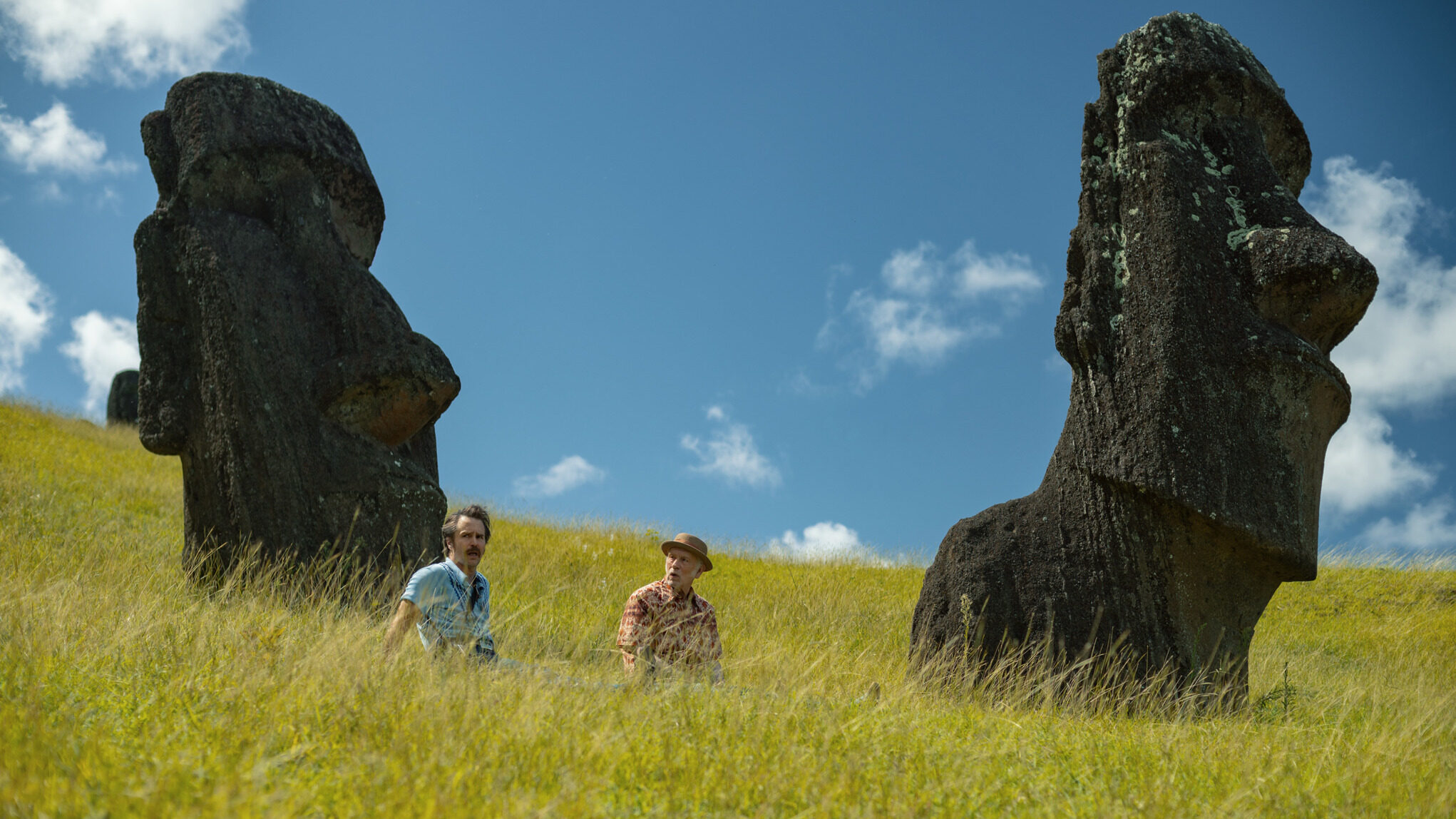
Martin McDonagh is the undisputed laureate of stories of male friendship, set in striking locations that intensify the drama: In Bruges (2008), The Banshees of Inisherin (2022) and now this terrific tale of two CIA operatives, Lee Chesterfield (Sam Rockwell) and his best friend and mentor Chris Carlisle (John Malkovich), which opens in Santiago in 1973.
Having set in train the military conspiracy that will overthrow President Salvador Allende – “we just paid off all the Pinochet guys” – they head to Easter Island (Rapa Nui). Aged 72 and diagnosed with terminal cancer, Chris has chosen this primordial place for his death, asking Lee to shoot him in the head when he uses a codeword.
“Can’t you shoot yourself in your own head?” says his friend. “You know I’m Catholic?” replies Chris, as if Lee’s reservations are both personally and theologically insensitive.
Pumped full of drugs (“morphine is wonderful!”), afflicted by early-stage dementia, and increasingly disinhibited, he is inclined to speak too candidly. “How do you like your new left-wing president?” he asks two young women at the airport. “Enjoy him while you can… Your country is going to get fucked.”
As much of a headache as this is for Lee and their station chief MJ (Steve Buscemi), the CIA hierarchy is even more worried about Chris’s plan to write a tell-all memoir. “Guatemala: successful. Congo: successful,” he recalls. “Bay of Pigs… less successful.”
In particular, the bosses at Langley are worried about what he might have to say concerning the assassination of John F Kennedy, and, even worse, whether he kept any souvenirs. As Lee tries to explain, Chris is – for now, at least – more interested in dinosaurs.
“So – he isn’t up to Dallas yet?” asks MJ. “Not unless Kennedy got killed by a diplodocus,” is Lee’s deadpan reply. Then again, Chris does boast that he has some spectacular footage of November 22, 1963: “You think Zapruder had a good angle?”
This being a McDonagh movie, the beautiful but desolate landscape of the island and its monumental statues lend a mythical quality to what would otherwise be no more than a grubby tale of jaded assassins and deep-state scheming. Though Chris insists he is not impressed – “It’s all just a load of fucking heads. Once you’ve seen one, you’ve seen them all” – he is enchanted by the wild horses that roam this rugged terrain. “They have cancer-sniffing horses?” he wonders.
Malkovich and Rockwell are magnificent, conveying genuine affection for one another without tempering their bone-deep cynicism and resignation to how the world really works. When Chris’s estranged brother Jim (Tom Waits) reproaches him about JFK’s death and says that “the country went to shit after that,” Chris begs to differ: “The country was already shit. You just didn’t know it.”
Elegy without redemption, humour without sentimentality, the wounds of a secret history: the mix is irresistible and should put McDonagh and his stars firmly in the running for Oscar nominations on January 21.
STREAMING
Black Doves (Netflix)
Joe Barton’s hugely enjoyable action comedy is also set in the world of espionage – but there ends any resemblance to Wild Horse Nine. As the second season begins, the eponymous secret organisation is preparing for its star agent, Helen Webb (Keira Knightley), to take up residence in No 10 as her husband Wallace (Andrew Buchan) becomes the new Conservative prime minister.
Days before they move in, Wallace delivers a speech in Paris, and Helen is instructed by her handler Elizabeth Reed (Sarah Lancashire) to crack a safe in the hotel suite of Russian oligarch Alexi Chernov (Goran Kostic) and retrieve a file named “Wildflower”. Unexpectedly, she finds herself assisted by enforcer Laila Joshi (Ambika Mod) – “I’m the muscle, babe” – and what is meant to be a black-bag job turns into a full-on shoot-out with Chernov’s security detail.
As for the intelligence that Reed is so keen to get her hands on, she remains tight-lipped – and is, in any case, kidnapped moments after she and her agent part.
Meanwhile, Helen’s best friend, triggerman Sam Young (Ben Whishaw), is in poor shape – strung out on booze and coke – and, after executing a small-time hit, is immediately arrested in what looks like a set-up. At the police station, the enigmatic Patrick (Sam Riley) offers to get him out if he agrees to carry out a series of contract killings: “no negotiations, no hesitations, no exceptions.” Unenthusiastic about going to prison for life, Sam takes the deal.
Reed’s disappearance prompts Helen to rendezvous with her old friend and ask him: “Should I be grabbing the kids and running?” At the school gates, she is approached by a stranger, Robert Conteh (Babou Ceesay), and told that Reed will not be coming back.
After a follow-up meeting at the Black Doves’ HQ – an office she did not previously know existed – Helen is told by the “executive level management committee” that Conteh will now be her handler. “You’d better learn to get comfortable with it,” is his frosty advice.
As Helen and Sam go hunting for answers, there are welcome returns for guns-for-hire Eleanor (Gabrielle Creevy) and Williams (Ella Lily Hyland) and legendary underworld fixer Lenny Lines, played by Kathryn Hunter (“These are strange times to be nefarious. And yet…’twas ever thus”).
The heart of the show is the screwball chemistry between Knightley and Whishaw: think Cary Grant and Rosalind Russell in His Girl Friday (1940), but with semi-automatic weapons. That said, Black Doves is also an increasingly assured ensemble piece, especially funny when, in the middle of a life-or-death car journey, the team has a noisy argument about an Olly Murs playlist; or when Eleanor can’t quite place a Michael Corleone line: “Do you know that one? The Hobbit? I think it’s from The Hobbit.”
Helen and Sam’s sleuthing leads them back to an undercover operation in East Berlin in 1988 that went murderously wrong, a dark chapter in the history of the Black Doves – but more than that I shall not disclose. All six episodes are streaming, and very bingeable they are too. Among the best Netflix shows of recent years and one that thoroughly deserves to be renewed.
Suggested Reading

Why Thomas Mann is the writer we need right now
FILM
La bola negra (selected cinemas)
From their devastating depiction of a Spanish village being bombed in 1937 – pointedly evocative of Picasso’s Guernica – Javier Ambrossi and Javier Calvo grip the attention in this quite extraordinary movie (for which they shared the Best Director prize at Cannes with Pawel Pawlikowski for Fatherland).
Fleeing the carnage, Sebastián (played by the musician and actor Guitarricadelafuente) thinks on his feet when he is stopped by a truckload of Nationalist soldiers – “I’m one of you!” – and is soon serving in the ranks of the Francoists.
When a captured Republican soldier, Rafael Rodríguez Rapún (a real-life character played by Miguel Bernardeau) is wheeled into the infirmary, Sebastián is ordered to engage him in conversation and find out what he knows – before the Falange interrogators get to work on him in earnest. Initially hostile to the captive, he is soon drawn to Rafael’s beauty, humanity and the mysterious love letter in his pocket.
The movie’s second timeline opens in Granada in 1932, as Carlos (Milo Quifes) applies for membership of an exclusive casino and is blackballed (hence the movie’s title) because of town gossip that he is gay. His father Vicente (Antonio de la Torre) is furious and insists that Carlos return, deny the rumours and demand a second vote.
Finally, in Madrid in 2017, Alberto (Carlos González), a former playwright turned historian, browses Grindr and seeks out rare music from the early 20th century, “from the margins of dissident desire.” To his surprise, he is contacted by the executor of his maternal grandfather – with whom he has had no contact – and told that there is a bequest for him in rural Cantabria.
What awaits him is a treasure that connects the three timelines. But there is nothing pat about La bola negra, no neat bow to tie the entangled narratives together. Across two-and-a-half hours of remarkable cinema, we encounter the most terrible cruelty, the deepest intimacy, battle-scarred terrain, sangria-soaked cabaret and flamenco, streets full of political energy, and snowy dreamscapes in which souls wander in baffled solitude.
Watch out for memorable cameos by Penélope Cruz as Nené Romero, a flamboyant singer and dancer, and Glenn Close as Isabelle Durand, a scholarly expert on Federico García Lorca. A movie like no other you will see this year, or probably next.
FILM
Avedon (selected cinemas; Netflix, November 11)
Richard Avedon was only 33 when Stanley Donen’s Funny Face (1957) was released, starring Audrey Hepburn and Fred Astaire as Dick Avery, a Hollywood version of the photographer who had already reinvented the portrayal of fashion in his work for Harper’s Bazaar.
In Ron Howard’s absorbing documentary, Avedon – who died in 2004 – is heard explaining that the glamorous postwar Paris he chronicled was a carefully curated fantasy: “of course, nobody was dressed like that”.
As masterly as he was in the use of light, the “existential white” backdrop, and the 8 × 10-inch Deardorff view camera that he adopted in 1969, his talent was intuitive rather than technical. “I can see like a son of a bitch,” he said.
On the one hand, this meant looking for unforgettable moments of juxtaposition, as in the iconic “Dovima with Elephants” (1955). On the other, it was a question of waiting – for days, if necessary – for the moment when the mask slipped, as it did in the portrait known as “Sad Marilyn” (1957).
Howard is quite right to foreground Avedon’s political commitments: his work in Vietnam and with the Black Panthers, the Chicago Seven, and, especially, James Baldwin: their 1964 collaboration Nothing Personal is arguably the photographer’s finest achievement, rivalled only by the project that absorbed him between 1979 and 1984, In the American West.
“Photography,” he said, “is the marriage of the imagination and the reality of a situation.” But then again: “Every photograph is accurate and none of them is the truth”. Genius is allowed to be Delphic.
 Most popular
Watching the fall of Trump with New York’s MAGA hardcore

The uncomfortable truth about Ariana Grande

The John Lewis Christmas advert meltdown is Britain’s most idiotic new tradition


Kid Rock, gold wheelbarrows and a bigger recount: How Trump and his inner circle spent election night in his half-built ballroom