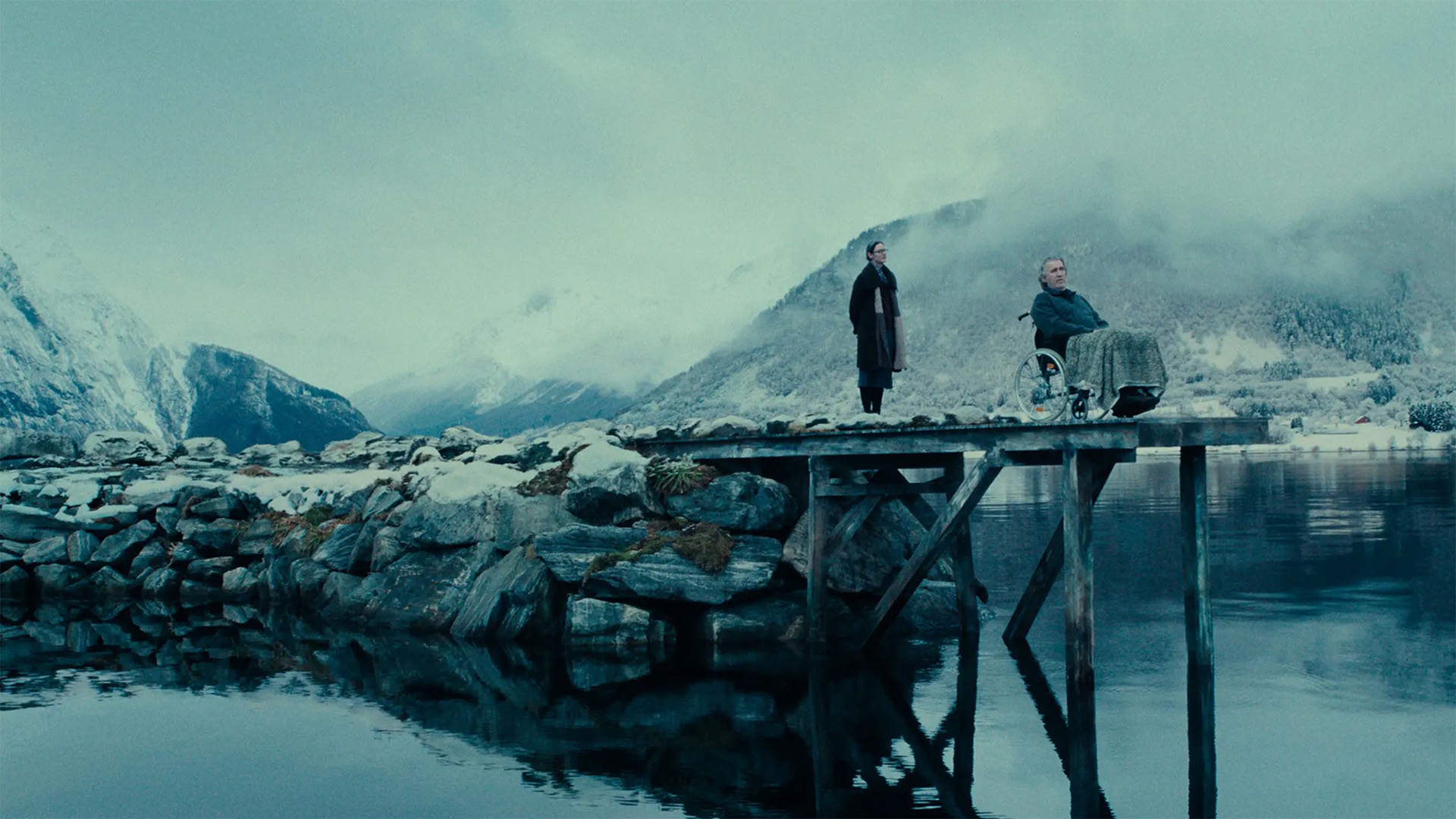
Christian Mungiu’s Fjord is a conversation sparker. The film, which won the Palme d’Or at Cannes in May and gets its UK release on November 13, stars Renate Rensive and Sebastian Stan as fundamentalist Christian parents – she is Norwegian; he is Romanian like Mungiu – who find themselves at odds with the Norwegian social services when their cultural attitudes to disciplining their kids lead to accusations of abuse.
For me, its politics of confused conservatives v smug liberals were as unsubtle as the film’s title (I mean, Fjord? It’s like setting a film in Egypt and calling it Pyramids). With Donald Trump’s dismissal of Norway as a “shithole country” for not awarding him a Nobel peace prize and his feud with Denmark over Greenland, Scandinavian nations are now among the many whipping boys of conservative fears; derided by MAGA and its acolytes for their high taxes and supposedly bleeding-heart societies.
Mungiu previously won the Palme d’Or for 2007 abortion drama 4 Months, 3 Weeks and 2 Days, but when I spoke to him in Oslo at the end of summer, even he was uneasy with the response his latest work had received in Cannes. “It polarised people in an extreme way: a lot of anger and aggression on social media before watching the film,” he said. “Isn’t this irrational? This is what this film is about.”
Yet Mungui, who spent the first 21 years of his life under communism, insisted that he welcomed arguments about Fjord, and about the levels of tolerance shown by people on the left and right of politics to one another. “I would have been disappointed if there was a consensus,” he told me. “The film is just the starting point of a bigger debate.”
In that spirit, here is an edited Q&A of our lively discussion about the pros and cons of Fjord.
John Bleasdale: I feel the left do listen to the right and take pains to understand. I don’t feel that the right does the same. The polarisation, in other words, is not equal and comparable.
Christian Mungiu: But do you refer to the film or to society in general?
JB: Society.
CM: Liberal society is inclined to be tolerant, but this we know already. That’s not a surprising story. My question is: is liberal society as open to listening to the voice of these people [conservatives] as much as they believe they are? If all these progressive societies have this great tolerance for minorities, why is it that they are not tolerant of this conservative minority?
You want to be a Muslim, you can be a Muslim. You want to say that gay marriage is not right? No, you’re not allowed.
And what happens when you’re not allowed? Would this change your opinion? No. You will just feel that there are things in society about which the majority obliges you to not say.
Suggested Reading
Wild Horse Nine is a darkly funny buddy movie with a body count
JB: In the film, it comes down to the children.
CM: People from more conservative societies come to Norway believing that their children belong to them, and their main freedom is to deliver their own beliefs to them. There’s a very unclear limit after which the authority belongs more to the state, and you will find out that after a certain moment, the state believes that (they’re) not your children any longer. Society’s values are more important. These people are not told this bluntly when they come in, there’s no social contract.
JB: If I moved to another country, and I didn’t know all its laws, and I broke the law, saying you didn’t tell me when I arrived wouldn’t change anything.
CM: All these people [like the Romanian in the film] grew up in communist countries that were so violent that it’s a trifle to say that if you slap your kid on the butt, this is violence. We were still using torture and arresting people on the streets even in the 60s. We don’t see violence in the same way.
People in Norway are 100 years after they stopped using violence; a different society. It’s just normal, conforming to the norm here. But it doesn’t mean any wrongdoing from people who grew up in my generation.
JB: I was raised in the 1970s. It wasn’t unusual to get a whack…
CM: And it didn’t mean anything. We can’t apply the norms of today to the way the world looked 50 years ago, and this is one of the greatest mistakes of these exaggerations of wokeism. Let’s title Agatha Christie’s novels differently now because now we can’t call these people “n*****s” [for the record, he said the n-word in full], but this refers to the moment when she wrote.
JB: But any sense of progress involves saying, “let’s not do that anymore”.
CML: I have kids and I don’t hit them.
JB: So we move on, and if people aren’t moving, laws will change.
CM: Absolutely. Whenever there’s violence in a family, clear violence with evidence, there’s nothing to talk about. Will these children be decapitated the next day? Well, take them. But most cases are not like this.
People have to make a choice without being sure. The question is, what risk do you take then? Do you think these children are at risk? Is it better to take them away from their families for six months just because of a suspicion?
You run the risk of alienating the children from their families, and when you make these judgments, it’s obvious to me that it’s not just the facts influencing you; it’s your standpoint, considering how judgmental you are towards the religious values of this family.
Suggested Reading
Taika Waititi’s whinge about critics is even worse than his new film
We all agree that in a conservative society we can’t even have this conversation. What I’m bothered by is that I express doubts about what I see as an exaggerated application of liberal measures, and it’s seen as something that I’m not allowed to do any longer today, and that’s a form of censorship. You should not be cancelled for expressing doubts. It’s not fine.
JB: Watching your film in Cannes, the majority of the audience were with you. They laughed at the short-haired lesbian having a go at the poor Christians. I don’t feel liberalism has this upper hand anymore.
CM: But don’t you feel that liberalism, because they wanted to have the upper hand, generated a huge problem by radicalising people and bringing Trump to power?
JB: No, I don’t.
CM: The film is the starting point of a bigger conversation about the responsibilities of what people do socially. This is why the story is important for me. Especially this radicalisation of saying, ‘if you dare to act differently to our values today, you are cancelled’.
What’s the effect of doing this when you have power? A countereffect. You radicalise people in the other direction. Instead of implementing common-sense values, you get the opposite.
Fundamentalism is a way of thinking. It’s not connected to the right or left. Let’s get back to some common sense. Don’t be so sure that you’re the smartest and you know everything. It will end up in civil wars, if we don’t find a way.
I will conclude with this. In R.M.N. (2022), I started talking about the limits of democracy. Unless you take time to invest in the education of people for a long time before you ask their opinions, they will reach, in a democratic way, a very illiberal conclusion. What will you do then?
This interview was carried out during OsloPix, which takes place every August in Oslo, Norway.
 Most popular

The reckoning I thought Russell Brand would never face
The press’s shameless David Walliams amnesia
Why does everyone hate Laura Kuenssberg?
16 things that will definitely now happen on the British right