
I recently entered my ninth decade. For 57 of the past eighty years, I have enjoyed a ring-side seat as a journalist and pollster, seeking to make sense of successive political dramas, from Wilson to Burnham via Thatcher and Blair – “into Europe” and out again.
This time, I have decided to stretch my legs. Here is a personal view of how progressive politics have evolved over my life and where they might go from here. At the heart of my story is a curious gap in Labour’s lexicon. The party has become increasingly comfortable with “markets”, “business” and, occasionally, “profit”. Yet old hatreds die hard. Today’s Labour Party still finds “capitalism” taboo. The time has come to put that right – even if this means the party must split.
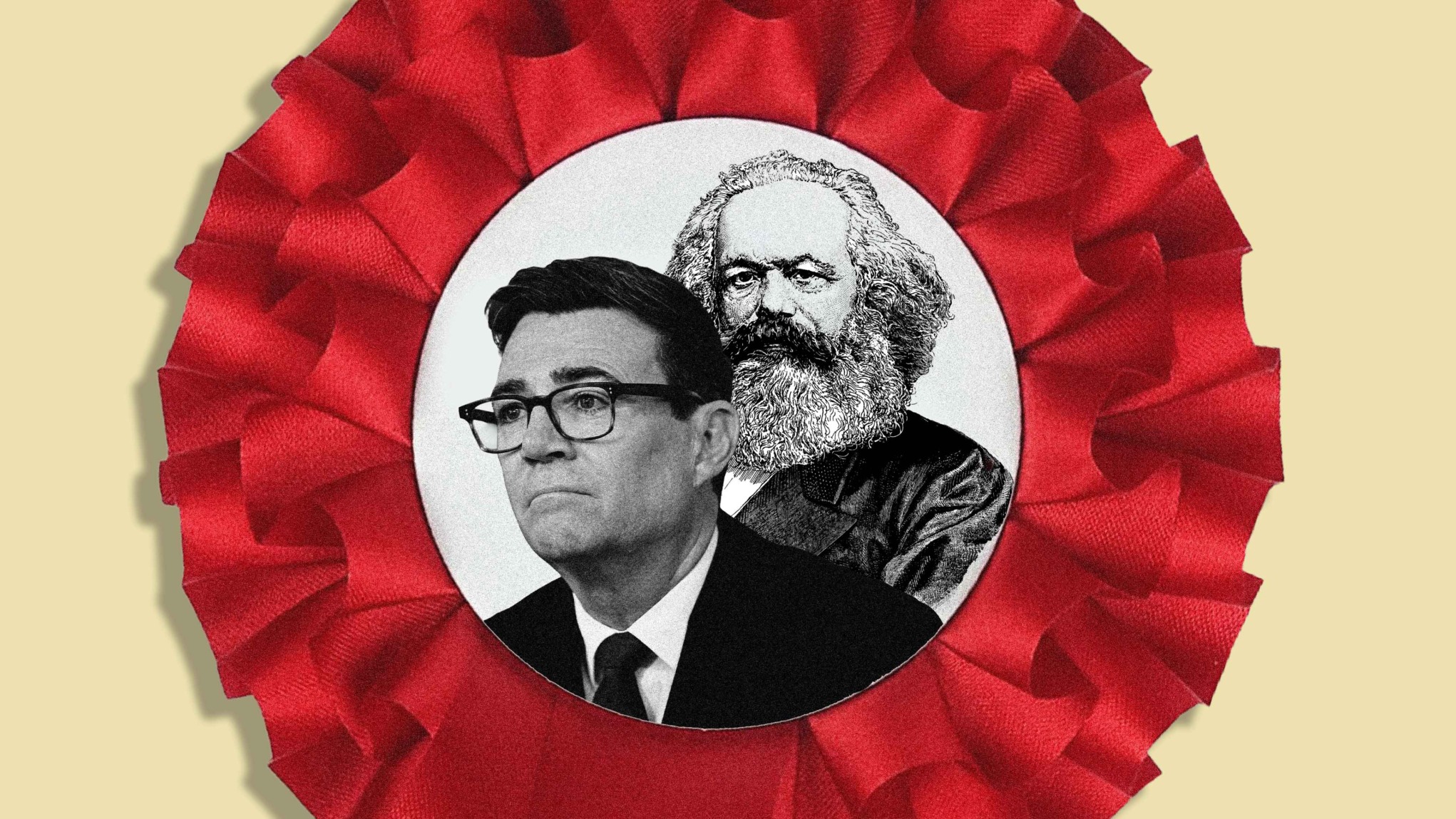
The lingering shadow of Karl Marx
I was born in 1946 into a Britain scarred by a war that it had survived by collective effort. Following Germany’s defeat, Labour was elected by a landslide, with a mandate to solve the problems of peace with the same collective determination that was used to mobilise for war. Labour’s Clement Attlee embraced that demand; Churchill rejected it.
Today’s Britain is another country. We do things differently here. Collectivism no longer holds sway. But in Labour’s institutional memory, the spirit of 1945 still looms large.
As with so much in politics, we can trace the trouble back to Karl Marx – and the solution to the pre-Marx era. The word “socialism” was coined in the 1820s by Henri de Saint-Simon, a French business owner and political theorist. He sought to transfer power from rich, idle landowners (as he saw them) to inventors, investors, managers and workers who could deliver prosperity. To him “socialism” was about people choosing to come together to build a productive future. It had little or nothing to do with the state.
Marx first used the word in 1844 in Economic and Philosophical Manuscripts. For him, socialism was the alternative not to landed wealth, but to all private property. To Saint-Simon, the bankers and business owners springing up in the nineteenth century were socialism’s flag-carriers. To Marx they were socialism’s enemies.
Saint-Simon’s definition was soon extinguished. Its appeal was not helped by the industrial revolution’s dark Satanic mills. Marx’s definition won out, along with his analysis of socialism as a transitional stage on the journey to communism.
Labour’s struggles to escape the past
For more than a century, Labour has tried to escape from Marx’s shadow without disowning the label “socialist”. In 1917, when it agreed to the constitutional objective of “common ownership”, it was deliberately distancing itself from the Russian revolution. “Common ownership” was intended to be different from “state ownership”, but never quite managed to shake off hopes (on the left) and fears (on the right) that Marx’s basic definition of socialism still held sway.
The argument simmered through the depression, the second world war and Attlee’s government. In 1959, Hugh Gaitskell, who had succeeded Attlee as Labour’s leader, tried to abolish the party’s commitment to “common ownership”, but was defeated. Instead, he was forced to concede not just that the commitment lived on; it should be printed on every membership card.
Germany’s Social Democratic Party was more courageous. It sought both to rebuild democratic politics following Hitler’s defeat and to distance itself from Soviet tyranny in eastern Europe. In 1959, it disowned its Marxist past. Six words defined its new ideology: “Markets where possible, planning when necessary.” Sixty-seven years later, Labour has failed to sign up to an economic doctrine anything like as succinct.
However, in the 1980s the party did begin a journey in that broad direction. Paradoxically, Tony Benn and his outriders on the party’s left provoked the change. Their attempts in the early 1980s to take over the party forced Neil Kinnock, elected leader in 1983, to adopt a strategy to put them out of business. In gradual stages he persuaded the party conference to drop its hostility to the market economy.
I followed the party’s battles through the eighties as political editor of the New Statesman. The worse the turmoil, the more exciting my task. Labour’s troubles served my career well.
After stepping down as party leader in 1992, Kinnock was invited to present two BBC documentaries entitled Tomorrow’s Socialism. They were broadcast in February 1994. I worked with him on them. For some weeks we struggled to find a new, succinct definition of socialist ideology that would be fit for purpose. Nothing we tried seemed to work. It was Neil who solved the problem, and with the utmost simplicity. Modern socialism should not be an ideology at all, but an ethic. The party’s long-term aims should leave out any reference to the ownership of businesses.
Suggested Reading


Andy Burnham thinks he has found Britain’s Brexit escape route
The evolution of Kinnock’s, and Labour’s, thinking coincided with a particular moment in the arc of twentieth century politics: the collapse of the Soviet Union. Its comprehensive failure to give its citizens either freedom or prosperity demonstrated one of the two great truths of the twentieth century: state socialism can’t work. The second truth is less straightforward: capitalism can work, but not on its own. It needs the right legal, political, social and cultural conditions.
Yet for the time being, Labour declined to abandon its formal devotion to the socialist ambitions of its past. Its constitutional commitment to common ownership remained. It was left to Blair to persuade the party conference to drop it.
This was part of a wider project. Ahead of Blair’s election as leader in 1994, we discussed at length how Labour should complete the process of modernisation. He was determined to confront head-on the Marxist distortion of socialism’s original meaning. However, he was reluctant to abandon the word “socialism”. For too many party members, it evoked dreams of a better, fairer world. So what to do? My one specific contribution to our discussions was a hyphen. I suggested that he update the word itself, and change it from “socialism” to “social-ism”.
Within weeks of becoming party leader, Blair made his intentions clear. In a speech to the Fabian Society, he said:
The Socialism of Marx, of centralised state control of industry and production, is dead. It misunderstood the nature of a modern market economy… By contrast, socialism as defined by certain key values and beliefs is not merely alive, it has a historic opportunity now to give leadership. The basis of such socialism lies in its view that individuals are social, interdependent human beings, that individuals cannot be divorced from the society to which they belong. It is, if you will, social-ism.
He repeated the hyphenation in his speech to Labour’s conference three months later:
This is my socialism. And we should stop apologising for using the word. It is not the socialism of Marx or state control… It is social-ism.
Blair pursued this argument (but not the hyphen) throughout his time as party leader. He told the party conference in 2005:
In the era of rapid globalisation, there is no mystery about what works: an open, liberal economy, prepared constantly to change to remain competitive. The new world rewards those who are open to it. Foreign investment improves our economy.
So capitalism rules, ok? Not so fast. Apart from a critical reference in a speech to Labour’s annual conference in 1998, the word “capitalism” is conspicuous for its complete absence from Blair’s vocabulary.
The taboo that holds Labour back
Blair is not alone. I cannot pretend to have checked every word every Labour leader has ever uttered in public. What I can say is that, despite my efforts to search Google, and employ those industrious if fallible AI researchers, ChatGPT and Claude, I cannot find a single, unambiguously positive, reference by any of them to capitalism by name.
This is odd. Examples abound, from John Smith and Gordon Brown to Keir Starmer and Rachel Reeves, of praise for “business”, “markets” and “wealth creation”, but not to the name of the system that underpins them all. Talking about markets but never mentioning capitalism is like talking about omelettes but never mentioning eggs.
Michael Frayn, a wry observer of British life over many decades, once wrote that “public opinion, so far as I can tell, unquestioningly concedes the right of men in a free society to withdraw their labour. It just draws the line at strikes”. Today’s Labour Party is fond of business; it just draws the line at capitalism.
Suggested Reading


Burnham’s hard road to hope
Jeremy Corbyn is an exception. He loathes capitalism. The fact that he was elected Labour leader showed that plenty of party members stayed loyal to the old religion. Labour’s crushing defeat in 2019 ended that ideological interlude. His departure gave Labour an opportunity to come clean about the way modern economies rely on capitalism. The need is for it to work for all.
In all fairness, Keir Starmer went further than many towards this goal. In his 2023 conference speech, he said “private enterprise is the only way this country pays its way in the world”. But even then, the taboo remained. Andy Burnham now has the chance to defy it, and incorporate capitalism into a progressive doctrine for the twenty-first century.
How could he do this? I recently asked Blair why he never supported “capitalism”. He told me: “I have never liked the word capitalism, not because I disagree with it but because it doesn’t capture the spirit of enterprise”. Fair enough: we need to promote a version of capitalism which does capture that spirit.
Here is one way forward. It speaks to the argument that capitalism should not be left to itself. It needs the right conditions to work well. One of any democratic government’s vital functions is to create those conditions.
Thirty-five years after I recommended to Blair that he add a hyphen to “socialism”, I suggest that Burnham does the same to “capitalism”: turn it into “capital-ism”. Lead a government that makes sure it works well for all. But don’t be coy about the underlying economic principle: the engine of prosperity comes from a system that, for all its faults, enables independent enterprises to invest, innovate and compete, and so increase prosperity.
The problem is that “capitalism” has two meanings. One is formal. At its core is finance: the provision of capital in order to grow businesses that generate profits. But alongside that, it has an emotional resonance for the left, which recoils from its association with inequality, exploitation, greed and social division.
By embracing “capital-ism” Burnham could accept its formal definition while distancing himself from its negative emotional baggage. He could share Blair’s view about the need for the “spirit of enterprise”, while distancing himself from the horrors of laissez faire and crony capitalism.
The case for socialist capitalism
If Burnham is really bold, he could go further, and embrace both “social-ism” and “capital-ism”. Better still, combine them into a single project which would then need no hyphens at all: socialist capitalism.
At first sight, that seems an absurd oxymoron. How can a society be both socialist and capitalist – with or without hyphens?
Actually, the point is not just that modern societies can, but that to succeed they must. Neither the state nor the private sector can succeed without the efforts of the other. The state must assert its power without undermining the ability of capitalism to increase prosperity; while the private sector needs to operate within a framework of rules and a broader civic culture, that protects and benefits us all.
Socialist capitalism rests on two principles. First, economic freedom – the freedom to work, earn, innovate, invest, hire, buy, sell and enter into binding contracts enforceable in law – is as important as the other great freedoms, such as those set out by Franklin Roosevelt: freedom of speech and worship, and freedom from want and fear.
The key issue is autonomy. The organisations might be private companies, co-operatives, public interest enterprises or voluntary organisations. They could even be publicly owned. What matters is that they are subject to the law, not political fiat.
Second, a healthy society ensures that economic freedom works for society as a whole, not just the biggest winners from market competition. Without that commitment, capitalism does too much harm and leaves too many people too far behind in their search for a decent life. This has always been the case, but the rise of AI makes the commitment more necessary than ever.
Suggested Reading
Andy Burnham wants to get back into Europe – here’s how he can do it
Hence the need for “capitalism” – economic freedom – to join forces with “socialism” as a partnership for the common good. Today’s ambition for progressives should be to make capitalism work as it should: as a dynamic system that rewards innovation, competition and transparency, within a social and political framework that also protects consumers, workers and families that struggle to make ends meet (and in the case of AI, keeps the human race alive).
In practical terms, it’s about education and infrastructure, taxes that encourage wealth creation and laws that curb exploitation: a system that reconciles freedom with fairness.
Time for the left to split
Operationally, this is not a new proposal. It is exactly what ministers say they are already doing. Yet that is not a complete answer to the deeper problem of Labour’s doctrine. It is no accident that “capitalism” has remained taboo. The word’s emotional resonance continues to feed doubts about the virtues of a system that is based on the profit motive.
Hence the widespread opposition in the Labour movement to private companies making profits by operating on NHS patients or caring for the clients of a National Care Service. The suspicion of the profit motive lives on. Under plans proposed by the Health Creation Alliance, a group campaigning to reduce health inequalities, “there will be no place for profiteering and the market in social care will be brought to an end”. Unions such as Unison, GMB and Unite agree.
Such dogma should be challenged directly. One political reason that remains for not doing so is that it could split the party. Two metaphors are frequently trotted out to maintain the current breadth of party doctrines: that Labour is, and should remain, “a broad church”; and that, like an airplane, the party needs two wings to stay airborne. To cast off traditional socialists would be to violate those principles.
So what? We should remember Kinnock’s response to Militant’s supporters in the 1980s who were resisting expulsion from the party. He said all churches need walls. The issue is who should join the congregation. People who believe in capitalism and those who deplore it belong to different religions.
As for aircraft wings: fair enough if the wings are fixed to the same plane, heading to an agreed destination. Pro- and anti-capitalists are on different journeys.
Enough of metaphors. As long as Labour recoils from proclaiming its faith in capitalism as the main engine of economic success, its basic doctrinal purpose will be blurred. Better to insist on clarity, provoke a split and insist that those who reject capitalism find their political home elsewhere.
Had this rule been imposed before 2015, Corbyn would not have become party leader, because he would not have been a party member. (I first met him 47 years ago, when we served together on the general committee of the Hornsey and Wood Green constituency party. I have always thought that he should belong to a different party. At last he does, decades too late.)
Andy Burnham’s opportunity
Doctrinal clarity would allow Burnham to define Labour’s purpose for the years ahead. Precisely because he has an ambitious agenda and needs the money to fund it, Burnham should be socialist capitalism’s greatest cheerleader.
Suggested Reading


Burnham’s NEET plan is doomed because of one fatal flaw
In his early weeks as prime minister, he appears to have rejected the very idea. He wants Britain to abandon “forty years of neoliberalism”, and has promised a ten-year plan to take “public control” of utilities such as water and transport. In his speech to party conference, he promised to repeal “Margaret Thatcher’s ideological ban on public ownership of water companies.”
His audience in Liverpool loved it. However, here are three reasons why his actions might diverge from his rhetoric.
First, his criticisms of neoliberalism relate to the suffering it imposed on the towns and people in Britain’s former industrial heartlands. He wants to revive them. His position is consistent with a better capitalism, not necessarily its destruction.
Second, he talks of “public control” of the utilities, not “public ownership”. As mayor of Manchester, Burnham established a good, pragmatic relationship with the city’s business community. He brought “public control” to its transport system, so that different services could be co-ordinated. Metroline Manchester, which runs the city’s buses, sounds like a classic public enterprise. It is, in fact, a subsidiary of ComfortDelGro, a multinational company based in Singapore.
Third, Burnham has made sure his rhetoric is qualified by pro-business sentiments, for example in this passage from his conference speech:
Where private companies serve the public interest, we will support them. But the consequences will be clear for those who do not, including taking back control or public ownership. Conference, when people hear the phrase public control, I am sure some think it’s anti-business. It’s the opposite. Businesses need the basics to be functional and affordable too, as does the wider economy.
That’s pretty close to a working definition of socialist capitalism. In a speech in June at the People’s History Museum, he promised to “back our scientists, technologists, entrepreneurs and creatives”. His aim was for Britain to “be the innovation nation of the next decade”. But like his predecessors, he could not bring himself on either occasion to utter the name of the economic system that, in partnership with a far-sighted government, would enable these things to come to pass.
As an exercise in party management, Burnham’s stance makes sense. But it can’t last. The calls to nationalise utilities as an ideological imperative, rather than a practical solution to a specific problem, will persist.
At some point, Burnham must either retreat into Labour’s traditional comfort zone and stay there, or confront the lingering appeal of state socialism. It will be the moment to make the principled case for socialist capitalism to boost economic growth.
In the 1990s, an American book, Reinventing Government, had a big influence on the Clinton and Blair camps. Its central message was that governments, whether national or local, should “steer, not row”. They should set the destination for public policy but, wherever possible, hire others to do the work.
In Manchester, Burnham was an effective, steer-not-row mayor. Will he now be a steer-not-row prime minister, matching his words to his deeds? Will he finally be the leader who tells his party that the best way to build a fairer, more prosperous society is to endorse capitalism, or at least capital-ism?
 Most popular

His dad tried to overthrow Putin – now Pavel Prigozhin runs an African country

Liz Truss’s new mini-book is every bit as bad as her mini-budget
I was at Eton with Charles Spencer – this is how it explains his battle with the royals


18 things that will absolutely, definitely happen if Trump gets whopped in the midterms