
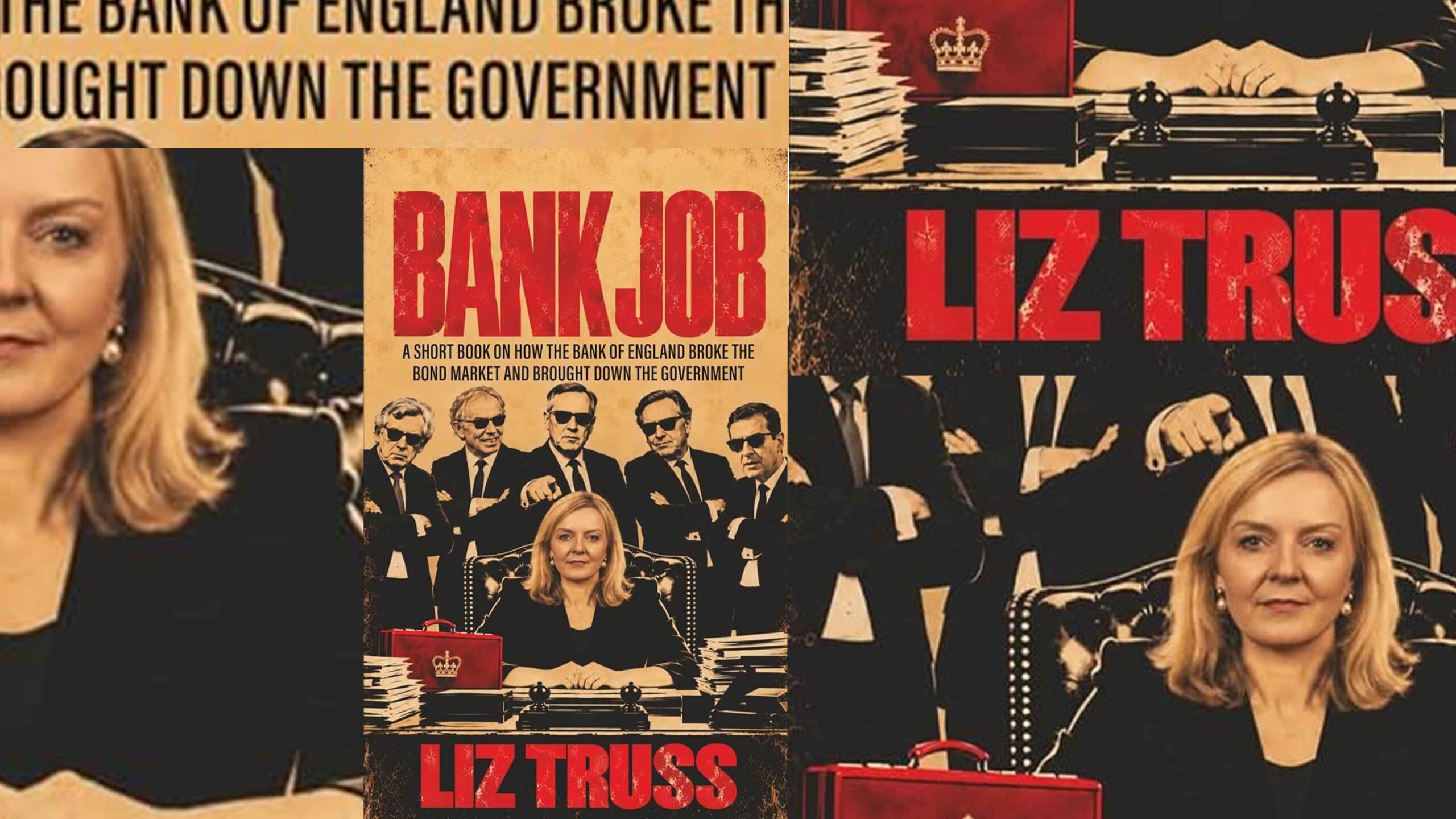
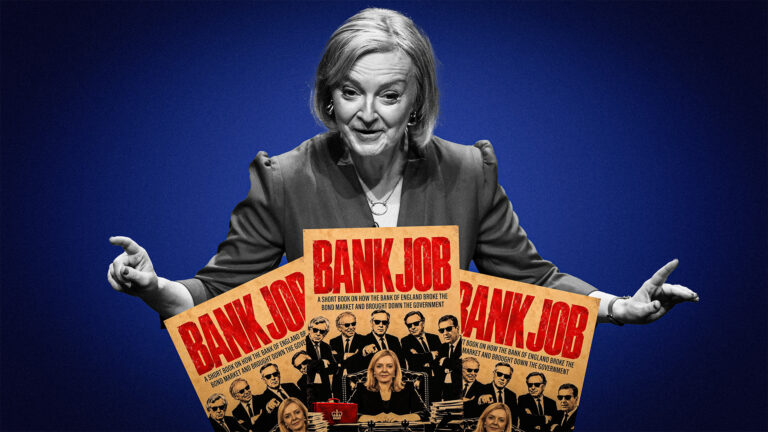
When Liz Truss’s new book was announced, its title – BANK JOB: A SHORT BOOK ON HOW THE BANK OF ENGLAND BROKE THE BOND MARKET AND BROUGHT DOWN THE GOVERNMENT – raised eyebrows.
Professional publishers rarely use capital letters quite so liberally. And most books don’t feel the need to put “short” in the subtitle. Having now read the book, though, the reasons for including the word are much clearer: it’s perhaps the only thing Truss’s new text has going for it.
The experience of reading BANK JOB is like nothing so much as hearing the ravings of someone who is furious at her smoke alarm for burning down her house. Time and again, Truss gets confused about basic facts, the passage of time, and the basis of how cause-and-effect works. This lack of expertise never gets in the way of her making a grand claim, though.
“In this conspiracy, there is no smoke–filled room and secret plan (although I can’t rule it out!),” she explains. “The media class were all too quick to accept a fake establishment narrative about the 2022 crisis, while ignoring the culpability of the Bank of England and its role in bringing down the Government.”
You might think, because you were led astray by a conspiracy consisting of the entire – mostly Tory-supporting – mainstream media, the financial markets, the Conservative Party, and the deep state, that Liz Truss’s government fell because her disastrous mini-budget contained £45 billion of tax cuts funded only by vague promises of future savings.
Truss insists that the real villain was the Bank of England, which surprised the government by announcing it would be beginning quantitative tightening – bond sales unwinding quantitative easing – the day before the Budget.
This came as a total shock, she insists, panicked the markets, and sparked the selloff of British government debt. This was then made worse by a crisis caused by pension funds having to sell off bonds due to their use of liability-driven investments, which the Bank was responsible for overseeing.
In other words, none of this was her fault. The problem for Truss is that Google is available for anyone with even the slightest curiosity in checking her facts. The Bank of England had started the process of quantitative tightening more than six months earlier. It had signalled for at least a year that it would start selling bonds once the base rate hit 1%, which it had in late spring 2022.
The Bank shocked the market, according to Truss, by doing exactly what it had signalled it would for more than a year. Looking at the graphs tells the real story: there was a modest but manageable increase in gilt yields after the Bank announcement. They hit their disastrous spike the following day, when her Budget was unveiled.
Truss grasps at anything that looks like it might help her case. “Sir Jon Cunliffe — one of the breed of Treasury mandarins who, in practice, run the system — later told the Treasury Committee that the Bank ‘did not have a full briefing of the package the night before’,” she splutters indignantly. “That sentence tells you all you need to know. The institution charged with ensuring financial stability admitted that it did not treat coordination with an elected government as a duty.”
Anyone who actually bothers to check what Sir Jon Cunliffe said to the Treasury Committee, though, will see he was saying that the Treasury hadn’t bothered to tell the Bank about its plans, which feels difficult to blame on the Bank. “Had they asked us what the market reaction would be, of course we would have interacted with them,” Cunliffe noted.
Truss dismisses claims that her tax cuts were “unfunded” by explaining “that by their definition the entire British government was permanently unfunded as the country had not generated a surplus for decades”, followed by word soup on the Treasury not accounting for “behavioural response growth” – which it specifically does account for – and vague comments about the iniquities of “fiscal drag”.
Blame is also, inevitably, laid at the door of “diversity, equity and inclusion”, because the Bank of England is naturally the heart of a “progressive power grab” by “Fabian and left-wing policy networks”.
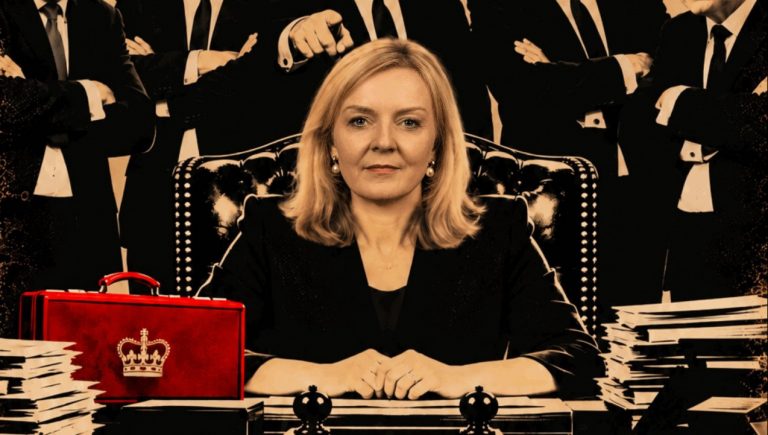

If Truss and her adherents want to break the vast Fabian/Blairite/Tory backbench/Bank of England nexus, they need look no further than cryptocurrency, she says. “Bitcoin arrived as a direct challenge to that power… The money-supply failure of 2021–22 and the hostility to Bitcoin are the same story.”
Throughout the book, Truss writes with the zeal of a fanatic who has seen things others could never comprehend, never stopping for a moment to contemplate that she might simply have got it wrong. Even her own decision to resign, she reveals, was a selfless sacrifice borne out of love of her country.
“If I had remained in office, there would have been even more of a pincer movement between the Bank of England and the Conservative parliamentary party to get me out,” she writes. “This would have created misery for ordinary British people. I could not allow them to be collateral damage.”
Your mileage may vary on that front. But when even Simon Heffer in the Telegraph is giving BANK JOB zero stars and calling it “the most deranged thing I’ve ever read”, perhaps there is reason to hope that Liz Truss’s literary career doesn’t long outlast her political one.
 Most popular

Nigel Farage’s attack on the RNLI and co is a new low even for this bottom-feeder
I was at Eton with Charles Spencer – this is how it explains his battle with the royals

‘The deep state stole my mini-budget’: An exclusive extract from Liz Truss’s new book

18 things that will absolutely, definitely happen if Trump gets whopped in the midterms