
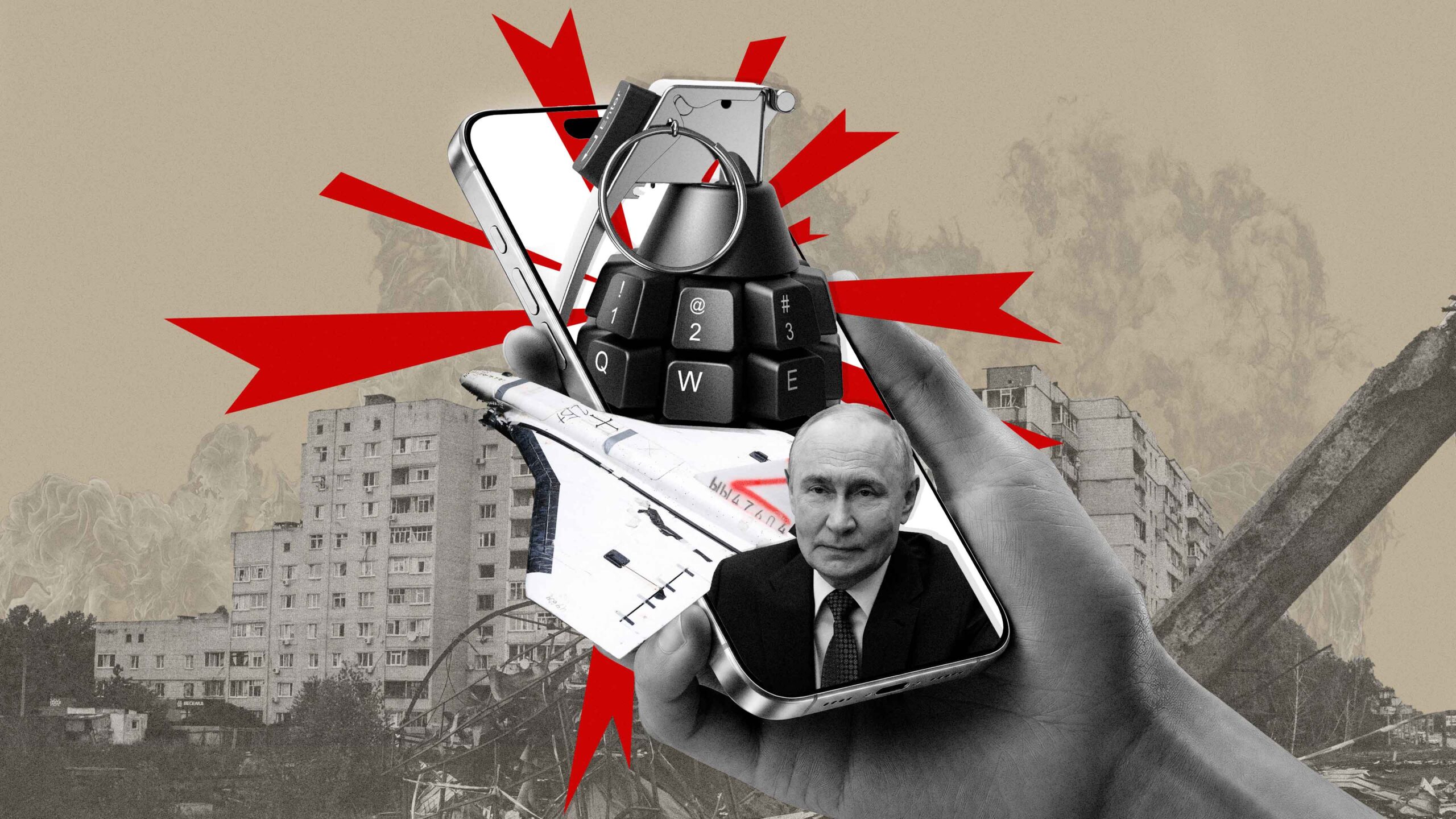
Designing the enemy was relatively easy. We used open-source information to identify 10 Russian intelligence and disinformation agencies operating against western democracies. We plugged that data into an AI model and trained it to think like Vladimir Putin’s finest hackers, assassins, scammers and spies. Then, by agreement, we unleashed it on Devon and Cornwall.
This was at a two-day conference at the University of Exeter in July, when we pitted professionals from police, fire, local government and the military against an AI-controlled “Red Team” to test their responses to Russian hybrid warfare. The results – as in all the other resilience wargames I’ve attended – were stark.
Everybody did their job: the police arrested the saboteurs, the energy companies coped with outages; the councils prioritised vulnerable people and the army stepped up to provide “military aid to the civil authority”. But the home side still lost.
Because in the game, as in real life, the ultimate target for all the bot farms, the deepfakes, the arson attacks, the subsea cables dragged and the GPS signals jammed is not physical. It’s in our brains.
Following the time-honoured doctrine of the Prussian military genius Carl von Clausewitz, Vladimir Putin’s secret state is engaged in a coordinated assault on our will to resist.
And what we found in our Exeter wargame, just as Sky News found in its TV series The Wargame, is that western democracies possess very little in the way of expertise, institutions and willpower when it comes to fighting this cognitive onslaught.
Our legal codes make it impossible to suggest, until explicit charges are laid, that an attack on a synagogue or airbase might be linked to a foreign state. Add to that a culture within the intelligence agencies to avoid attribution – and indeed to avoid telling the public much at all – and you’re left with a series of local agencies, each of which has different rules and lines of accountability, none of which owns the job of fighting back against what Russia and Iran are trying to do to us.

Yet the evidence is clear. Since 2014, the Russian state has adopted a strategy of hybrid warfare against the west. Putin knows that, given demographic tensions, the rise of extremist politics and a broken economic model, the west has become much easier to destabilise than to defeat militarily.
And with cryptocurrency and a Telegram account, you don’t even need to send trained spies to do the dirty work. Small-time crooks are easy to find through the “gig economy” – and recent convictions show both Iran and Russia have begun to employ them, here and across Europe.
In January this year, arsonists attacked four points on Latvia’s railway system, posting videos claiming they were the result of Russian military action. In February, the Russians sent a drone to buzz a French aircraft carrier off the coast of Sweden.
In March, German police swooped on a man and woman accused of aiding a planned assassination attempt against the boss of a military drone company. In August, an explosive-laden drone was found near a Ukrainian transport aircraft – an attack publicly blamed on Russia by the German government.
If you place these and other attacks on a timeline, it is hard not to conclude that Russia is already at war with Europe. The disinformation, the hate they’re stirring up on the far right, among Islamists and an antisemitic section of the left, is already more effective than anything Hitler achieved with Lord Haw-Haw in the second world war.
To protect ourselves, I have argued here that we need to become a “militant democracy”: changing our laws and political culture to meet the fact that hostile powers – Russia and Iran for certain, with China operating at the fringes – are exploiting our system to destabilise it.

Now it looks like we are about to get change. First, a change in attitude towards foreign visitors intent on stirring up hate. Over the past two years the government has banned a string of far right, Islamist and far left hate preachers, culminating in the exclusion last week of the environmentalist Andreas Malm.
Malm, whose work on the origins of the fossil fuel economy is respected in left wing circles, said weeks after the October 7 atrocity in Israel that Hamas fighters were “heroic”. Referring to videos of them attacking Israeli soldiers, he said: “I consume these videos as a drug… I inject them into my veins, I share them with my closest comrades.”
I am glad he won’t be touring British campuses to spew this bile. But it will take a lot more to suppress the campaign of cognitive destabilisation we are being subjected to.
It’s not just that the Online Safety Act is weak, and its regulator Ofcom next to useless. The wider problem, revealed in the Exeter research, is that our system seems set up to facilitate destabilisation.
At the heart of what government is now calling “Home Defence” stand 42 Local Resilience Forums (LRFs) across England and Wales, and their counterparts in Scotland and Northern Ireland. Based on policing boundaries, these bring together the emergency services, armed forces, national infrastructure providers and local government to assess local risks and coordinate responses to crisis under the Civil Contingencies Act.
But they are entirely voluntary and have little funding. As a result, their performance is patchy and fragmented. Designed to deal with floods, pandemics and wildfires, they seem ill-suited to defending civil society against the mixture of lies, sabotage and cyber-attacks Britain’s enemies are throwing at us.
Next year the government will introduce the Defence Readiness Bill, designed to introduce powers to direct critical industries in times of crisis. And it is reviewing the Civil Contingencies Act – whose emergency powers have never been used since they were introduced in 2004.
As it does so, there is a lot to learn from the Exeter experiment. Because the most revealing moment came when we applied artificial intelligence to the “Blue Team” – setting up a “virtual” LRF consisting of fictional police, fire, hospital and council chiefs.
Suggested Reading
Trump, Putin and the ‘peacemakers’ who make war more likely
This part of the research is unfinished. We fed in the rule books, standard operating procedures, laws and professional standards into the machine, and set 25 fictional individuals to work doing what real people have to do in a crisis.
It will not surprise you that we produced a virtual edition of “the Blob”. I am now three weeks into trying to get my virtual local resilience team to cope with a fictional Russian attack, but all they keep doing is asking permission, referring up, citing the risk of a scandal and avoiding overall responsibility.
Every real-life catastrophe – from Covid to Grenfell – shows this is a feature, not a bug, in the British system of disaster preparedness. But in every resilience wargame I’ve run, or taken part in, the humans do eventually learn to “find each other and act”, working around the official system to achieve effectiveness.
But this is not ideal. What we need are Local Resilience Forums that are properly funded, supported by civil service expertise, that can learn from each other and propagate knowledge across the system. We need, across officialdom, something equivalent to a “doctrine” for how to fight back against the information war being waged in our society.
As we move from passivity to a militancy in defence of our own freedoms, we’ve all got to get our heads around the fact that, for Putin and for the Iranian torture regime, the front line is the smartphone in our hands.
 Most popular


What happens to Trump if he loses the midterms?

It might not look like it, but a motoring miracle has now happened


How Abdul El-Sayed became the man who can break Trump

The truth that Northern Ireland has never confronted