
Woodward Avenue is the artery that pierces Detroit, Michigan, linking downtown, midtown and uptown, then continuing all the way up to Pontiac. It is 27 miles long and, even in the heart of the 650,000-strong city, at 8am or 6pm, it’s possible to cross it insouciantly, without waiting for the little man to turn white. That’s how empty the place is.
Few American cities are known for their footfall, and Detroit is no exception, but even the cars have too much space on the roads here. If you speak to residents, they’ll tell you it’s one of its great advantages – traffic is never this smooth in a metropolitan area – but they’ll also acknowledge that it’s a pretty thin silver lining.
At its height, in the 1950s, the city was home to 1.85 million people, and those residents enjoyed the highest per capita income in the country. Detroit has, since then, lost two-thirds of its people, and most of its wealth too. It’s the poorest large city in the US, and its Blackest. 78% of people there are African American; many of them are struggling and, though the city has slowly been getting better over the past decade or so, everyone there knows just how much work there is to do.
You may, for example, take the fact that 27,000 long-abandoned residential structures have been demolished since 2014. It feels impressive from the outside but, driving across the city, you’ll notice that street after street, in the centre and elsewhere, remains dotted with hundreds more empty, rotting buildings.
In fact, you can stand just outside the local Democratic Party’s campaigning office on Woodward and spot a huge family home just on the other side of the parking lot, which has been uninhabited for so long that no glass remains on any of its large windows.
It feels like standing in the middle of nowhere. In some ways, it’s the exact opposite.
“Michigan is the centre of the universe in this cycle”, said Austin Cook, a political strategist who spent years working for Democrat senator Elissa Slotkin. “It’s a race that Democrats absolutely have to win if there’s any chance that we’re going to reclaim the Senate majority this year”.
One of the country’s seven swing states, Michigan was flipped by Donald Trump in 2024. The result came as a shock, and probably led to Abdul El-Sayed being chosen as a candidate in the first place: desperate times call for desperate measures.
Suggested Reading


What happens to Trump if he loses the midterms?
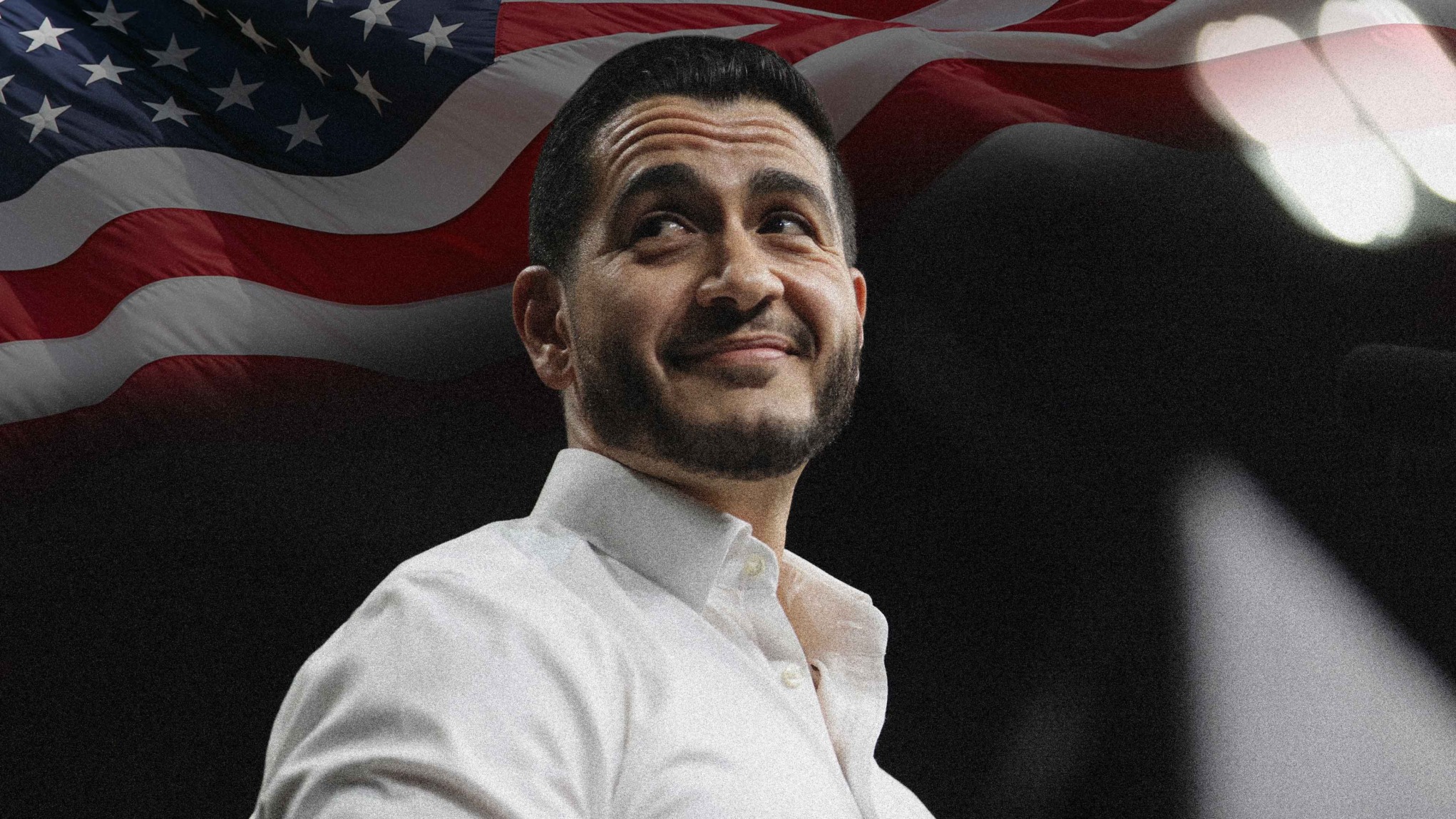
Last summer, the 41-year-old public health official, a staunch left winger by Democrat standards, won a long, bruising, expensive primary against Haley Stevens, a more centrist, establishment politician. Though New York City is home to Alexandria Ocasio-Cortez and mayor Zohran Mamdani, this part of the midwest just isn’t a natural home for a candidate wishing to enact Medicare for All, abolish ICE and stop military funding to Israel. That’s how the story goes anyway, and what many Democrats will say both in public and private.
His identity also doesn’t help; any Democratic Senate candidate in Michigan needs Detroiters to turn up in their droves in order to win, and the Black and Arab communities in the area haven’t always been the best of friends. As is often the case in the region, it’s something you can bring back to Henry Ford. The industrialist changed the face of business forever with his assembly lines, but he liked to play favourites with his workers.
Though many of the people who worked in his factories lived in Dearborn, a few miles out of Detroit, Black workers were actively – and sometimes physically – discouraged from moving there, and told to settle elsewhere instead. Orville Hubbard, its segregationist mayor, was elected 15 times between 1942 and 1978 and was once quoted saying that he wasn’t racist, but just hated “those black bastards”.
Meanwhile – and due to the vagaries of ethnic classification in the 20th century – thousands of Arabs ended up moving to the area to work for Ford, and happily settling in Dearborn. The city now has the proportionally largest Muslim population in the US and, in 2020, became majority Arab, with 54.5% of people claiming North African or Middle Eastern descent.
In 2024, the state’s community made the news nationwide for its Uncommitted Movement which aimed to pressure Joe Biden to support a ceasefire in Gaza. The campaign created friction with the Democratic party, and with Michigan’s Black community, with whom Biden had always been popular.
This is why it felt significant that, on October 28, Dearborn mayor Abdullah Hammoud spoke on stage at an event held by the Fellowship Chapel, a prominent Black church in the suburbs of Detroit.
“The reality is that [Republicans] are looking for a scapegoat, and they are looking for a villain, because they are failing to deliver on policies to make our lives better”, he told the crowd. “And the way in which they do that is by turning us against one another, by saying the reason that you are not successful is because of Abdullah Hamoud and the way in which Muslims pray. You know what does not matter? What does not matter is how I pray: what matters is what I pray for”.
His remarks were met with rapturous applause, though the star of the evening remained El-Sayed, who took the stage not long after him. Getting into politics, he told them, was never part of his plan.
“I’ve got an 11-letter first name, Abdulrahman. I’ve got sounds that come out of parts of people’s throats they don’t know they have,” he said with a smirk. He told the crowd he’d just wanted a quiet life as a doctor. Instead, circumstances forced his hand.
He clearly enjoys the fight, though. He was mostly there to discuss his razor-sharp focus on the affordability crisis, but still took time to hit out at RFK Jr, who’d recently come to the state and delivered a stridently Islamophobic tirade against the community.
“He came to lecture us about how the 500 million Arabs in this world have not contributed anything to science, which is ironic because he came specifically to campaign against me”, he said. “I’ve got two doctorates! He’s got none.”
Some have said that his campaign has been needlessly blokey and aggressive; others argue that it’s exactly the point. “He’s got really sharp elbows”, said Scott L Greer, a political scientist at the University of Michigan. “It’s not a mistake. He played lacrosse for this university – lacrosse is not a peaceful sport.
“He’s not stupid. Democrats want someone who’s really going to throw some elbows, […] and El-Sayed’s strategy is: you give it, you get it. And I think that’s how you unite Democrats after that really unpleasant primary”.
The Democratic Party is a broader church right now than it’s felt in some time, but there is one thing that unites them all, and it’s the need to take the fight to the Republicans. Voters are also likely to appreciate someone willing to go big and meet the occasion.
At least, that’s the hope in other, less flashy, less newsy parts of the state – like Battle Creek.
Suggested Reading
Meet the woman who won’t back down from Trump
Though the city has relatively little in common with Detroit, which sits 120 miles away, an eerie emptiness can also be found at its center. The half dozen streets of its downtown area are conveniently located near the train station, and there are some perfectly pleasant small businesses there, but vanishingly few people seem to visit them.
Once nicknamed Cereal City, Battle Creek really came to life at the start of the 20th century, when Will Keith Kellogg started serving newly invented “corn flakes” to the patients of the local sanitarium. A company selling the product was officially launched in 1906 and, at its height, it was joined by around 80 others, making the city a breakfast table celebrity across America and the world.
That glorious past is still obvious there – there’s a small but charming cereal museum, complete with a five-foot-tall statue of a metal spoon by the front door; a wheat-based mural on the side of a much-loved restaurant; and every other building has “Kellogg” in its name. There’s a Kellogg community credit union; a WK Kellogg Foundation; and even DBCZ, a locally made zine, tells you on the back page that it probably wouldn’t exist without Kellogg Community College’s printing services.
Still, “the big story here is corporate pullout”. As Sam, a local Democrats staff member, explained, “the Kellogg’s company is here, but they have consistently been laying people off and reducing the amount of folks that they hire every year over the last two decades”, as have other once-big employers in the area. The result has been that, though many parts of the state have been getting slowly but progressively bluer over time, Battle Creek has remained a tough spot for the Democrats.
Calhoun County, of which the city of 50,000 people is part, voted for Barack Obama twice but has been increasingly staunchly Republican since then. 56% of its electorate went for Trump in 2024 and, on a local level in Cereal City, people chose to oust Democrat Jim Haadsma in favour of his red counterpart Steve Frisbie. It shouldn’t really matter to you, or to anyone even 50 miles outside of Michigan, but those people may yet decide on much of the planet’s future.
“The folks here in Battle Creek? Their vote is more powerful than 99.75% of Americans”, Sam said. Amazingly, he wasn’t wrong. “We have a competitive Senate election, a competitive gubernatorial election, and in Michigan there are only two federal House seats that are really in play. One of them is here in Battle Creek, and there’s a highly competitive state House seat. Only 0.25% of the U.S. population or so satiate all of those requirements.”
This is why Abdul Al-Sayed chose it as one of the last few places in which to make an appearance before the election – at the Kellogg Community College, naturally. Sam is optimistic that the tide is finally about to turn again; not just because Haadsma, the candidate he works for, only lost by under 100 votes last time, but because, at state level, El-Sayed is offering something people there are craving: something different.
Knocking on doors in the area has involved dealing with a fair number of comments on his religion – both positive and negative, he said, though with a face that hinted at hearing more about one than the other – but mostly “the thing that I’ve heard over and over again, that I have taken away from conversations about Abdul, is the change that he’s mentioning”. In an area of slow but seemingly unstoppable decline, there is an appetite for at least trying something new, especially after voters gave Trump another chance, and have since been made to regret it.
It’s a theory Mike Murphy agreed with. Once an adviser to, among others, John McCain, Jeb Bush and Mitt Romney, the prominent Republican operator turned into one of the country’s fiercest Trump critics in 2016. He has, since then, endorsed several Democrats and is feeling pretty optimistic right now.
“Trump made a pact with the American voter when he was elected the second time, which was ‘you know me, you know I’m an asshole, but you know I can run the economy’, and they believed it; they voted for him”, he said.
“Trump’s job approval has always been middling but when you ask about specific job approval, ‘running the economy; has always been very good, 60% or better. Now it’s down to the high 20s. So he’s lost his franchise, the perception he can run the economy, because of the tariffs, gasoline prices, inflation. It’s like McDonald’s being unable to sell a hamburger.”
Suggested Reading
I went looking for Trump’s America – this is what I found
Crucially, Trump has also been unable to come up with any convincing attacks on Democrats this time around. Back in Michigan, the president, Senate candidate Mike Rogers and other prominent Republicans have spent much of their time calling El-Sayed a jihadist and a supporter of the Muslim Brotherhood, among other similar lines, in the hope that some of them will work with the electorate.
Instead, it may have ended up uniting a community which El-Sayed wouldn’t have been able to count on otherwise. It’s what frustrates Mahmoud Al-Hadidi, a doctor and the chair emeritus of the Michigan Muslim Community Council. “A large section of our community supported President Trump when he ran”, he said. “He reached out, he came on multiple occasions, and he met with people. He reduced the rhetoric against Muslims and minorities, so people supported him. He won Michigan.”
Now, however, “there’s solidarity with Abdul, not because of his agenda, his thoughts, or his policies, but because of those attacks on the minorities and their religion. A lot of the Muslim community don’t believe in several of the things that Abdul is calling for, but they’re going to vote for him because of Trump’s attacks.”
Or, as Greer neatly put it: “there are liberals of choice and liberals of necessity”. In any case, he argued, “most things don’t matter. The polarisation around Donald Trump is so immense that candidate quality matters, but it doesn’t matter relative to the impact of Trump.”
Michigan has also been having a particularly rough time since 2024, because of its location. As Cook explained, “It has the busiest land border crossing with Canada in the United States. A huge amount of commercial traffic comes over that bridge every day, so the tariffs with Canada have been a huge issue with very real, immediate impacts on Michigan businesses and suppliers.”
Though both political discourse and popular culture like to focus on America’s southern border, Detroit is, not unlike San Diego, a place which is defined by its closeness with another country. People there will often have ties with Windsor just across the border, both socially and professionally.
“If you go down to the riverfront in Detroit and you’ve got the former General Motors headquarters behind you, you’ll see smaller parallel office towers for all the same companies right across the river”, Greer said. “It’s partly because they have manufacturing in Canada that’s really integrated, and it’s also because Canada has different visa policies. Windsor has a lot of engineers who can’t get American visas.” They frequently meet with their colleagues just over the border.
Unsurprisingly, this has meant that both tariffs and relentless attacks on Canada have not been going down well in southern parts of the state. Couple this with needlessly high gas prices in a place where many people commute over long distances multiple days a week, and you have a place where voters are just about ready to do anything to send the current lot packing.
Really, the most interesting shifts won’t quite happen on the evening of November 3, as the Democrats hopefully retake the Senate, but in the months that will follow. Over the past weeks, cautious centrists have warned that this cocky, unapologetic candidate will probably win but ultimately not do as well as a more traditional candidate would have done.
Fellow firebrand Alexandria Ocasio-Cortez, on the other hand, told the press earlier this month that “If Abdul can win in Michigan, anybody can win anywhere”. Who has it right? Mamdani changed the game when he won New York City exactly a year ago; El-Sayed now has a chance to keep building on what the mayor started then.
Over 200 years ago, after nearly all of the Detroit settlement burnt down, a Catholic priest, hoping to soothe his flock, wrote that Speramus Meliora; Resurget Cineribus. “We Hope For Better Things; It Shall Rise From the Ashes” ended up becoming the city’s motto. It was fitting then and is fitting now.
Cook was mostly right when he said that Michigan is currently the centre of the universe, but he may not have gone quite far enough. Not for the first time, the state now feels like the place where the future is being built.
 Most popular
What happens to Trump if he loses the midterms?

It might not look like it, but a motoring miracle has now happened
It’s time for Burnham to kill off old Labour

18 things that will absolutely, definitely happen if Trump gets whopped in the midterms