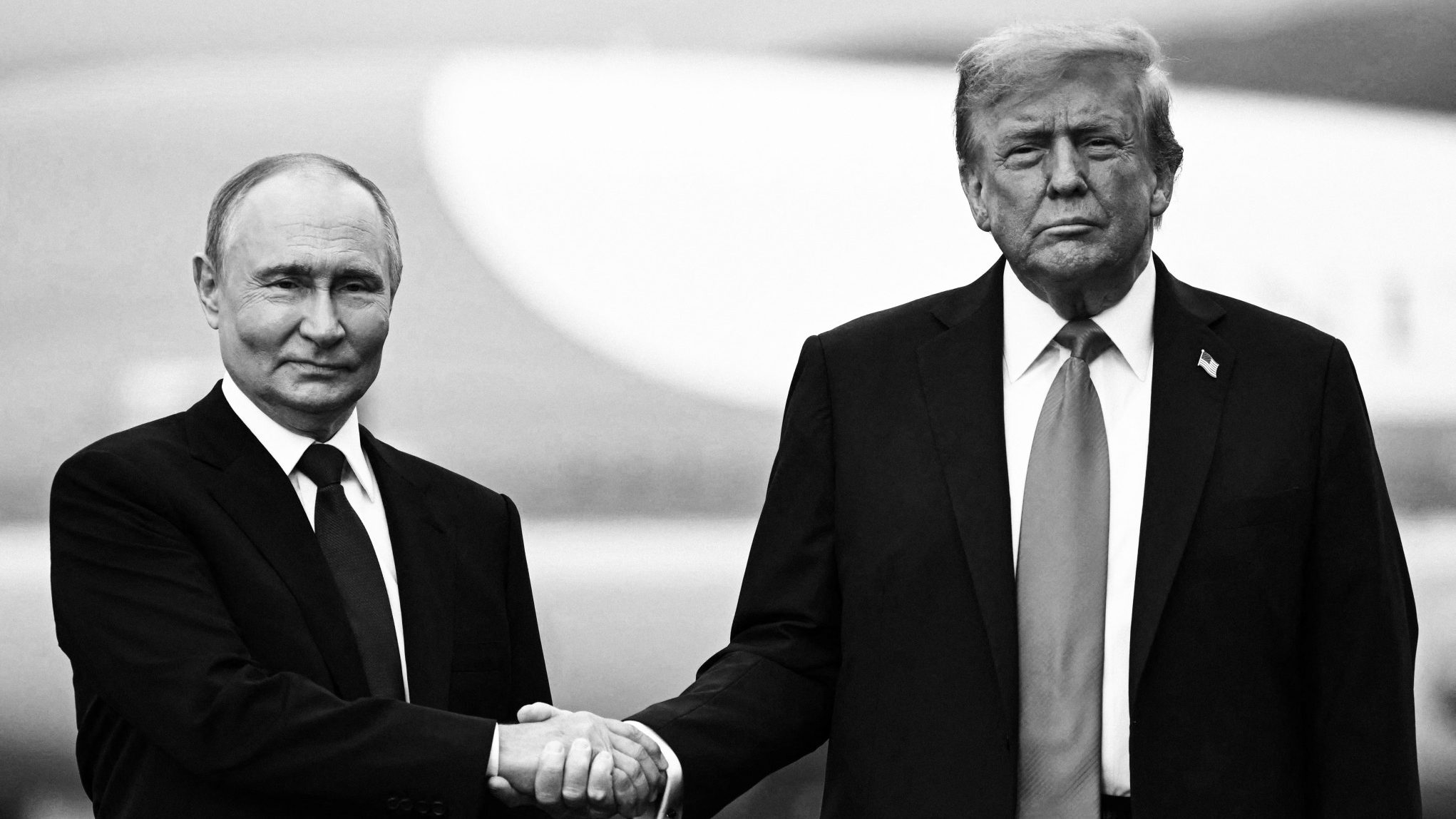
A series of events in early October 2026 shook the parameters of the Trump-Putin-Zelensky triangle. On October 8, Donald Trump said Vladimir Putin had agreed to release 300,000 tonnes of diesel immediately “to the American and global marketplace,” followed by 500,000 tonnes in November and a further one million after that. This deal implied that the US Treasury was suspending sanctions on Russian diesel exports until April 7, although other Russian assets like those in American banks are still frozen.
Trump wrote on his Truth Social platform that a further three million tonnes of Russian diesel would be delivered “within a short period”, depending on the condition of its refineries, which have been attacked by Ukraine – the first hint that he was blaming Ukraine for the shortage of fuels.
The reaction came fast: on October 9, Volodymyr Zelensky condemned Trump’s announcement of a deal to import Russian diesel into the US, calling it a gift to Putin that amounts to “an investment in a war that must be ended, not prolonged”; this condemnation was quickly backed by Ukraine’s European allies.
Just a day later, Trump reacted with his usual brutality: on October 10, he criticised Zelensky, saying he would “suggest” Ukraine get a new leader: “I suggest they get a new leader who can make a deal because he could have made many deals and for some reason, he never does.”
A White House official said the US repeatedly asked Ukraine to halt its attacks on Russian diesel refineries, to no avail. Trump said millions more tons of Russian diesel would be supplied following the first tranches “based on the condition of their diesel refineries.”
Asked about concerns that the deal with Russia could prolong the war in Ukraine, Trump said, “Zelensky could’ve settled this war many times… and he chooses not to.” He went on to slam Zelensky for striking Russian refineries, claiming the Ukrainian president “wants to make problems for the world.”
Another surprise soon followed: Trump announced that both Russia and Ukraine had accepted his proposal to stop destroying each other’s refineries and other energy sites for two months. Russia immediately broke this partial ceasefire and continued attacks on Ukrainian energy sites, while Ukraine decided to restart striking back.
Among other ominous signs, Starlink slowed down Ukraine’s internet speed (after pressure from the US government, its owner Elon Musk claimed, although other reports claim Musk suggested it to Trump). This rendered its defence against Russian drones and rockets much less effective (the internet link has since been restored). Meanwhile, Ukraine has run out of Patriot interceptor missiles just as Zelensky and Trump clash.
Suggested Reading

Slavoj Žižek on Trump, Musk and the antichrist
The reasoning that sustains Trump’s acts is clear: the price of diesel is going up because Ukraine is bombing Russian refineries, and doing so because it doesn’t want a peace deal. So it is Ukraine, and not Trump’s bungled politics over Iran and Israel, that is responsible for the high prices of oil products.
This also explains why the US didn’t react when Russia destroyed US properties in Ukraine, including a Coca-Cola factory and a McDonald’s warehouse. In short, the US is more and more openly taking sides in the Russia-Ukraine war.
In a further ominous anti-European twist, Russia again sharpened its nuclear doctrine: it formally declared that, if Nato blocks access to its Kaliningrad enclave, Putin reserves the right to resort to all measures, including nuclear attack.
The irony is that Germany has at least the same historical right to Kaliningrad (Königsberg) as Russia has to the Donetsk region: Königsberg was never Russian; it was for centuries a German city, which was for some years the seat of the Prussian monarchs. The region was then integrated into the USSR as a territorial gain after the second world war.
I want to avoid taking an anti-Russian stance directly here and ask a simple question: is there a reasoning with which one can defend Trump’s actions? I think the clear answer is: yes – and it relies on what I call abstract pacifism. This is based on two premises:
1) We have no direct actual enemies; enemies are other human beings who frighten us because they are afraid of us.
2) More armaments to retain parity with the enemy is never a way to prevent war.
Here is a clear case of this pacifism from the last pages of Carlo Rovelli’s 85 Seconds to Midnight:
I would like countries to find the wisdom to bring a little rationality into the current madness of international politics made up of wars, misunderstandings and power games that end badly. We have seen in the previous pages how many countless corpses have been left on the ground due to misunderstandings and short-sightedness.
I would like some of our politicians to be able to look a little beyond their noses, to think about the fate of the planet and take a stand against the current arms race and suicidal belligerence. The only reasonable response is to stop looking at enemies as enemies, as we are doing today.
Stop thinking that they must submit to our cultural, economic and military supremacy. Stop thinking that the problem is how to be stronger and more aggressive than others.
The problem today, the days of nuclear risk, climate crisis, still widespread poverty, increasing belligerence, is not who wins. The problem is how to avoid war. To learn to collaborate instead of fighting.
If we think we can avoid war by becoming stronger and more aggressive, looking at others in disdain, the result is that others try to become even stronger and more aggressive than us, and to look at us more and more in disdain. I believe that we must learn to see enemies as human beings who frighten us because they are afraid of us.
I cannot emphasise enough how much I appreciate his books on quantum physics, but when he writes about the threat of global war, I think he relies on an inadequate notion of rationality – here are what are for me his most problematic lines: “The only reasonable response is to stop looking at enemies as enemies, as we are doing today… I believe that we must learn to see enemies as human beings who frighten us because they are afraid of us.”
Does such an approach not end up in a vicious cycle which is just the obverse of the vicious cycle of being frightened of an enemy who is afraid of us? Up to a (very limited) point, we could say this for Stalin’s USSR until the late 1930s: the west was frightened by the USSR because the USSR was afraid of the west and saw in it a threat to its very existence.
Suggested Reading

Why Slavoj Žižek probably hates you
But with Hitler, the situation is different: there is an asymmetry; he was not frightened by the (antisemitic figure of the) Jews because Jews were afraid of him. Hitler’s hatred focused on Jews because the Nazis needed a figure like “the Jew” to sustain their ideological identity.
Hitler’s antisemitism thus comes first; it is not a reaction to Jews but a fantasmatic construct that enables Nazism to account for social antagonisms (Jews are foreign intruders who introduce social struggle into our harmonious society, like immigrants for today’s racists). So there is clearly a limit to how far we can “learn to see enemies as human beings who frighten us because they are afraid of us”: there are enemies who are not afraid of us but simply want to destroy us, for profit or for pleasure.
What we have to learn is to see (those who appear to us as) ordinary human beings as true enemies with whom no dialogue and mutual recognition are possible. If our open conflict would lead to mutual destruction, then we should, of course, negotiate with them to avoid a self-destructive explosion, but with full awareness that they are real enemies.
This brings us back to Trump. Seen through Rovelli’s eyes, Trump could appear as a minimally reasonable negotiator who patiently tries to achieve peace between Russia and Ukraine, putting pressure on the extremists on both sides. Is he not moving in the same direction also with regard to the conflict between Israel and Iran? Furthermore, do we not find the same stance in a remark Trump made about the American civil war a couple of months ago, when he said that slavery could have been abolished gradually in a peaceful way, without the big war that split the US for decades?
I think that in all these cases the deep asymmetry between the two sides in conflict is obfuscated. It is not that Nato wants to contain and even destroy Russia, which is now in effect threatened: Russia attacked an independent country a decade after it already grabbed part of its territory (Crimea). Russia is clear: it denies that Ukraine exists as a nation, while nobody denies the existence of Russia. The same holds for the US civil war: Lincoln and the Southern Confederacy were not two symmetrical opponents; the South advocated slavery.
Even if we accept Rovelli’s opposition between rationality and irrational belligerence that hurts both sides, Rovelli avoids the key problem: how to rationally deal with irrationality. Irrationality being what it is (inconsistent and self-destructive), sometimes the only effective way to prevent a war is to prepare for it in order to dissuade the enemy from attacking us.
Enemies do not only attack when they feel threatened, they often also attack when they feel we are weak. Trump’s opponents often feel his weakness: he can be aggressive against Venezuela, Cuba and the like, but already with Iran his bellicosity seems to reach a limit.
At a more general level, the dimension ignored by Rovelli was perspicuously described by Rowan Williams, who wrote apropos of Dostoevsky’s Notes from Underground:
The right-minded liberal of his time assumes that when human beings are authoritatively shown what is good for them, they will want it and choose it; but the fact is that human beings are not so constructed… People will not readily accept any would-be definitive account of what is in their interest… In other words, part of the distinctively human is the capacity for perversity, addictions, self-sacrifice, self-destruction and a whole range of “rationally” indefensible behaviours.
Remove this capacity and two things result: the distinctively human disappears and is replaced by a pattern of ordered but mechanical interactions; and violence is canonised as the means of social rationalisation – because the amputation of irrational human needs or wants can only be effected by force.
Naive and simplistic as this view may sound, it fully resonates with today’s predominant normativity of enlightened hedonism: pleasures are allowed, promoted even, insofar as they serve healthy reproduction (the “sex is good for health” stance), and experts who know what is good for us are thereby justified in regulating our lives – a regulation which can go up to the amputation of those of our needs which are perceived as irrational and dysfunctional (just think about anti-smoking legislation).
The dimension that resists this regulation – what Williams designates as “the capacity for perversity, addictions, self-sacrifice, self-destruction and a whole range of ‘rationally’ indefensible behaviours” – is the very dimension of irreducible self-sabotaging, of the “pursuit of unhappiness,” that Freud designated as the domain of the death-drive. We ignore this dimension at our own peril.
Along these lines, in his book on Dostoevsky, Williams proposes a radically new (to my knowledge, at least) reading of Dostoevsky’s The Idiot. The novel’s hero, Prince Myshkin, is normally perceived as a person of saintly love and goodness, “the positively good and beautiful man,” as Dostoevsky himself characterised him, a person for whom the real world of brutal power play and passions is too harsh so that, at the end, he has to withdraw into the seclusion of madness.
In contrast to this standard reading, Williams reads Myshkin as the eye of a storm: yes, a good saintly person, but a person who, precisely as such, triggers havoc and death all around him. It is because of him, because of the role he plays in the complex network of relationships around him, that Rogozhin slaughters Nastassja Philippovna.
So it’s not just that Myshkin is an idiot for those around him, while he is, in himself, a model of goodness: he is effectively a naive idiot, unaware of his disastrous effect on others.
And this brings me to my sad conclusion. Abstract peaceniks who refuse to perceive any of their opponents as a true enemy and insist on treating them as just confused and misinformed are precisely like Dostoevsky’s idiot: models of principled goodness, dialogue and respect for the others who are a catastrophe for their surroundings.