
PICK OF THE WEEK
Disclosure Day (general release)
Very unexpectedly, Steven Spielberg’s 37th feature film – and his third, after Close Encounters of the Third Kind (1977) and E.T. The Extra-Terrestrial (1982), to address contact between humanity and benevolent aliens – opens at an all-in wrestling match.
On-the-run cybersecurity expert Daniel Kellner (Josh O’Connor) is in the crowd to meet the menacing agents of private contractor Wardex, from which, exploiting his top-level clearance, he has stolen 100 ultra-classified data drives and a mysterious “device”. If he hands them all back, the promise is that his kidnapped girlfriend Jane Blankenship (Eve Hewson) will be released.
Outside the venue, Wardex CEO Noah Scanlon (Colin Firth) is waiting to oversee the exchange. “Well, this is all rather disappointing,” he tells Daniel in that laconic Colin Firth voice.
The world, we soon discover, is on the brink of nuclear war, as North Korea descends into crisis and American and Russian forces prepare to strike. “Do you really think that dumping inventory will be anything other than a dangerous distraction?” Scanlon asks his rogue employee. Which begs the question: what “inventory” exactly?
Unlike the well-meaning international team of government scientists supervising first contact in Close Encounters – led by François Truffaut as Claude Lacombe – Wardex (Waived Reporting, Development, and Extraction) is a downright sinister private contractor set up in the 1970s to keep all evidence of alien contact completely secret, to interrogate extra-terrestrials with shameless cruelty and to reverse-engineer their technology. If you think Alex Karp and Palantir are scary, wait till you meet this lot.
But a clandestine resistance network within the company, led by “director of biological assets” Hugo Wakefield (Colman Domingo), believes that Scanlon has gone too far and wants to reveal the files – and more – to the world. Daniel is a big part of that plan, though he protests to Hugo that “I’m not a field guy.”
So too is Kansas City-based television weather reporter, Margaret Fairchild (Emily Blunt) who, after a red northern cardinal bird flies into her apartment, finds that she can somehow speak Russian and Korean and read people’s minds (handy when you’re trying to avoid a ticket from a traffic cop).
On air, her speech descends into a series of apparently meaningless clicks, she collapses and is taken to hospital. Laid low by migraines and a sudden rush of knowledge, she quickly intuits that she needs to team up with Daniel due to some inexplicable but profound affinity.
The first two acts of Disclosure Day are firmly in the chase movie genre, recalling, in this respect, Spielberg’s Indiana Jones franchise, Jurassic Park (1993) and Minority Report (2002) as much as his previous alien films. A car is as likely to fall off a cliff into a river as it is to crash in and out of a cabin.
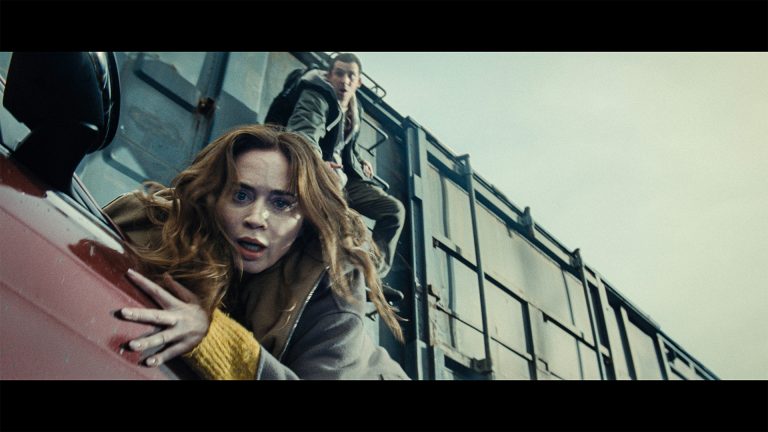
The 10-minute sequence in which Daniel and Margaret, pursued and shot at by Scanlon’s chief of security Boyd (Henry Lloyd-Hughes), leap from a moving car on to a train is Spielberg at his matinee movie best. Even so, my favourite vehicle in the whole white-knuckle pursuit is an invisible fire engine (don’t worry, it makes sense by that point).
This helter-skelter pace deserves emphasis because, above all, Disclosure Day is a first-class entertainment from the director who, along with his great friend George Lucas, breathed life back into the popcorn spectacular more than half a century ago. Blunt, O’Connor and Domingo all bring their A-game, and know that they are the stars of a pedal-to-the-metal adventure story rather than a solemn cinematic treatise about humanity’s relationship with otherworldly beings.
That said, there is also plenty of trademark Spielbergian enchantment: most mystically captured in Margaret’s recurring dreams about visiting a Hansel and Gretel house in a woodland clearing and the haunting role played by animals, seeking some sort of communion with the two fugitives.
The Deep State and conspiracy theory themes are, of course, very timely (with reassuring predictability, David Icke has already declared the movie a “psyop” and “a complete misdirection of the truth”). But so is the unembarrassed and direct way in which the movie addresses the potential challenge posed to religious faith by the disclosure that we are not alone in the universe: a question not often confronted squarely in science-fiction, notable exceptions to the rule being the classic James Blish novel A Case of Conscience (1958) and Robert Zemeckis’s Contact (1997).
“I will not be anyone’s religion,” insists Margaret. In one powerful scene, Jane, a former novice nun, is being controlled by Scanlon via the alien “device” she holds in one hand – while seeking to overpower his telepathic manipulation by holding her crucifix tight in the other. As her grip leads her to shed blood, the allusion to stigmata is unmistakable.
“People will see [the aliens] as deities,” she warns. “They’ll leave the church.” Not surprisingly, the film has already stoked much controversy in the US over its significance to Christians (for more on the framing in MAGA discourse of UFOs as demonic forces, check out my piece in April).
The laziest attack on Spielberg has always been that his movies are too sentimental. In the first place, it’s a ridiculous accusation to level at the director of Schindler’s List (1993), Munich (2005), and Lincoln (2012). But it also diminishes the central role that emotionalism has played in the history of cinema. Charlie Chaplin, Frank Capra, Vittorio De Sica, David Lean: were they insufficiently cynical, too?
At 79, Spielberg is still turning out big-ticket IMAX movies, which speaks well of the spirit of youthful curiosity and energy that has been hardwired into his work from the very start. Disclosure Day is a thrilling finale to a lifelong obsession and a delight from start to finish.
Suggested Reading

Spielberg’s Disclosure Day is willfully gullible guff for Trump wingnuts
STREAMING
Brexit: A Very British Civil War (iPlayer)
The most astute observation in this riveting two-part documentary from Norma Percy and Max Stern is made by George Osborne, who remarks that the whole disaster of the Brexit referendum owed much more to the ethos of Game of Thrones than to competing visions of Britain’s geopolitical and economic future.
Ten years on, that failure of the political class in general and the Conservative elite in particular feels even more scandalous than it did at the time. “I would have become prime minister anyway,” boasts Boris Johnson – his deranged hair now almost as character in its own right – as though that exonerates him from his plainly unprincipled decision to back Leave.
His sister Rachel is quite clear about the psychological backdrop to it all and his rivalry with fellow Old Etonian David Cameron. “The fact Dave became PM first, even though he was two years younger, I think really riled Boris. He thought that it was his turn to be world king before it was David Cameron’s.”
According to Johnson, Cameron warned him that, if he backed Brexit, “I will fuck you up forever.” Michael Gove recalls that the then prime minister divided the world into “team players” and “wankers”. When Johnson invited Gove to dinner to discuss their options, the main question was: “Do we want to go through the pain of being at variance with the prime minister, seeming to be difficult, being mutineers and then probably lose it? And then cast as splitters.”
The narrowness of their horizons is breathtaking, especially now that we have experienced the grievous cost of their collective folly. Gordon Brown emerges with credit, correctly advising Cameron and the Remain campaign that the key task was to get Labour voters out.
In contrast, Jeremy Corbyn is at his smug worst – with that strange snort he emits between assertions that he considers portentous – proud of the fact that he refused to join in cross-party campaigning and didn’t like the EU much because of its “free-market economics”. When he announces that “there’s no ‘I’ in Corbyn”, you can tell that part of him still thinks he’s on the Pyramid Stage at Glastonbury.
It gives me no pleasure to say that Nigel Farage comes across as much the most strategically minded in the stellar line-up of interviewees (of the big players in the referendum, only Dominic Cummings is missing). Quick to found Leave.EU and to grasp how anti-immigration sentiment could be mobilised to secure victory for his side, he was ahead of the official Vote Leave campaign and the hapless Remainers (who thought that a torrent of economic statistics would close the deal). Of the notorious “Breaking Point” poster, he says: “It’s an image by the way, that if you used to today, you’d probably get very little criticism.”
Unfortunately, he may well be right.
Meanwhile, Johnson reflects upon the immediate aftermath of Leave’s victory: “We didn’t have a plan for what to do next, because we didn’t think it was our job to have a plan.” And here we all are.
Suggested Reading

The shocking lesson of the BBC’s Brexit: A Very British Civil War
BOOK
Western Star: The Life and Legends of Larry McMurtry, by David Streitfeld (Mariner Books)
In a readers’ poll published by the Guardian on June 6 of the 100 greatest novels ever written, Larry McMurtry’s Lonesome Dove (1985) finished joint 52nd, ahead of (among other classics) Animal Farm, Mrs Dalloway, Madame Bovary, Midnight’s Children, Possession, Tinker Tailor Soldier Spy, and The Life and Opinions of Tristram Shandy, Gentleman.
Five years since its author’s death, the doorstop western epic is considered by many to be the “Great American Novel”. Yet, outside the US, McMurtry remains a comparatively obscure writer, mostly categorised (if at all) as a successful genre novelist who somehow managed to land a Pulitzer Prize.
This very readable biography by New York Times journalist David Streitfeld – a Pulitzer winner in his own right – is an important corrective that has much to say about McMurtry’s nuanced relationship with his home state of Texas, his friendship with Ken Kesey (whose widow Faye he married in 2011) and, especially interesting, Peter Bogdanovich’s 1971 adaptation of his novel The Last Picture Show (1966) and the two men’s respective relationships with actor Cybill Shepherd (“we were lovers on and off,” she told Streitfeld).
Though the movie launched Bogdanovich as one of the most important directors of the “new cinema”, he went on to resent McMurtry bitterly for – in his eyes – taking a prospective movie treatment they had worked on together and turning it into Lonesome Dove. They reconciled intermittently, though McMurtry’s last words to Bogdanovich were: “I’m sorry I picked up the phone.”
Taylor Sheridan, probably the most powerful television showrunner working today, has often said that his mighty empire of MAGA-friendly franchises at Paramount+, with Yellowstone (2018-24) at its heart, might never have been built without the Texan writer’s influence.
Yet it is no less important to remember that McMurtry quickly spotted the greatness of Annie Proulx’s tale of a love affair between two cowboys, “Brokeback Mountain”, which was first published in the New Yorker in 1997, and admitted that “I wish I’d have written it myself”. In 2005, he and Diana Ossana won an Oscar for their screen adaptation of the original story.
This is a fine biography, which sheds much light on the crosscurrents of modern American literature and culture – superior, if you’re picking one of the two, to last year’s account of McMurtry’s life by Tracy Daugherty.
Suggested Reading


Inside Marilyn Monroe’s image machine
FILM
The Titfield Thunderbolt (4K UHD Blu-ray, STUDIOCANAL, June 15)
Though director Charles Crichton is primarily remembered for The Lavender Hill Mob (1951) and A Fish Called Wanda (1988), this beautifully restored Ealing Studios gem, first released in 1953, deserves to be celebrated alongside them.
In his screenplay, TEB Clarke conjures a fairytale of indomitable English localism, amateurism and civic spirit, fighting off the forces of officialdom and postwar rationalisation. When the Titfield to Mallingford branch is threatened with closure, village vicar Sam Weech (George Relph) joins forces with Squire Gordon Chesterford (John Gregson) to go it alone with their own community company. The prospect of a carriage with a bar brings on board the rich and bibulous Walter Valentine (Stanley Holloway).
In the opposing corner are Vernon Crump (Jack MacGowran) and Alec Pearce (Ewan Roberts), who want to supplant the old branch line with a bus service and recruit steamroller operator Harry Hawkins (Sid James) to sabotage the buccaneering railway enthusiasts.
Chesterford’s impassioned plea to a town meeting foreshadows the major cuts and closures imposed by the Beeching reports a decade later. “Do you realise you’re condemning our village to death? Opening it up to buses and lorries and what’s it going to be like in five years’ time. Our lanes will be concrete roads. Our houses will have numbers instead of names. There’ll be traffic lights and zebra crossings – and that’ll be twice as dangerous!”
For the most part, though, The Titfield Thunderbolt – loosely inspired by the true story of the volunteer-operated Talyllyn railway in Snowdonia, still running today – is a joyous Technicolor caper, in which a bishop joins the engine crew, an old locomotive is liberated from the town museum, and plucky amateurs will always find a way of beating grey officialdom.
Hugh Griffith is priceless as platelayer Dan Taylor, who lives in an old carriage and is brought out of retirement to run the underdog operation. And, as always with STUDIOCANAL, the extras are excellent, too.
 Most popular

My day out with Danny Tommo
I was at Eton with Charles Spencer – this is how it explains his battle with the royals


Emily Maitlis’s diary: Trump doesn’t fear the AI apocalypse – but he’s terrified about the midterms

Memo to Burnham: this is how you beat the populists