
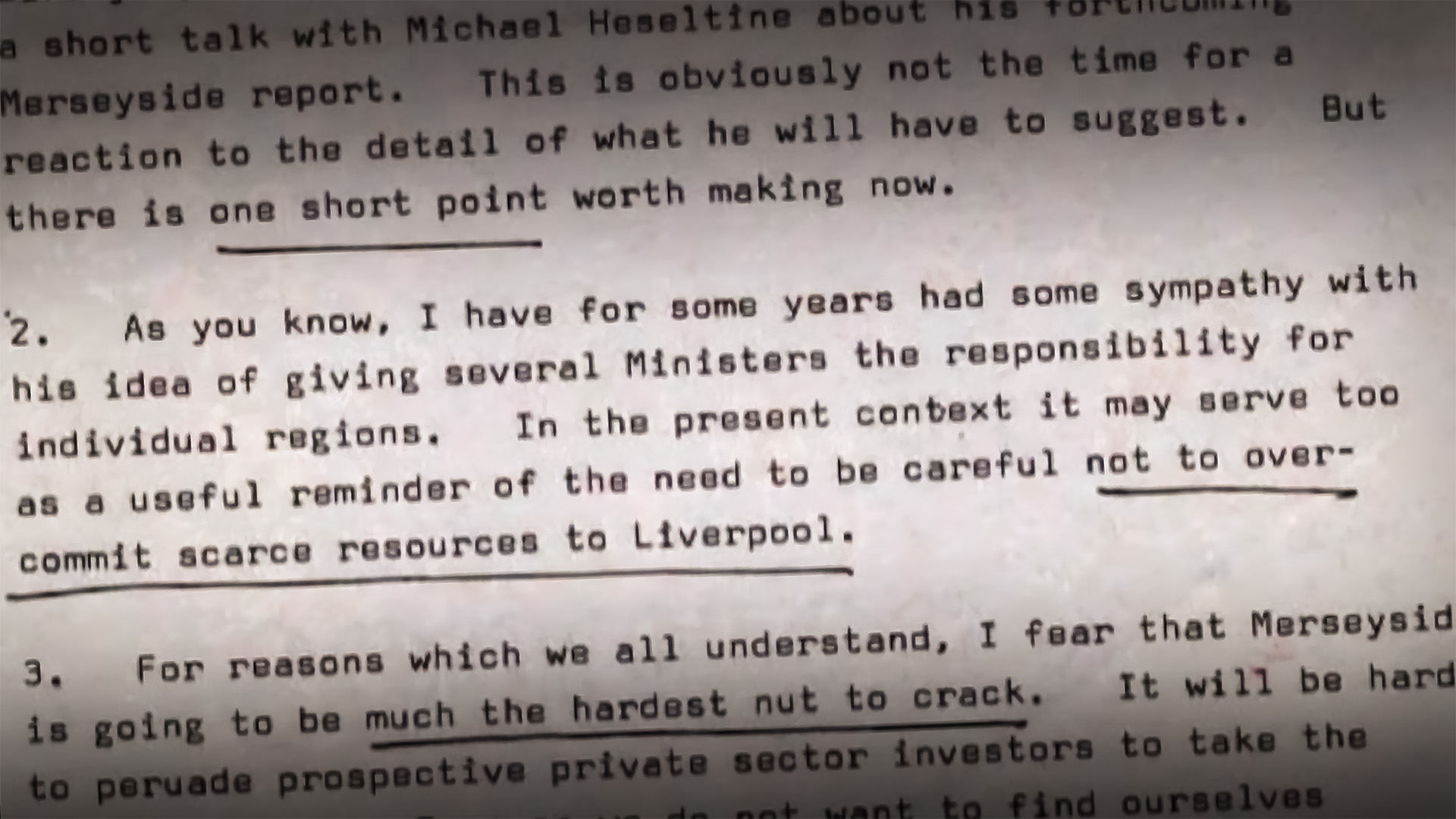
There’s a letter Andy Burnham should make a copy of, frame, and stick on the wall in the Cabinet Office – so he can point at it, lest any member of his government forget why his mantra of a politics of place really matters.
It might just be the most grotesque missive ever written by a British politician. Certainly I know of nothing quite so offensive. And not just because the city it sought to consign to the dustbin of British history, Liverpool, was the city I happened to be growing up in at the time.
Reading it today, exactly 45 years after it was written by chancellor Geoffrey Howe, it still has the power to shock, and not only because its central thesis was that my city Liverpool was simply not worth saving.
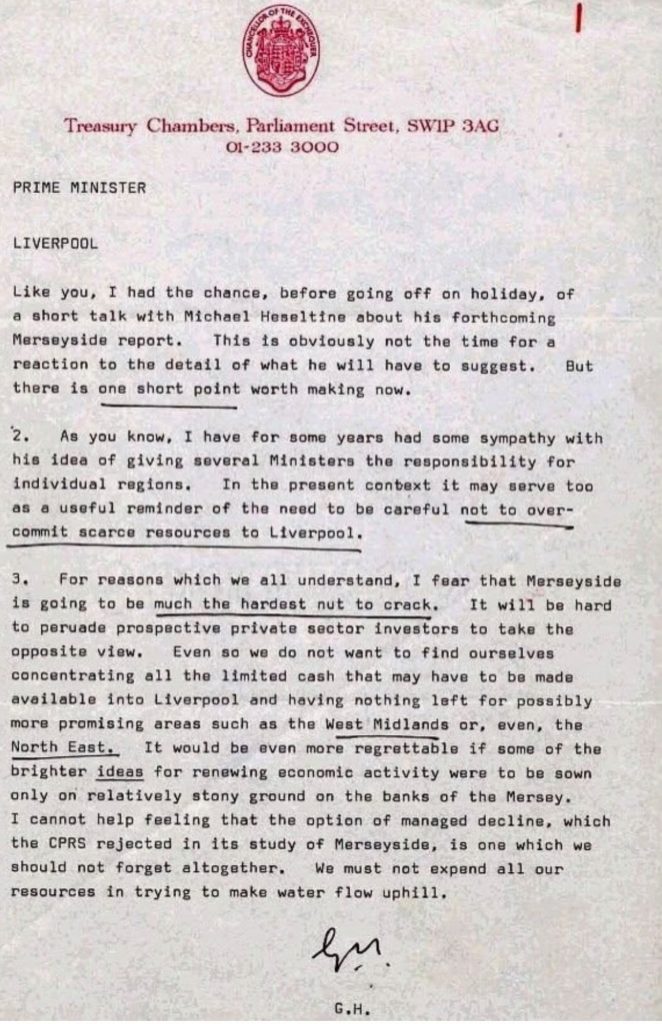
The real shock in that letter is how it exposes what happens when a politician, at the very highest level of government, forgets what they’re there for.
So here it is. This was Geoffrey Howe’s letter to prime minister Margaret Thatcher, intended to remain confidential, and sent on August 11, 1981, a month after the Toxteth Riots. It’s worth reading in full.
PRIME MINISTER
LIVERPOOL
Like you, I had the chance, before going off on holiday, of a short talk with Michael Heseltine about his forthcoming Merseyside report. This is obviously not the time for a reaction to the detail of what he will have to suggest. But there is one short point worth making now.
As you know, I have for some years had some sympathy with his idea of giving several Ministers the responsibility for individual regions. In the present context it may serve too as a useful reminder of the need to be careful not to over-commit scarce resources to Liverpool.
For reasons which we all understand, I fear that Merseyside is going to be much the hardest nut to crack. It will be hard to persuade prospective private sector investors to take the optimistic view. Even so we do not want to find ourselves concentrating all the limited cash that may have to be made available into Liverpool and having nothing left for possibly more promising areas such as the West Midlands or, even, the North East. It would be even more regrettable if some of the brighter ideas for renewing economic activity were to be sown only on relatively stony ground on the banks of the Mersey.
I cannot help feeling that the option of managed decline, which the CPRS [think tank Central Policy Review Staff] rejected in its study of Merseyside, is one which we should not forget altogether. We must not expend all our resources in trying to make water flow uphill.
G.H.
Of course, we know now that Howe was objectively wrong. By the time he died in 2015, Liverpool’s renaissance as one of the most vibrant cities in Europe was well established.
A combination of national government support (led, heroically, by Michael Heseltine), European Union investment in major infrastructure (and if you want to know one reason Liverpool voted Remain, the abundance of blue flag plaques in the city is a clue), private investment (almost £1billion of investment in the Liverpool One shopping centre that changed the city centre is just one example) and devolution (Liverpool city region has, like Manchester, its own metro mayor) has made a nonsense of the callous indifference Howe’s letter conveyed.
Suggested Reading

Devolution isn’t a magic fix – ask the rest of the world
I don’t imagine Geoffrey Howe had it in for Liverpool especially, though of course there was no love lost between the city and Thatcher’s government.
He was just looking at the books. Balancing the budgets. His was the thinking of a man who saw a city as a line item, not a place where half a million people lived, hoped, strived.
That is the exact thing Burnham’s politics of place is set against. The irony is that when he talks about place today, Liverpool is one of the few he doesn’t have to worry about.
But Britain is full of towns and cities that feel closer to the Liverpool of 1981 than the Liverpool of 2026; forgotten, unseen, dismissed, left behind. That is a helplessness which curdles into resentment; the kind of resentment toxic populism feeds on.
Howe’s question in 1981 was whether Liverpool was worth the government’s money. Burnham’s question today is what the people of Liverpool are owed from government. Only one of those is a question a government has any business asking.
 Most popular

Churchill, the Beatles, St George: All the English heroes who aren’t actually English

The New World at 500: Independence isn’t our marketing slogan. It’s our business model

The problem is they just don’t care about us any more

Sorry Nigel, but the polls show you’ve had it