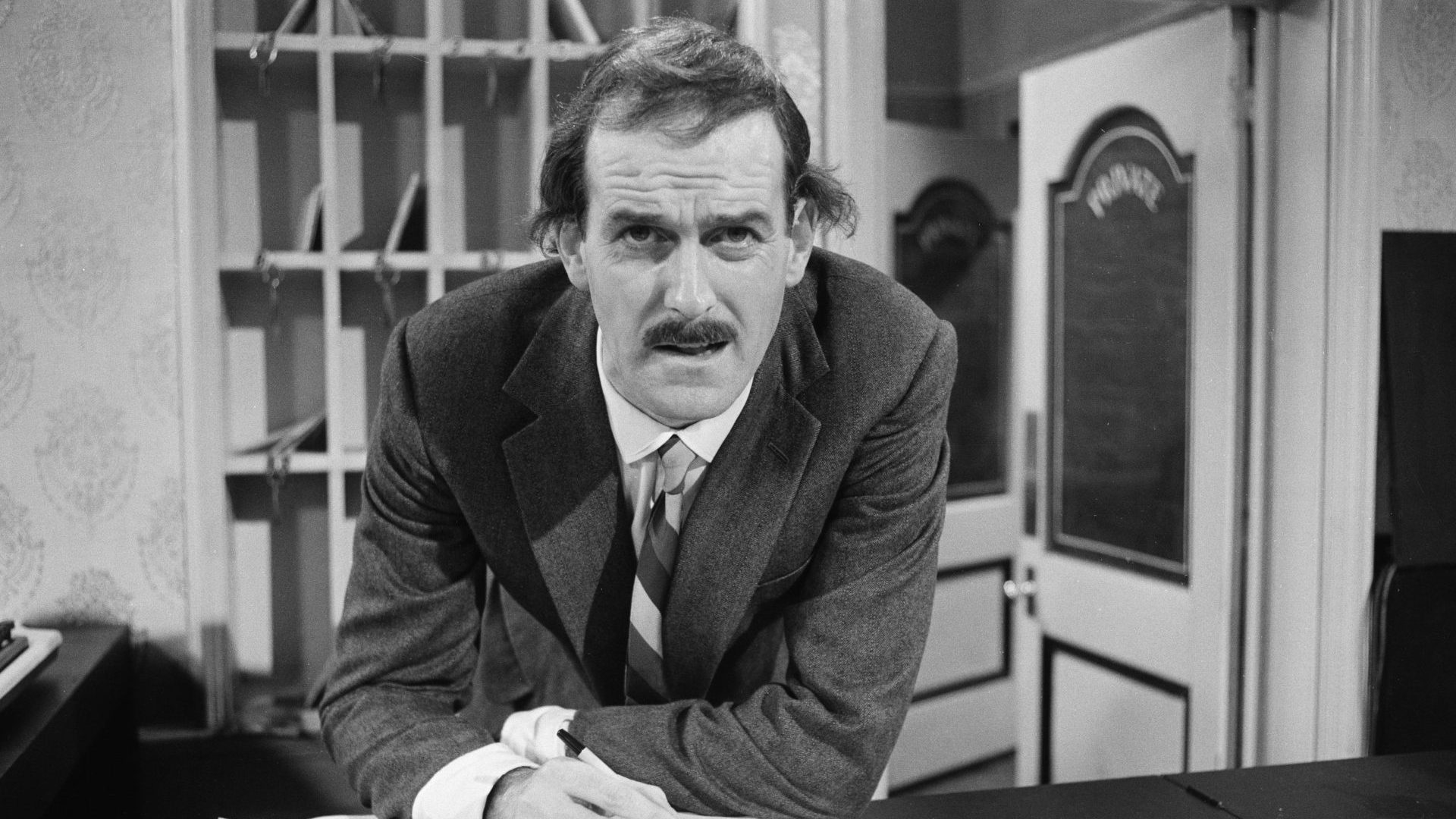
John Cleese has been playing miserable old farts for more than half a century. Cleese was barely 35 when he created Basil Fawlty, a brilliant, furious, reactionary send-up of millions of the very people the BBC relied upon as its viewers.
Cleese’s skill and generosity as a comic was to reliably make himself the heel, the butt of the joke, inviting the audience to laugh at his characters, and by extension at himself – often playing short-sighted fools unaware that they, themselves, were the origin of their own misery.
The trouble is that today, Cleese, now 86, risks becoming exactly what he has spent most of his life parodying with such finesse. The man who, as one-sixth of Monty Python, took on the might of the Church of England itself with Life of Brian now sounds as fusty and as angry as any of his opponents in the 1970s ever did.
Suggested Reading

Has-bin: This could be the end of Nigel Farage
On his X feed, in between posts supporting far right MP Rupert Lowe, Cleese has shared an obviously doctored AI video created by far right agitators apparently showing migrants helpfully saying directly to the camera in only slightly accented English that: “I want my money, and my free house and English woman. It’s my dream. If everyone can have that, we want it.”
Cleese’s caption might once have been a masterstroke of ironic comedy, though today seems only unintentionally funny, if at all. “The sad thing about real stupidity is that we can do nothing about it,” he posted as a caption to the fake video he shared.
On August 9, he wrote on X: “The entire problem is this: The immigrant cultures that have no respect for British traditions and intend to completely replace them.”
On August 10, he retweeted a meme from an account called The English Crusader, which asked “Should Islam be considered a key part of modern British identity”? Cleese added the desired answer, which was “No”, and received approving comments from those who considered that “Islam needs eradicating from the face of the Earth”, “Islam is a cancer that slowly destroys every country it has infected” and “dirty, smelly cunts all of them, they need to try using deodorant”.
Cleese otherwise obsesses about the “disgraceful” crimes of non-white Britons, shares posts from Matt Goodwin on the UK’s problem with “suicidal empathy”, declares “I trust Rupert Lowe more than any other leader” and excoriates the media – including GB News – for being nasty to the openly racist Great Yarmouth MP.
Someone who encountered Cleese’s feed knowing nothing of his history might only see a reactionary old man, one they might easily assume has been radicalised by a constant stream of racist videos. But to only see that would be to miss a lifetime spent sending up exactly those attitudes.
One of the most famous interviews of Cleese’s career was given to the BBC in 1979, in which he and fellow Python Michael Palin took on the Bishop of Southwark, and the elderly journalist Malcolm Muggeridge, both of whom were outraged at how they had supposedly portrayed the story of Jesus in Life of Brian.
Throughout the exchange, Cleese was puckish and insouciant, deftly yet politely making fun of his interlocutors. When Muggeridge argued that Cleese’s movie would never last in history like Chartres Cathedral, Cleese sadly noted it was “not a funny building”. He celebrated that while “four hundred years ago we would have been burnt for this film”, its release showed that “we’ve made an advance”.
Suggested Reading


Red flag, blue cheese: my picnic with a Rupert Lowe fan
If Cleese ever seemed frustrated during that exchange, it was at his critics’ failure to understand the target of the movie’s satire. It was not, he said, aimed at Christianity at all. Instead, it was “about closed systems of thought, whether they are political or theological or religious or whatever”.
Long before “cancel culture” was ever a term, Cleese was battling a cancellation attempt coming from the very heart of the British establishment.
There is no simple rightwards arc for Cleese in the decades between Life of Brian and today. Most of Cleese’s political interventions between the 1980s and the early 2010s were in support of the Liberal Democrats, particularly to support proportional representation.
Cleese in 2011 still described his own “inclinations” as “slightly left-of-centre”, though he admitted he had been “terribly disappointed with the last Labour government”. Cleese deployed his rapier wit against the Republican presidential ticket of John McCain and Sarah Palin in 2008, commenting that “I’m sorry, Michael Palin, but you’re not the funniest Palin any more”.
Generally, if Cleese was railing against the left, it would be on the grounds of “political correctness”, particularly when he saw his own work being softened or adjusted to suit modern political sensibilities.
From his perspective, though, this was simply consistency: where once the pressure to silence comedy had come from the political right, or from the establishment, it now more often came from the left, in the name of taste or decency. “You could say that we were early targets of cancel culture,” Cleese noted in a Sunday Times interview in 2023. “People don’t like to have their cherished ideas punctured or questioned.”
Similarly, Cleese used his Channel 4 documentary John Cleese: Cancel Me to note that “if you have to keep thinking which words you can use and which you can’t, then that will stifle creativity”.
All of that is consistent enough with the puckish Cleese of the 1970s, now feeling stifled and misunderstood by those on his left, rather than those on his right. But from the mid-2010s, there was a more noticeable rightward shift on other issues, too – most notably, on Brexit and immigration.
From 2014, Cleese said he thought Ukip was “enunciating something enormously important”, and he supported Brexit on the basis that he didn’t believe the EU to be democratic, and did not think it was capable of being reformed.
Suggested Reading
The Thetford mob is coming for Burnham
By 2019, these attitudes had hardened. “Some years ago I opined that London was not really an English city any more,” he noted on Twitter, adding that “I note also that London was the UK city that voted most strongly to remain in the EU”.
By 2020, he was revising his assessment of what the Pythons had been about. “People said we were anti-authoritarian,” he told the New Yorker. “I think the truth is we were anti-bad authority.”
Today, it seems like Cleese knows what he thinks qualifies as the good kind of authority, and it is Lowe – a multimillionaire former banker, leading a political party promising to deport millions of people, throwing out basic human rights and international agreements to do so.
Cleese’s story might be one of online radicalisation, something to which older adults seem to be particularly vulnerable. It might be about how being targeted for cancellation can radicalise the target – drastically changing their original politics.
But it might be an even simpler one. It could just be that spending 50 years or more sending up reactionary old farts is still not enough to stop you one day becoming one yourself.