Let us call it what it is: snuff politics. In an interview with far right conspiracy theorist Jack Posobiec posted by streaming channel Real America’s Voice last Thursday, US defense secretary Pete Hegseth announced the first state-sanctioned public execution in America for 90 years.
On December 3, Nidal Malik Hasan, a former army major and psychiatrist and self-described “soldier of Allah”, who, in November 2009, killed 13 people and injured 32 others at Fort Hood, Texas, is set to be put to death by firing squad at the site of the massacre.
“We’ll make sure that people are able to watch it, that it’s public,” Hegseth told Posobiec aboard the aircraft carrier USS Abraham Lincoln, “because people need to understand there’s serious consequences for these types of things.”
Later that day, the Pentagon confirmed that Hasan’s execution would indeed be livestreamed. On Friday, vice-president JD Vance, hedging his bets as a pay-per-view Pontius Pilate, told reporters on Air Force Two that “if it’s ultimately live-streamed, I’m not going to be watching it.”
On the same day, however, Donald Trump backed Hegseth unequivocally. “Did I approve?” he said. “Absolutely I did.” To livestream the execution? “Yeah.”
Is it possible that the administration will walk back this grotesque decision? Of course. On Saturday, the president gave himself some wiggle room: “There are two thoughts: don’t show it, and show it,” he said. “By showing it, maybe other people won’t be doing what he did. I’ll make a decision, ultimately.” And might the courts intervene? Yes, they might.
Already, however, a moral line has been crossed, monstrously so, and an atavistic form of bloodlust invested, at least in principle, with the full authority of the most powerful government on earth. For what Hegseth proposes is nothing less than the state’s adoption of the depraved theatre of public lynching. Yet again, Trump and his regime have expanded the realm of the conceivable.
To be honest, I was shocked at the end of last week by the initially perfunctory media response to Hegseth’s announcement. A decade ago, such a horror would have immediately led bulletins all over the world. But now? Most news sites seemed more interested in the president’s glamorous new press secretary Katie Zacharia than in the prospective resumption of public executions by the nation that Lincoln called “the last best hope of earth.”
It is important to understand what, precisely, is at stake here. This is not a story about the death penalty (heinous as that is); or the second amendment (terrible though its consequences have been for the republic).
Hegseth’s plan marks something much worse: namely the convergence of ancestral barbarism with hyper-modern entertainment culture. Comedy roasts, reality television, WWE, UFC, and the testosterone-fuelled world of “Podcastistan”: Trump’s political ascendancy has been rooted in his instinctive mastery of these and other pop cultural forms.
Yet the line between laughter and a snarl – between comedy and cruelty – is often very thin indeed. Video footage of extreme violence has proliferated online for decades. But never before has it been stamped with the great seal of the US government.
In the past few years, I have often referred to Neil Postman’s classic 1985 work of cultural analysis, Amusing Ourselves to Death. That title has now ceased to be a metaphor.
It is too easy to dismiss Hegseth as a blowhard and a braggart, though he is undoubtedly both. Ex officio, he ranks third among US cabinet secretaries, behind only state and treasury, and is sixth in line in the presidential order of succession.
And now here he is, making the provision of death porn at global scale a function of US statecraft: clippable, meme-ready, a disgusting feast for AI and sadistic voyeurism. When I saw his chest-beating interview with Posobiec, I was horribly reminded of Quilty’s offer (at gunpoint) to Humbert in Nabokov’s Lolita: “I can arrange for you to attend executions, not everybody knows that the chair is painted yellow -”
In our postliterate age, increasingly untroubled by the lessons of the past, it is all the more important to spell out what is being squandered at such a moment. For most of human history, punishment – and especially execution – was etched into public ritual and tribal drama.
The penal system was not simply or even primarily about justice. It was the means by which those in authority inspired terror in their subjects; and by which collective identity was asserted through the inflicting of pain upon the culprit.
Suggested Reading

Worried about the AI apocalypse? You’re already living in it
In Violence and the Sacred (1972), the Catholic historian and philosopher René Girard (often cited, though much misunderstood by both Vance and his tech billionaire patron Peter Thiel) identified the “scapegoat” mechanism as the heart of this anthropological structure.
By focusing its antagonism upon an individual, the disorderly or fractious group discovered a unity based in sacrificial violence. “The old pattern of each against another,” Girard wrote, “gives way to the unified antagonism of all against one.”
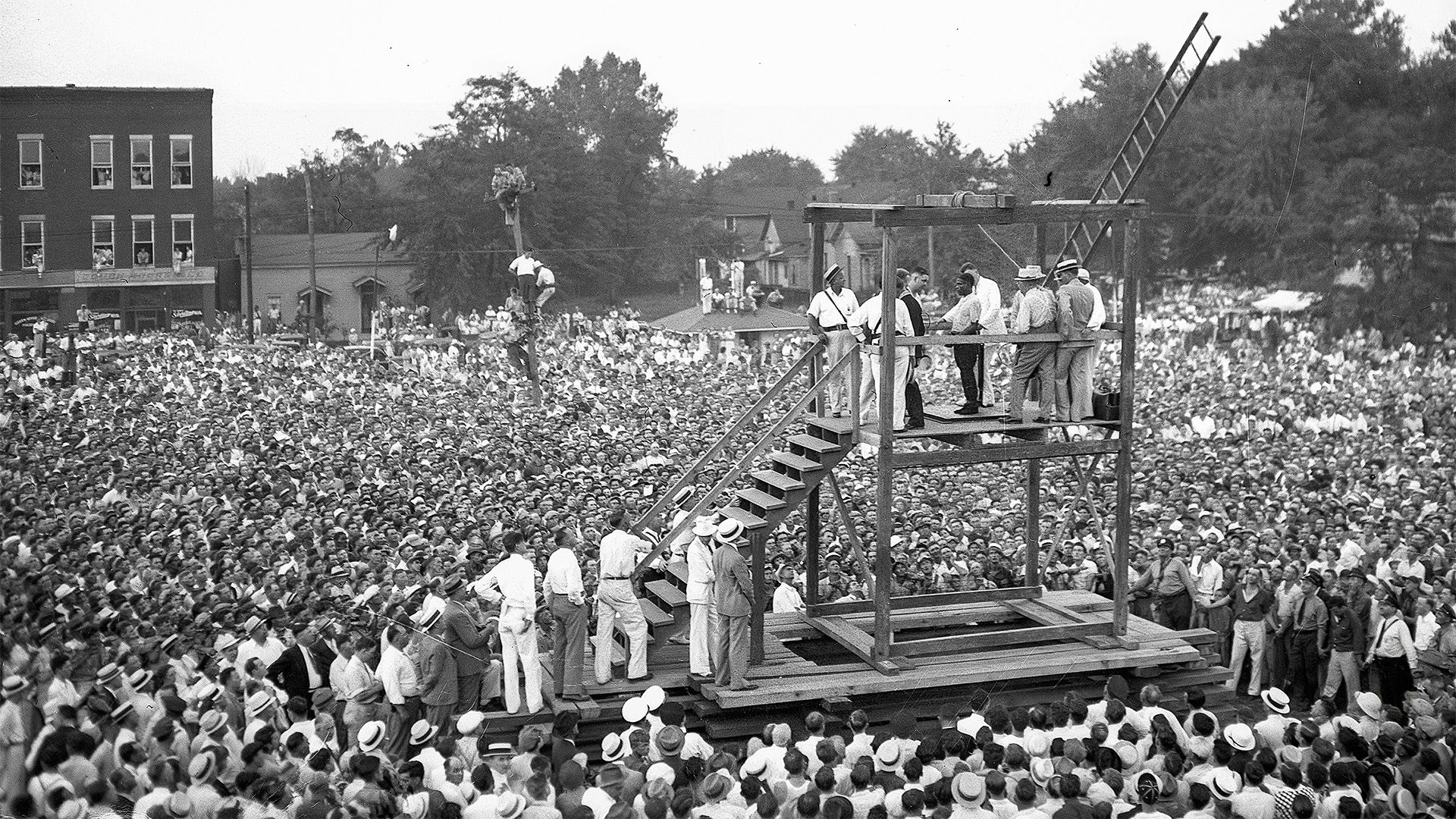
In addition to their function as a primitive bond of solidarity, these spectacles were enormously popular: in August 1936, the last time a death sentence passed by an American court was carried out in public, 20,000 gathered in Owensboro, Kentucky, to witness the hanging of Rainey Bethea, a 22-year-old Black man convicted of raping an elderly white woman.
The gallows and the guillotine also sustained a thriving business model. At Tyburn and Newgate, balconies and other prime locations were rented out to wealthy spectators. There was a similar market in premium seating around the scaffold in France; food stalls, restaurants, cabarets de la Guillotines, along with a brisk sale in souvenir beheading models and death masks. If public execution were to take off in the US, do you really imagine that Trump’s close friend, Dana White, president and CEO of UFC, wouldn’t get in on the action with a series of top-dollar premium access rates and VIP packages?
Two forces conspired to end the death carnival and drive capital punishment behind closed doors. First, these debased spectacles insulted Enlightenment values and evolving notions of Christian compassion. In a 1787 pamphlet, the founding father Benjamin Rush argued that such spectacles, far from acting as a deterrent, positively brutalised the public: “Murder is propagated by hanging for murder.”
Tolstoy, on the other hand, experienced straightforward revulsion when he was “foolish and cruel enough” to attend an execution in Paris in 1857. “This spectacle left such an impression on me that I will not recover for a long time,” he wrote to his literary confidant Vasily Botkin. “I will never again look at such a thing.”
The second force banishing capital punishment from public spaces in much of the western world was a technocratic recognition that the forces these rituals unleashed were too primal and unruly for an orderly modern society. As Michel Foucault put it in Discipline and Punish (tr. 1977), “the great spectacle of physical punishment disappeared… The age of sobriety in punishment had begun.”
That this interlude in the history of the west is set to end on Trump’s watch should not surprise us. As long ago as April 2013, after the Boston marathon terrorist slaughter, he posted on what was still Twitter: “Should be public execution for all to see – you will end this bullshit fast!”
As Adam Serwer of The Atlantic wrote of Trump’s conduct during his first term: “The cruelty is the point.” Timothy Snyder, the great anatomist of contemporary authoritarianism, has described this governing playbook as “sadopopulism”, whereby “pain is a resource.”
In his second term, the scope of Trump’s cruelty has expanded dramatically: in the deployment of ICE agents; in the appalling video posted in March 2025 of deportees being frogmarched into the CECOT hellhole in Tecoluca, El Salvador; and in the callous destruction of lifesaving USAID schemes.
The great mistake is to imagine that everything will go back to normal if, after terrible midterms for the Republican Party on November 3, a Democrat wins the presidency two years later. The moral degradation wrought by Trump and his gang will not be undone at the flick of an electoral switch.
According to a snap YouGov survey of 11,045 US adults posted on Saturday, 27% already support the livestreaming plan: equivalent to 72 million Americans. I might be wrong, but I cannot believe that anything like as large a proportion would have admitted such approval to pollsters before the convulsive disinhibitions of the MAGA era.
The lesson of this mighty ethical and cultural upheaval – and not just for America – has been that barbarism is not something out of which we have definitively and irreversibly evolved. It is a chronic condition that we must treat constantly with the immunotherapy of strong democratic culture. And, in so lazily neglecting to renew and strengthen our civic defences, we in the west have faltered unforgivably.
In his imperishable essay After Ten Years (1942), the German theologian and anti-Nazi dissident Dietrich Bonhoeffer warned of the terrible price a society pays when these base instincts are underestimated: “The failure of “the reasonable ones” – those who think, with the best of intentions and in their naive misreading of reality, that with a bit of reason they can patch up a structure that has come out of joint – is apparent… Disappointed that the world is so unreasonable, they see themselves condemned to unproductiveness; they withdraw in resignation or helplessly fall victim to the stronger.”
Suggested Reading
BORN IN THE FIRES OF 9/11
For a sense of the lasting damage, consider the findings of new research by the eminent political scientist and adviser to successive US administrations, Professor Robert Pape of the University of Chicago. According to his team’s rolling surveys, 44% of Democrats (65 million Americans) now believe that political violence may be acceptable in order to thwart Trump; while 16% of all Americans (almost all Republicans) – equivalent to 40 million people – would support the president using the military to suppress Democratic protests. This, Pape argues, represents an unprecedented level of cross-party backing for brute force used to achieve political ends.
Even before these findings, the trajectory was clear. Amongst Republicans, 77% considered ICE’s killing of Renée Nicole Good in Minneapolis in January to be justified and – perhaps more remarkably – 55% drew the same conclusion about the death of Alex Pretti in the same city 17 days later: an act of street violence that was hard to interpret as anything other than an extrajudicial killing.
But it is not only the MAGA base that has been brutalised. In particular, the online celebration of the assassination of Charlie Kirk on September 10, 2025, continues to be depraved. Ditto the lionisation of Luigi Mangione, who allegedly murdered Brian Thompson, the CEO of United Healthcare, in December 2024.
According to a poll in the same month, 48% of college students thought Thompson’s killing was somewhat or totally justified. And what made a chat show host as seasoned as Jimmy Kimmel think it was a good idea to joke about the “huge wave of horny” for Mangione?
Habituation and trauma work in tandem to desensitise us to the erosion of decency. As CS Lewis’s demon Screwtape tells his nephew Wormwood: “It does not matter how small the sins are provided that their cumulative effect is to edge the man away from the Light and out into the Nothing. Murder is no better than cards if cards can do the trick.”
Murder and cards, violence and entertainment: these have indeed been the twin forces sustaining MAGA’s corrosive grip on the American psyche. And the harm radiates all over the world.
We are a demon-haunted species, striving intermittently to embrace the better angels of our nature. What Trump has shown conclusively is that the battle is as fierce today as ever.
Even if he departs peacefully for retirement to Mar-a-Lago on January 20, 2029 – and such a conventional ending seems unlikely – the wounds he leaves behind will still be livid and infected. By definition, consequential presidents have a legacy that far outlasts their term of office.
On Friday, the New York Times posted a short letter in response to Hegseth’s announcement from a reader called Suzanne Smythe in Essex, Connecticut, who asked: “How will we recover from this? Or will we recover at all?”
That is, and shall long remain, the question.
 Most popular

Suella Braverman’s book has sold only 106 copies. This is why
Zack Polanski’s moment is over

Emily Maitlis’s diary: My deep dive into Jeffrey Epstein’s hidden empire – and the network that let him get away with it
I was at Eton with Charles Spencer – this is how it explains his battle with the royals