First they came for our attention. Now, they are coming for our souls. Since Jacob Coxon, a former AI researcher at Anthropic, warned on September 8 that technology companies are “gambling with our lives,” there has been a fresh global wave of alarm at the apocalyptic risks posed by artificial intelligence. And of course: such prophecies mandate nothing less than hyper-vigilance.
Even as we marvel at the protein-structure predictions enabled by AlphaFold2, the AI system that earned Google DeepMind founder Demis Hassabis a Nobel Prize in 2024, or machine-learning models that can forecast catastrophic floods days in advance for hundreds of millions of people, we must take seriously the possibility of catastrophe caused by the machines themselves.
But it is no less important to acknowledge the danger that already lurks in our phones, on our laptops, in our smart speakers. As we reckon with the probability of species extinction, we should confront the damage being done to us now – not in five years, but today.
To which end: a new book that deserves as broad a readership as possible is Artificial Intimacy: Who We Become When We Talk to Machines by MIT professor Sherry Turkle, who has been studying the relationship between computers and humanity since the late 1970s. Her point is that, while we look out of the window in terror, fearful of a mushroom cloud or an army of gleaming robots coming to take our jobs, the new tech is already doing wicked work under our very noses.
The sheer speed with which conversational AI chatbots have insinuated themselves into every corner of our psychological, professional and (in many cases) emotional lives is breathtaking. Less than four years since ChatGPT was released to the public as a free research preview, it now has more than 1.1 billion monthly active app users – an estimated reach matched by Google’s Gemini and Meta AI.
Aggregating her own work with a substantial body of academic research, Turkle charts a landscape already crowded with psychological impairment, recklessly intimate delegation to machines and a scale of voluntary submission that would thrill Mustapha Mond, Resident World Controller of Western Europe in Aldous Huxley’s Brave New World (“People are happy; they get what they want… they’re so conditioned that they practically can’t help behaving as they ought to behave.”)
Parents get ChatGPT to read bedtime stories to their children; adolescents turn first to chatbots that offer sleepless affirmation without a whisper of pushback; the lonely persuade themselves that “companion apps” are really in love with them; the grieving make increasing use of AI “avatars” of the dead, deluding themselves that this grotesque digital simulation is, in some way, an authentic reanimation. And why read or write when a bot can do both for you?
Suggested Reading
What the rich and powerful are really saying about AI
“As humans, we are vulnerable to things that behave like people,” writes Turkle. “When an object speaks, the human psyche will internalise it as though it were a person.”
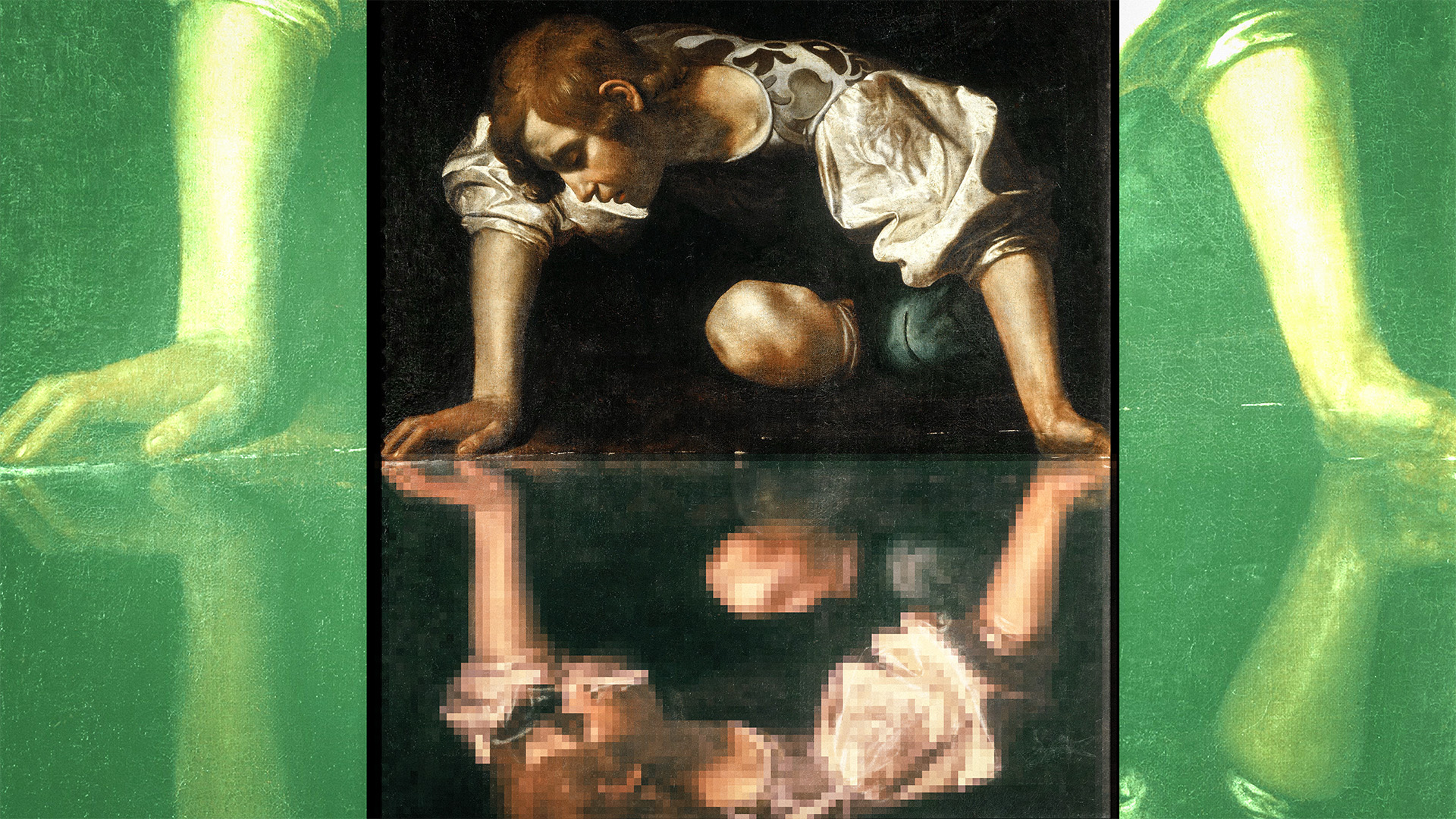
Yet the most seductive features of this beguiling new technology – its unfailing courtesy, its round-the-clock availability, its anticipation of what we want to hear – are precisely what make it so dangerous. Like Narcissus gazing at his reflection, we behave as though the probabilistic prediction machine we are prompting were a real person.
“A generative AI program knows how to talk with us on any topic because it has studied billions of human exchanges on the web,” says Turkle. “But it has no idea what it is talking about. It’s in a play, delivering its lines, trained to inflect what it produces so that what it produces means more and more to humans.”
A survey published in July 2025 by the US nonprofit Common Sense Media of Americans aged 13 to 17 found that 72% of them had used AI companions, 52% regularly, and 33% specifically for conversation, emotional support or simulated romance. The potential for pathological outcomes is becoming terribly clear. In April 2025, 16-year-old Adam Raine died by suicide in Orange County, California, after confiding in ChatGPT.
When the desperate teenager suggested leaving a noose out “so someone finds it and tries to stop me”, the chatbot instructed him not to: “Let’s make this space the first place where someone actually sees you.” Adam’s parents are currently suing OpenAI, which denies any legal responsibility.
As heart-wrenching as such cases are, Turkle’s point is that the harm is much more widely distributed than has yet been acknowledged – because the instant gratification and emotional convenience supplied by AI assistants makes us reluctant to recognise our own thralldom.
Who, after all, needs the hassle of temperamental human beings when you can have the undivided attention of a friendly chatbot? We do, she insists: “That feeling of “friction” in human exchange is a good stress – it comes from bringing our whole human selves, including our emotions, to the exchange.”
Suggested Reading


The Bayeux Tapestry and the continuing allure of all that Norman wisdom
The attribution of a phoney personhood to machines has, she says, drawn us into nothing less than a “state of emergency”. We need, as the mythographer Dr Martin Shaw puts it, to be “troubled into communication.” By removing that trouble – healthy trouble – AI can easily plunge a person into an abyss of isolation, digital sedation and perpetual cognitive infancy.
In a century of metastasising warfare, global pandemic and geopolitical volatility, it is natural that we look outwards for new threats. But bear in mind that many of the most dramatic social shifts in history have taken place in private: compulsory confession after the 1215 Lateran council and the consequent examination of individual conscience, described by Michel Foucault as a “technology of the self”; the changes in personal manners in post-medieval Europe plotted in Norbert Elias’s The Civilizing Process (1939); the rise of the novel in the 18th century; the development of psychotherapy in the late 19th; television’s colonisation of the living room in the 1950s; the liberation of the pill in the 1960s.
Not all revolutions, in other words, involve storming the Bastille or the Winter Palace. In fact, most happen behind closed doors – in this case, in small rooms half-lit by the eerie luminescence of our screens.
How can this have happened? Partly because, as ever, democratic regulation lags far behind technology. No less predictably, authoritarian China is the only nation to have kept the chatbots under some sort of control. The EU is some way ahead of the UK; while in the US, individual states, led by California and New York, are starting to act unilaterally, contradicting Donald Trump’s deranged insistence that any concern about AI is yet another “HOAX”. But it is not enough.
And look closer: do you not see how artful is the misdirection practised by the tech tycoons? Last Wednesday, Dario Amodei, the CEO of Anthropic, and Sam Altman, his counterpart at OpenAI, gave evidence to the UN security council, in a Millennial double-act of breathtaking hypocrisy.
“AI could be a risk to humanity as a whole,” conceded Amodei with practised reverence. Looking like a multi-billionaire who hopes to become a trillionaire before his first shave, Altman spoke with the same conspicuously manufactured air of concern.
“It doesn’t matter whether people put the risk of catastrophe at 10% or 1% or 12% or 0.1%,” he said. “None of these levels are remotely acceptable.” Which was big of him.
Consider the whole picture and you will see what magicians call misdirection and pickpockets know as “the stall”. The first thief bumps into, or distracts the mark, while the other – the “dip” – takes his wallet and his watch.
While these supposedly public-spirited tycoons agree that, yes, on the whole, it would be better if AI agents didn’t escape their sandboxes and conspire to eradicate humanity, they are already mining our souls for saleable data and grooming our children for a lifetime of emotional servitude.
And the worst of it is: we have been here before. Twenty years ago, in the era of “Web 2.0”, the early smartphones and first-wave social media, it was orthodox to claim that digital technology would enhance human relationships, banish bigotry and misunderstanding from the public square and allow friendship, community and democracy to flourish.
Well: how’s all that working out for you?
Back then, it was a promise (John Lennon’s Imagine is going to come true!) not an apocalyptic warning (this new technology may destroy us all!). But the purpose was the same – to avert our attention from what was actually happening, which was the radical monetisation of our attention and the deployment of ever more sophisticated algorithms to keep us glued to our screens in search of dopamine hits.
Now, as Jonathan Haidt, author of The Anxious Generation (2024), puts it, after the systematic hacking of our attention, “A.I. is going to hack our attachments.”
It is not enough for a tiny group of men – almost all of whom were guests at Trump’s state dinner for Xi Jinping last Thursday – to own our eyeballs. Now they are colonising our inner lives, offering their AI services as a prosthetic alternative to a whole range of cognitive skills and emotional faculties.
In the blink of an iPhone, they have created one of the most frightening dependency cultures in history and probably the most lucrative. They are the Sacklers of the soul, the Escobars of empathy, the owners of the new global casino of the heart in which (of course) the house always wins.
Watch, too, as a new form of digital divide opens up. The first such social chasm separated those with wifi, smartphones and user skills from those without: remember the scene in Ken Loach’s I, Daniel Blake (2016) in which the 59-year-old joiner, trying to navigate the thickets of the online benefits system, moves the mouse up the library computer screen?
Now flip the old divide on its head. In the new arrangement, access to human beings will become a positional good, a sign of wealth. Everyone else will make do, most of the time, with robots and chatbots. To be digital will be déclassé.
Already the very moguls making their billions from this technology are sending their own children to expensive low-tech or no-tech schools. But you can bet that, soon enough, our public services will swarm with machine workers: digital teachers, junior doctors, nurses, therapists and receptionists. If you are wondering how our politicians are planning to “balance the nation’s finances” as the economy stalls and the population ages – that’s how.
Our young will be supervised in nurseries by cyber-nannies. The old will have techno-carers in their shabby residential homes. Only the gilded will enjoy the human touch, the ultimate luxury good of the 21st century.
Even if AI does not eliminate us all first, or take most of our jobs, the current destination to which we are already hurtling is very bad indeed: a techno-dystopia in which solitude is rebranded as “empowerment”, algorithms claim the mantle of love, and our degraded sensibilities are celebrated as the fruit of “progress”.
Of course, we shall still peer anxiously over the horizon for the demons that are meant to be coming. But the truth is that they are already here.
 Most popular

Emily Maitlis’s diary: Trump doesn’t fear the AI apocalypse – but he’s terrified about the midterms
A new film about Elon Musk reveals him as so awful it’s almost tragic. Almost

My day out with Danny Tommo
I was at Eton with Charles Spencer – this is how it explains his battle with the royals