
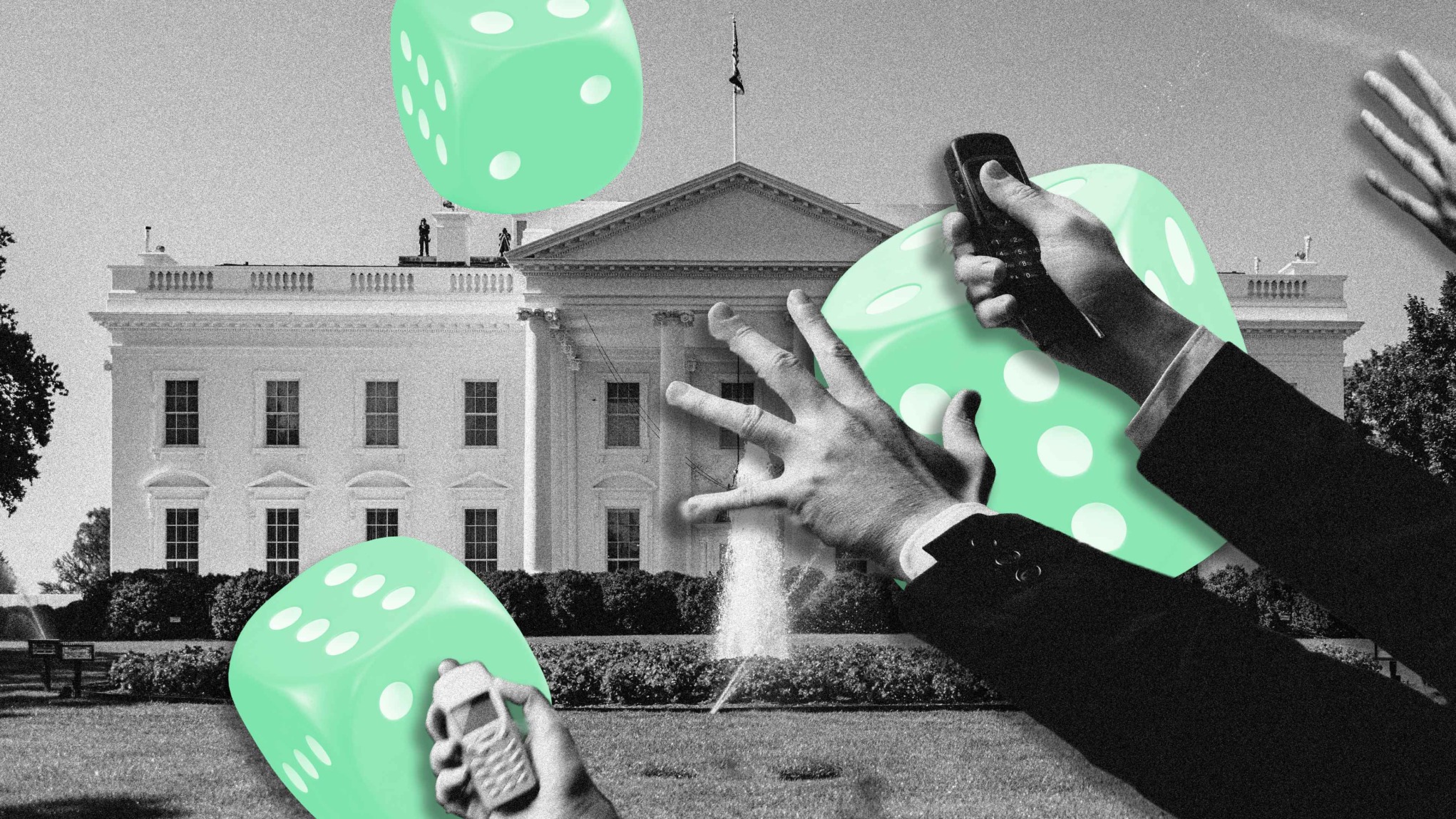
Until last week, anyone with a crypto wallet could bet on whether any of seven Cornell fraternity brothers accused of rape would be charged with a felony. More than $450,000 changed hands before Polymarket, the site hosting the market, pulled it after a public outcry, explaining that it believed in the wisdom of crowds and had “heard them loud and clear”.
Think of gambling in the US and your mind will likely be drawn to Vegas, all sequins and fountains; older readers may hark back to the romanticised image of junior mafiosi running backroom “numbers” games in a Scorsese-esque version of twentieth century New York. Now, though, if you’re a young North American thinking of placing a bet, there’s a good chance you’re heading to a “prediction market”.
For the uninitiated, prediction markets are – ostensibly at least – exchanges where you bet against other people on whether something will happen. You buy a “yes” or “no” on a future event – an election, a sports game, a missile strike – at a price between $0.01 and $0.99, and if you’re right, it pays out a dollar. Buy “yes” at 40 cents on Arsenal beating Palace and you’ve effectively got a 6/4 bet; sell when they go 3-0 up by the 63rd minute and you’ve made a profit.
The two companies that dominate the prediction market business were both started in New York by people in their twenties. Kalshi was founded in 2018 by MIT classmates Tarek Mansour and Luana Lopes Lara. Polymarket was set up from his bathroom by Shayne Coplan, a 22-year-old New York University dropout, in June 2020. Five years later, when the owner of the New York Stock Exchange invested $2bn in his company, Coplan became the world’s youngest self-made billionaire. Mansour and Lopes Lara followed him onto the billionaire lists two months later.
The speed is staggering. In September 2025 the two platforms traded under $5bn a month between them. This September the sector traded around $78bn. Kalshi is valued at $22bn, Polymarket at $21bn – between them they account for roughly 90% of all prediction market activity.
As to what you can bet on – well, (almost) anything you like! You can trade on whether Jesus Christ will return before 2027 (current crowdsourced likelihood: ~4%) or whether the hantavirus will become a pandemic. Someone appears to have tampered with the temperature sensor at Charles de Gaulle airport to win a bet on the weather in Paris. Gamblers threatened to kill a Times of Israel reporter unless he rewrote a story about a missile strike that would settle their market. It is wild out there.
You may have thought that Americans disapproved of gambling – and, legislatively at least, they used to… until 2018. Before that, sports betting was (mostly) confined to Nevada; then the Supreme Court struck down the law that kept it there, and states rushed to legalise and tax it, with the result that millions have now happily embraced the excitement of losing money via the medium of betting.
The growth of prediction markets is in many respects an object lesson in evading the spirit of the law. Rather than seek a gambling licence in each state, Kalshi argued that its contracts were “swaps” – effectively classifying them as financial derivatives, like oil futures – and so answered only to the Commodity Futures Trading Commission (CFTC) in Washington.
In September 2024, under the Biden administration, a federal judge agreed that betting on elections wasn’t “gaming”. Four months later Kalshi began offering contracts on the Super Bowl in all 50 states, including Texas and California, where sportsbooks remain illegal. Thanks to these clever bits of regulatory manoeuvring, it didn’t need a state licence to pay state gambling tax or to restrict access to under-21s, making prediction markets suddenly very visible, very accessible and immensely lucrative.
Suggested Reading

The fall of Trump’s empire of madness
In many respects this is a market with “Trump” written through it like a stick of rock. Donald Trump Jr is a paid adviser to Kalshi. He is also a partner at 1789 Capital, the venture fund that has put around $500m into Polymarket, and he sits on Polymarket’s advisory board. The Justice Department and the CFTC dropped their investigations into Polymarket in July 2025, just weeks before a large investment by… Donald Trump Junior’s 1789 Capital.
Trump’s own media company has launched a prediction market, Truth Predict. Even the ostensible regulator, the CFTC, is now being run by a single Trump-appointed commissioner, Michael Selig; it has sued nine states to stop them regulating the industry, while the president has labeled state officials who tried to do so “scum”.
There have also been rumblings around some of the trades, and a lot of what has at times looked awfully like insider bets being placed based on some very privileged information.
A US special forces soldier is charged with making around $400,000 betting on the raid to remove Nicolás Maduro of Venezuela, a raid that he allegedly helped plan. Israeli air force personnel have been indicted for betting on strikes on Iran. Outside prediction markets, Bloomberg reported this month that CFTC analysts flagged billions of dollars’ worth of oil and stock-market futures placed minutes before Trump’s U-turn on Iran in March.
There is, though, no hard evidence that anyone in the White House has profited from prediction-market bets, still less that announcements are being timed to make money. This may be due to the fact that it’s not always easy to tell who’s profiting; Polymarket’s crypto ledger is public but its wallets are pseudonymous, meaning it would require specific regulatory intervention to check. So far the regulators don’t seem to care too much – the CFTC brought 13 enforcement actions of any kind in its 2025 financial year, down from 96 two years earlier.
The only person within the orbit of the administration who has been found to have been cheating on prediction markets was the president’s teleprompter operator, who traded on what Trump was about to say.
While much of the attention paid to prediction markets has been on the more outlandish, eye-catching and “coincidental” politics and geopolitics-themed trades, the real impact is less conspiratorial and more depressing.
Strip out the war bets and what’s left is, overwhelmingly, sport, and its customers are young men. Roughly 3m of Kalshi’s 4m active users are male, and six in ten are aged 18-34. One poll found 11% of men aged 18-34 use prediction markets to bet on sport, more than twice the rate of the population as a whole. Americans aged 18-21, aggressively marketed to via social platforms and influencers, have traded an estimated $5.4bn on Kalshi alone so far this year.
While prediction markets are sold to punters as a battle of wits, your intel and savvy versus everyone else’s, the reality is that most of them are trading against professionals. A Wall Street Journal analysis found that just 0.1% of Polymarket accounts have taken 67% of the profits, while more than 70% of users lose money. Kalshi itself says it has 2.9 losing customers for every winner. The other side of many retail trades is a market maker such as Susquehanna, the Wall Street trading firm, armed with algorithms, but it’s being presented as a fair means of making bank from your knowledge.
It’s not hard to see the appeal in 2026 America, amid rising prices, a poor economic outlook and an overall vibe that could best be described as “rancid”. Jonathan Cohen of the American Institute for Boys and Men calls this “economic nihilism”: young men who can’t see a path to a house or a decent pension deciding that a lucky streak is their best shot, blowing their meagre savings or weekly paycheck on a trade or two because they just know the Mariners are set to hit a hot streak.
Suggested Reading


Forget the Terminator – the age of AI weaponry is already here
The research on America’s betting boom since 2018 makes for grim reading. One study found that in states with online betting, the likelihood of bankruptcy rose by as much as 25-30% within four years, with the damage concentrated among young men in low-income counties. Prediction markets extend that to 18-year-olds across the nation, to increasingly ruinous effect.
Whether prediction markets survive the Fall of the House Of MAGA remains to be seen, but it would be a mistake to assume they go when Trump does. Kalshi won its key court case under Biden. Wall Street is now a shareholder, and other companies like Robinhood, Coinbase, DraftKings and FanDuel all run prediction markets of their own. The NBA, the NHL and Major League Baseball have recently signed partnerships. Kalshi donates to Democrats and Republicans alike, and most of the relevant bills before Congress would ban politicians from insider betting rather than ban the product itself.
Prediction markets are not at present legally available to citizens of the UK (although, with VPNs, anything is theoretically possible). As to whether we will ever be lucky enough to wager with strangers over (say) the number of times Nigel Farage will interrupt a female BBC reporter in one interview – probably not. In February the Gambling Commission said prediction markets would need a betting intermediary licence here and would not be able to present themselves as “non-gambling” products, requiring them to be taxed and regulated like any other bookies, and rendering the UK a far less appetising market.
The US, then, presents – as is often the case – a cautionary tale of what can happen when a generation has its prospects stripped away and replaced with the chance of buying tickets for a lottery they will likely never win. Coplan, Polymarket’s founder, likes to wax lyrical about how prediction markets can discover the truth via the wisdom of crowds. But the only truth so far revealed is one we already knew – that the house always wins.
 Most popular

If Burnham held a snap election, he’d win – but there’s a catch

Yes, there must be another EU referendum. So let’s win it

What happens to Trump if he loses the midterms?


The frontline of our war with Putin is the phone in your pocket