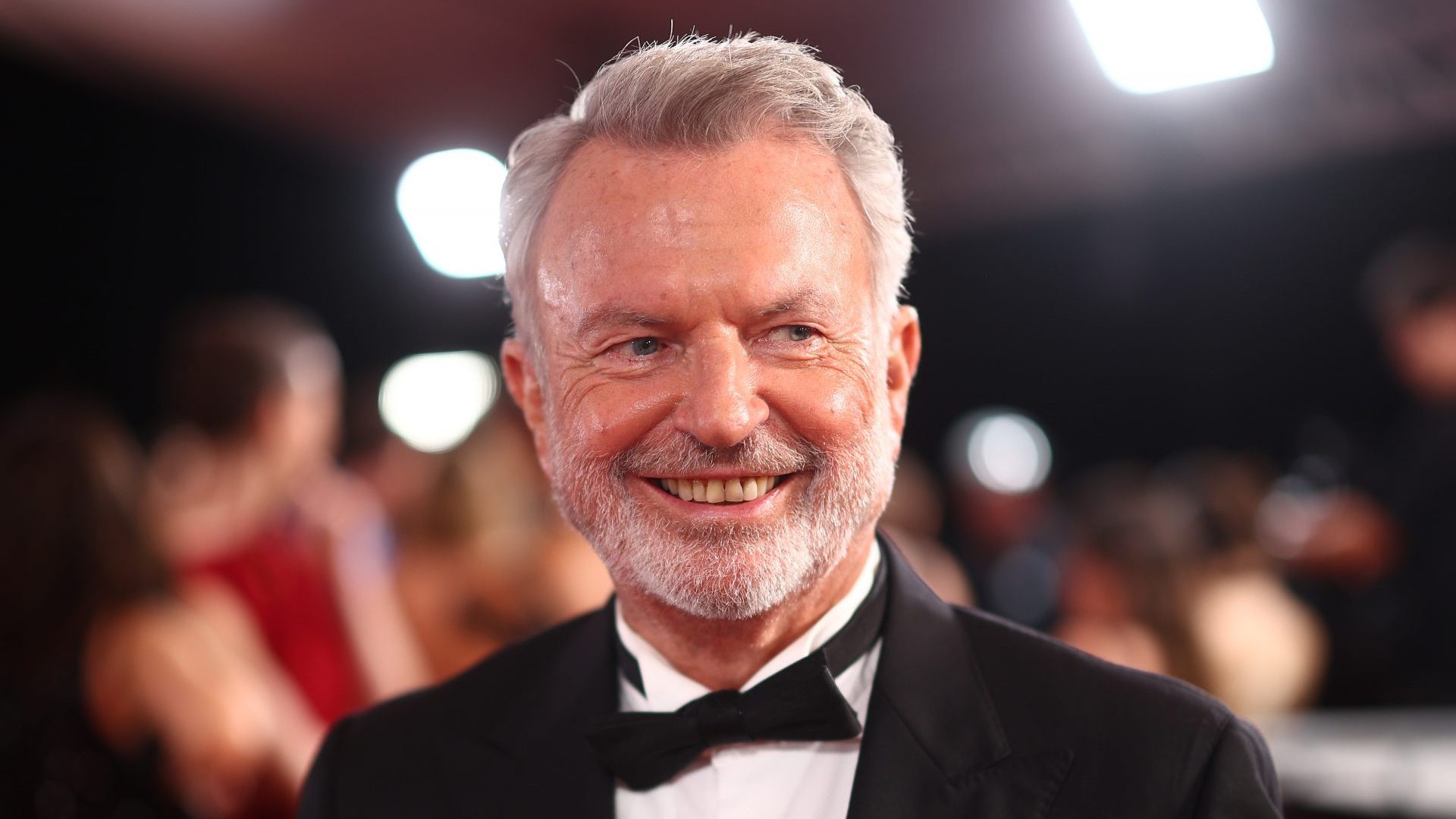
The actor Sam Neill, who died in Sydney on Sunday aged 78, wasn’t some vain screen idol obsessed with money and image. He was a real person, with real passions. He created a vineyard and organic winery and enjoyed drinking its produce. A New Zealander, he supported environmental campaigns against open-cast mining, and based himself in Central Otago, the rugged heartland of the South Island of Aotearoa.
I still remember seeing him in Sleeping Dogs. Released in 1977, it was the first commercially successful Kiwi feature film. Based on a book by CK Stead, it told the tale of a man caught in the middle of a revolution and it was a breakthrough for both the Australian director Roger Donaldson and the movie’s lead actor, Neill. When Sleeping Dogs got a slot in the Cannes Film Festival, it was literally front page news – I interviewed Donaldson for the Auckland Star.
Neill went on to make movies and TV series for 50 years. He is probably best known for his roles in the Jurassic Park series, A Cry in the Dark, Dead Calm, and Peaky Blinders, but he didn’t turn his back on the New Zealand film industry. As well as Sleeping Dogs, he played a taciturn settler in The Piano, directed by Jane Campion. It won multiple awards, including the Cannes Palme d’Or and helped to set the country on a higher cultural plane.
A more colloquially Kiwi work was his role as a grumpy old man reluctantly helping out a runaway kid in The Hunt for the Wilderpeople. Based on a comic novel by Barry Crump, it was directed by Taika Waititi before he joined the Marvel Cinematic Universe. A classic New Zealand story of good people “going bush” to get away from bad police, it’s the top-grossing film ever to be funded and produced within New Zealand. It’s also a great laugh.
I met Sam Neill when the production director of The Piano, Andrew McAlpine, phoned me the day before my 50th birthday party. Did I mind if he brought a friend and fellow Kiwi with him? It was Sam Neill, he explained. Mind? I was delighted and Neill was an utterly charming, and completely unstarry party guest.
Suggested Reading
The night New York discovered Frida Kahlo
It was my 70th birthday party on Saturday and I was re-telling this story. I later discovered through friends that Neill was very ill in hospital. He had been treated successfully for cancer in recent years, but treatment had left him with a very weakened immune system.
He was loved by Kiwis everywhere. Film producer Finola Dwyer, best-known for Brooklyn, first knew him when they worked at the NZ Film Unit and would often see him in the UK, and at his New Zealand home near Alexandria.
“Sam was a very open-hearted and curious person and his impact on NZ was enormous,” she says. “He was so down to earth and easy to be around. That made him very accessible. People felt they knew him even if they didn’t. He would joke about the monosyllabic NZ male, but he wasn’t like that at all.”
“He loved to act, he was always happy when he was going into another film, another series, and he liked to mix it up.”
She had recently had dinner with Neill and Kristin Scott Thomas who had worked together on The Horse Whisperer in 1998. They both talked about how TV series – Peaky Blinders for him, Slow Horses for her – had made them more recognisable to the public. “He didn’t see that as a problem, he just felt they were so lucky, to be doing interesting work, to be successful, and enjoying themselves.”
Neill’s generosity was legendary. When he owned a London house, it became like a hostel for visiting New Zealanders in the arts. After she made the stunning Jane Campion film An Angel at My Table, the New Zealand actress Kerry Fox got to know Neill, who understood how difficult and financially precarious the acting life could be. To help her build her career in London, he insisted on paying for flights back to New Zealand whenever she needed them.
I mentioned this to Dwyer who said, “That’s typical Sam. He was so generous and kind-hearted. He loved to help make things happen, he was an enabler. He didn’t throw his weight around, and he was always the least pretentious person in the room.”
Suggested Reading
How Beyoncé inspired Tina Turner’s last stand
He provided New Zealand with a new model for how famous folk should behave. Neil Finn of Crowded House was a friend of Neill’s and treads a similarly low-key track. Peter Jackson, whose Lord of the Rings and Beatles films have made him a billionaire, also lives in New Zealand and is similarly informal.
Neill founded his vineyard, Two Paddocks, in the early 1990s and until recently, it cost him much more than it made. But he described it as “a counterbalance” to his acting life. “One was the palliative to the other.” And he loved to work on improving his product, including the vital test of consuming it.
He took this rural life to social media and gained 1 million Instagram followers, who learned that he named livestock after co-stars. There were cows named Helena Bonham Carter and Laura Dern, and pigs called Amy Adams and Bryan Brown.
Last year, Neill told an interviewer that he held no fear of death. He simply wished to carry on living, because he enjoyed life so much. Sadly his dry laconic voice has now gone quiet. His whanau (family) and friends will mourn Neill’s passing, but his wairua (spirit) is destined to remain with us for a very long time to come.
 Most popular
My truly deranged encounter with Trump apologist Kellyanne Conway

The moral depravity of Robert Jenrick
Is this the real reason Trump keeps falling asleep in public?

Suella Braverman’s book has sold only 106 copies. This is why