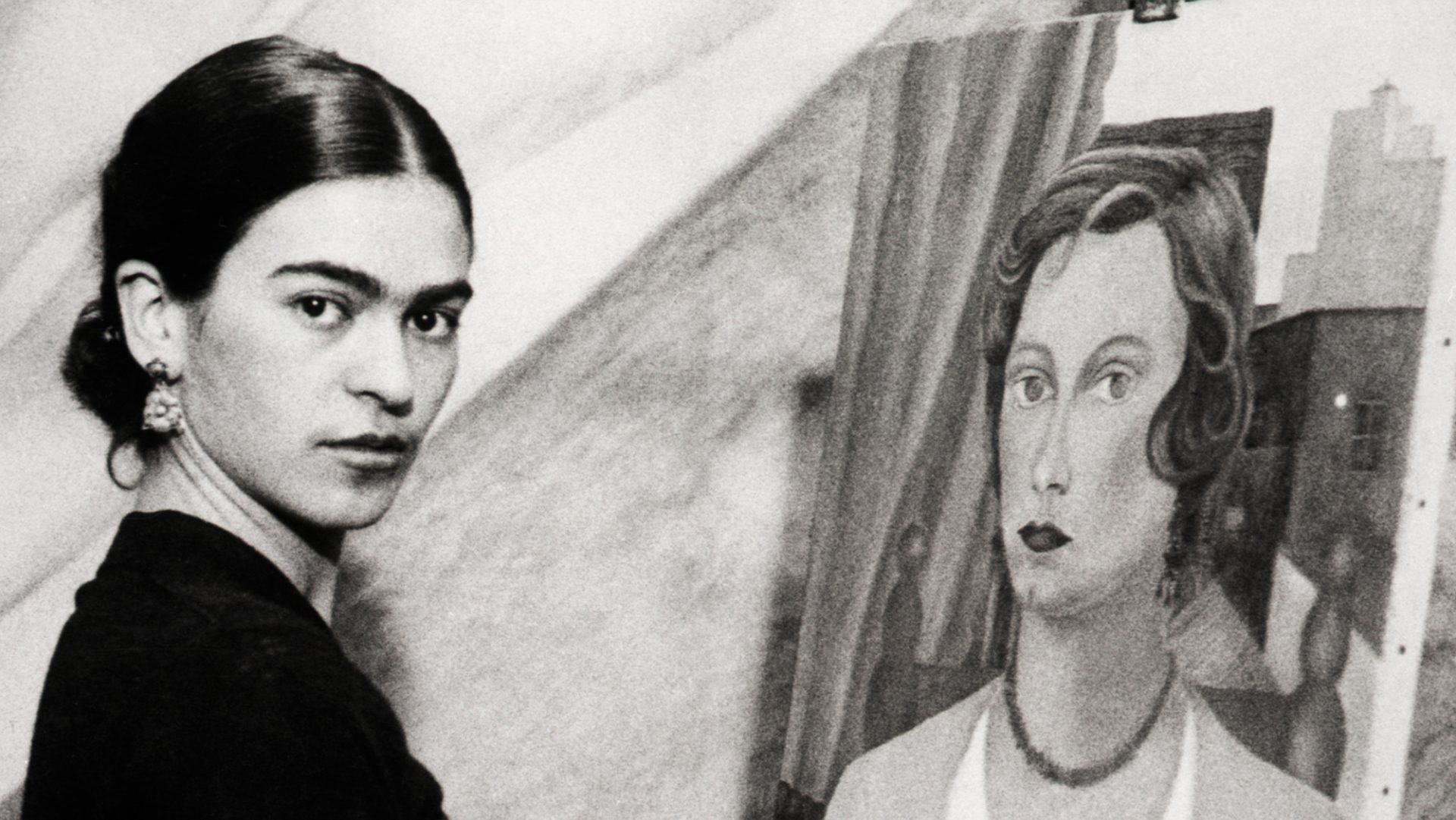
July 6, 1907 – July 13, 1954
We are still in the great depression, and the world is spiralling towards the second world war. But on the night of November 1, 1938, none of this is going to spoil the party New York is holding for Frida Kahlo.
In the corner of the Julien Levy Gallery on Manhattan’s East 57th Street is the painter Georgia O’Keeffe, renowned for her paintings of the island’s skyscrapers. Clare Boothe Luce, whose hit play The Women is still running on Broadway, drifts between conversations.
Also here is Isamu Noguchi, the designer whose new Zenith Radio Nurse – the first baby monitor – has been flying off the shelves. He is having an affair with Kahlo, as is another guest, celebrity photographer Nickolas Muray.
On the walls are paintings Kahlo has already sold to actor Edward G Robinson, and a self-portrait she created for Leon Trotsky, with whom she has also had a brief affair. Pointedly not here is Kahlo’s husband, muralist Diego Rivera, who is snubbing New York after his three-panel Man at the Crossroads was removed from the Rockefeller Center because of its depiction of Lenin. He is present, though, in the exhibition’s catalogue, which lists the artist being celebrated as “Frida Kahlo (Frida Rivera)”.
Frida herself is very much here, wearing a brightly coloured Tehuantepec costume and talking her guests through the 25 paintings hanging on the walls. She had recently written to a friend that her new paintings were “small and unimportant, with the same personal subjects that only appeal to myself and nobody else”. But now New York is begging to differ.
Suggested Reading
Why Diogo Jota will always be Liverpool’s number 20
Half the canvases sell, and the press coverage is favourable, if sometimes patronising. Time magazine praises “Little Frida’s pictures”, which have “the playfully bloody fancy of an unsentimental child”. The New Yorker admits its presence at the opening was entirely due to surrealist André Breton describing Kahlo’s work as “a ribbon around a bomb”.
It marks the beginning of her journey towards the icon status in which she is held today. And it is all the more remarkable because of what happened to her 13 years earlier.
As an 18-year-old medical student, she was returning home from school on September 17, 1925, when a tram smashed into her bus, its handrail entering her through her side and coming out of her pelvis. Several passengers died; others, like Kahlo, suffered life-changing injuries. She had a broken spine, broken ribs and a broken collarbone. “A handrail pierced me like a sword pierces a bull,” she said later.
Doctors told her the pain and the damage to her spine would be permanent. She spent a month in hospital, then recuperated at La Casa Azul (The Blue House), her childhood home. Her parents encouraged her return to her childhood interest – painting – installing a mirror above her bed.
In the confines of her convalescence, Kahlo became her own muse: “I paint myself because I am so often alone and because I am the subject I know best.” Gradually her embodied experience took centre stage in her work.
At the age of 21, no longer bound to the Blue House, she started a friendship with Rivera, already famous. The two became romantically involved and married in 1929 – he was 42, she was 20 years his junior. It was a passionate and turbulent relationship, one which was reflected in her art.
The more she suffered, the more vivid and raw the work: 1932’s Henry Ford Hospital was inspired by her three miscarriages. Her constant pain was no longer just physical, it was now compounded by the agony of child loss and the humiliation of Rivera’s repeated infidelities. He even slept with her sister, Cristina, and Kahlo responded with her own affairs. Julien Levy, in whose gallery the New York show was held, became one of her lovers.
Whether Self-Portrait Dedicated to Leon Trotsky, on show at the Levy Gallery, was born from romance or revenge on Rivera remains a tantalising mystery. Gone is Kahlo’s familiar imagery of physical hardship and distorted bodies; instead, she looks defiantly out from the canvas, graceful, strong, beautiful.
Her figure is full-length, while many of her self-portraits concentrate on her face. In her hand, she holds a letter of dedication to the exiled communist. When Kahlo returned to Mexico, Rivera filed for divorce and Kahlo moved into La Casa Azul. They reunited, but the affairs continued, as did Kahlo’s health problems.
When photographer Lola Álvarez Bravo learned that Kahlo did not have long to live, she arranged for the first-ever Kahlo solo exhibition in Mexico in 1953. It had been assumed Kahlo would not be well enough to attend the opening, but she shocked everyone by arriving in an ambulance and being carried to a bed that had been moved from her home to the gallery.
She stayed in it for the duration of the party. Time described “a frail, dark-eyed woman lying in a great four-poster bed… friends and critics turned out to sing, sip and applaud her paintings.”