Be warned – or possibly cheered. Andy Burnham and Nigel Farage will dominate the political headlines for the rest of the summer. But a new poll, conducted by Norstat, the company whose eve-of-election figures two years ago came closest to the result, shows that voters do not share Farage’s view of himself.
He may see himself as a plain-speaking anti-establishment hero. They do not.
The poll’s main lessons are that 60% of voters think Farage “has dangerous ideas for running Britain” and 63% don’t trust him to tell the truth. His figures are the worst out of Burnham, Badenoch and even Starmer.
The poll also shows there has been a swing of almost 10% from left to right since the election, but that Reform is highly vulnerable to tactical voting. Burnham’s Makerfield result defied that swing. He needs to repeat that nationally.
As for Burnham himself, he comfortably beats Starmer on the main qualities of leadership, especially among the voters he needs to win over at the next election
How voters from 2024 would vote today
On the day after the 2024 election, Norstat asked 10,000 voters online how they voted. They have now gone back to almost 6,000 of them to ask what they think now. Here is how their 2024 vote compares with how they would vote today.
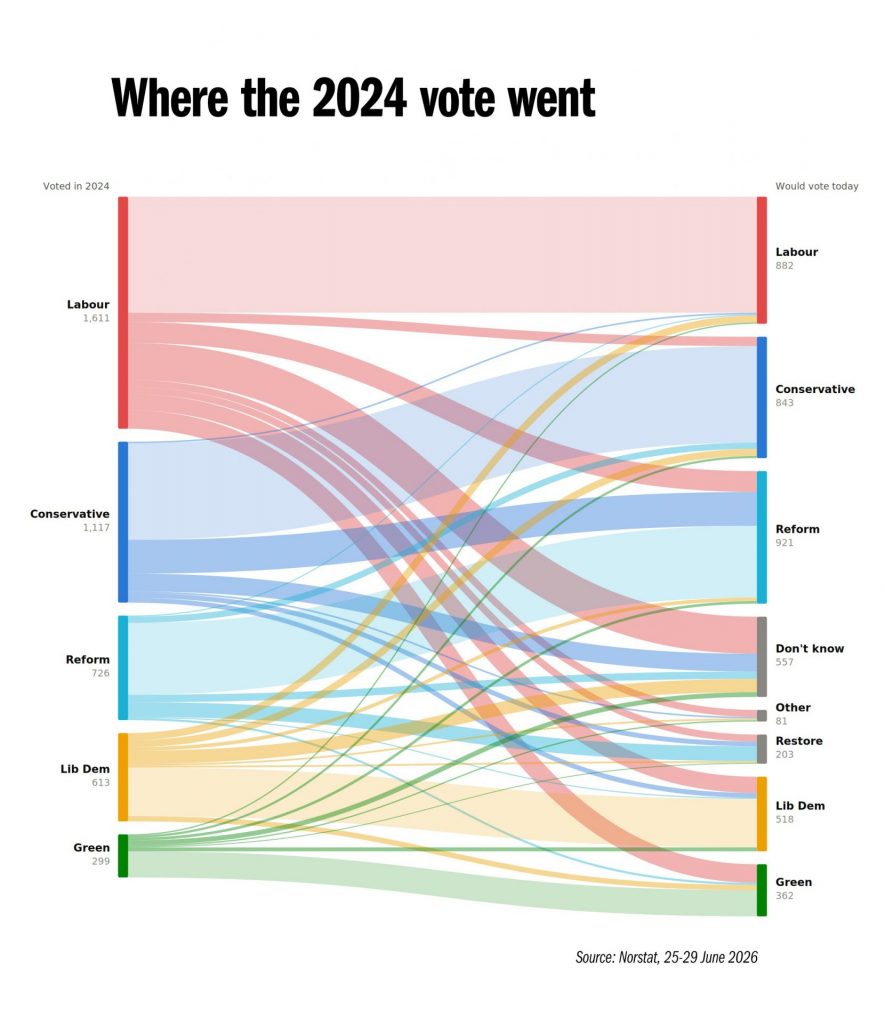
Calculating voting intention in the normal way, excluding “don’t knows”, Reform are currently on 24%, Labour and Conservative 21%, Liberal Democrat 15%, Green 10%, Restore 5%. (Given the demographic balance of the sample, my guess is that these figures probably overstate Labour and Conservative by 1-2 points and understate the Greens by 2-3 points.)
But the central fact is the degree of churn. Reform’s 2024 voters are the most loyal: 68% would stay with the party – but Farage has still lost 32% to other parties, or to “don’t know”. At the other end of the scale, Labour’s voters divide evenly between loyalists and defectors. Voters are footloose to a remarkable degree.
One of the controversies of recent months has been the destination of voters leaving Labour. In February, I reported that the proportion of Labour voters switching to the Greens varied from 9% (More in Common) to 27% (Find Out Now). The 18-point gulf was remarkable. The lessons to be drawn by the parties, and Labour in particular, are very different depending on which figure is closer to the truth.
Nortstat put the figure at 8%, a figure that includes “don’t knows” – if you strip them out, the figure rises to 10%. If we allow for the under-representation of younger voters in Norstat’s sample, my estimate is that the figure for Labour converts to the Greens rises further, to 12-14%.
Whichever way you look at it, Labour’s losses to the Greens look serious and Burnham can’t win the next election without persuading the majority of them to return. But the figures are not as catastrophic as the higher estimates suggested.

Left versus Right
Another way of looking at voter volatility is to count how many people have crossed the left-right divide since 2024 and how many have stayed put. The figures are striking. A significant minority of “left” voters from 2024 have switched to the right (13% of those who voted Labour, Lib Dem or Green), while only 4% of Conservative and Reform voters have moved to the left.
The problem for the Tories and Reform is not the number of their supporters who have moved left, but the number who’ve gone even further to the right: Tories to Reform, and Reform to Restore.
The overall effect is that the electorate has moved right since 2024. In the general election, 54% voted Labour, Lib Dem or Green, while 39% voted Conservative or Reform. Omitting “don’t knows”, the current figures are: left 46%, right (including Restore) 50%.
Which means since the last election, a 15-point lead for the left has given way to a four-point lead for the right. This represents a swing of 9.5% – large but not unusual in mid-term. It’s the movements within both left and right that are exceptional.
Last year, the swing to the right enabled Reform to capture Runcorn and Helsby from Labour. Burnham’s achievement in Makerfield was two-fold. First, he prevented a swing to the right – the left-right balance was 56-43% both two years ago and last month.
Second, Burnham almost completely monopolised the left-of-centre vote, gaining ten percentage points since 2024, while the combined Green and Lib Dem vote collapsed by ten points, from 11% to 1%.
Burnham’s strategic challenge is to repeat nationally what he achieved in Makerfield: to attract Green and Lib Dem sympathisers in Labour’s target seats, while also winning back the voters Labour has lost to the Right, mainly Reform. Labour can survive as a major force in British politics by achieving one of those objectives, but to remain in office, it needs both.
Tactical voting
At the last general election, many constituencies were two-horse races – typically either Conservative-Labour or Conservative-Lib Dem. Next time, with the rise of Reform, there will be more combinations – just like Makerfield – and so the importance of tactical voting will increase. So, confronted with two horse races, how will voters react?
In a straight Conservative versus Labour vote, with no other options available, Nortstat found that the Tories get 39% and Labour 34%. In this head-to-head contest, the Conservatives are helped by the fact that 68% of Reform voters favour the Tories, while only 4% do not. In contrast, support for Labour is less among Green supporters (57%) and much less among Lib Dems (23%).
When people are asked who they’d vote for in a Labour versus Reform race, the results are Labour 40%, Reform 34%. With no Lib Dem option available, 58% of Lib Dems switch to Labour, as do 69% of Greens. But only 30% of Conservative voters opt for Reform.
In a Conservative versus Reform two-way race, overall, the result was Conservative 41%, Reform 25%. Half of Lib Dem voters switched to Conservative, as did 37% of Greens and 38% of Labour voters.
If the Conservatives are set up against the Lib Dems, the overall result is Conservative 36%, Lib Dem 37%. Of Labour voters, 62% opt for the Lib Dems, as do 62% of Greens, while 57% of Reform voters go Tory.
These figures are bad news for Reform and good news for the Tories and Lib Dems. For Labour, the picture is mixed. The Conservatives can expect large numbers of Labour, Lib Dem and Green supporters to help them defeat Reform through tactical voting. The other contests see tactical shifts in both directions.
As for Burnham, he managed to win over almost all Green and Lib Dem voters in Makerfield. He needs to repeat that tactical triumph in all Lab-Con and Lab-Reform contests. But at present, many Lib Dem supporters who are keen to help Labour defeat Reform are more reluctant to help Labour fend off the Tories.

Sensible or dangerous?
Increasingly, politicians accuse their opponents of being not simply wrong but dangerous. The accusation doesn‘t always work. In 1997, Tory ads ran the slogan “New Labour, New Danger” under a picture of Tony Blair. Much good did it do them.
Reform could be more vulnerable. As many as 60% think Farage’s ideas are dangerous. When asked about Burnham and Badenoch, almost as many people say “sensible” as “dangerous”. Starmer’s reputation is bad, but not as bad as Farage’s.
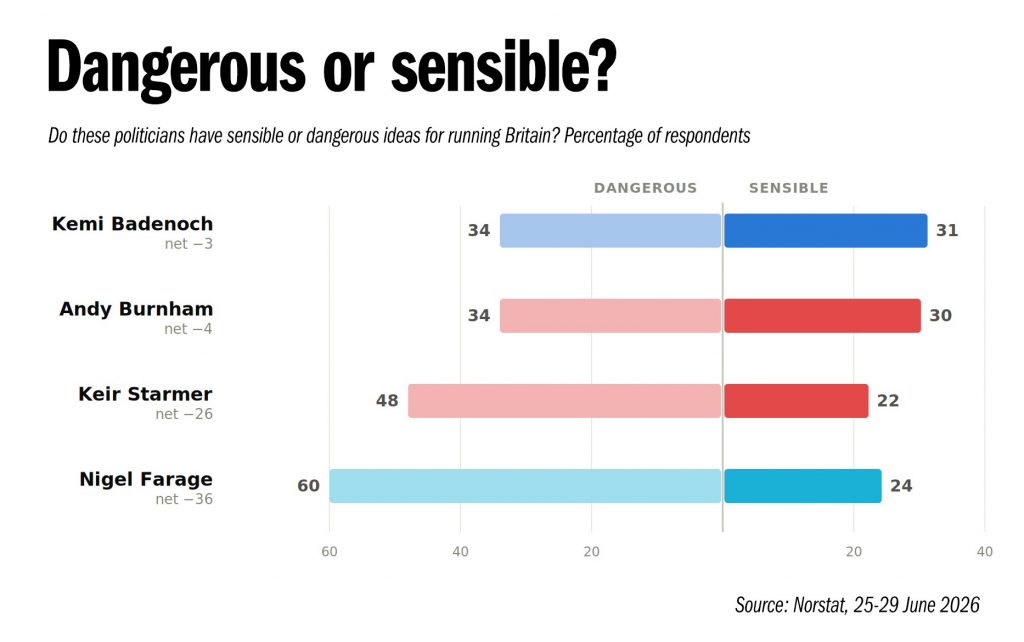
What is striking is the reason for Farage’s bad rating. While Reform voters are loyal towards him, as are Labour and Tory loyalists towards Burnham and Badenoch, he scores badly with everyone else. In particular, only 16% of Reform voters think Badenoch is dangerous, but as many as 51% of Conservatives think Farage is dangerous.
This helps to explain why widespread tactical voting could damage Reform, while helping Labour. Among left-of-centre voters, Burnham is seen as dangerous by just 15% of Lib Dems and 16% of Greens.
Do they have the character to govern Britain?
The poll also tested voters’ other views of the characters of the four politicians. Are they competent? On my side? Strong? Truthful? The table shows their net ratings on the four qualities.
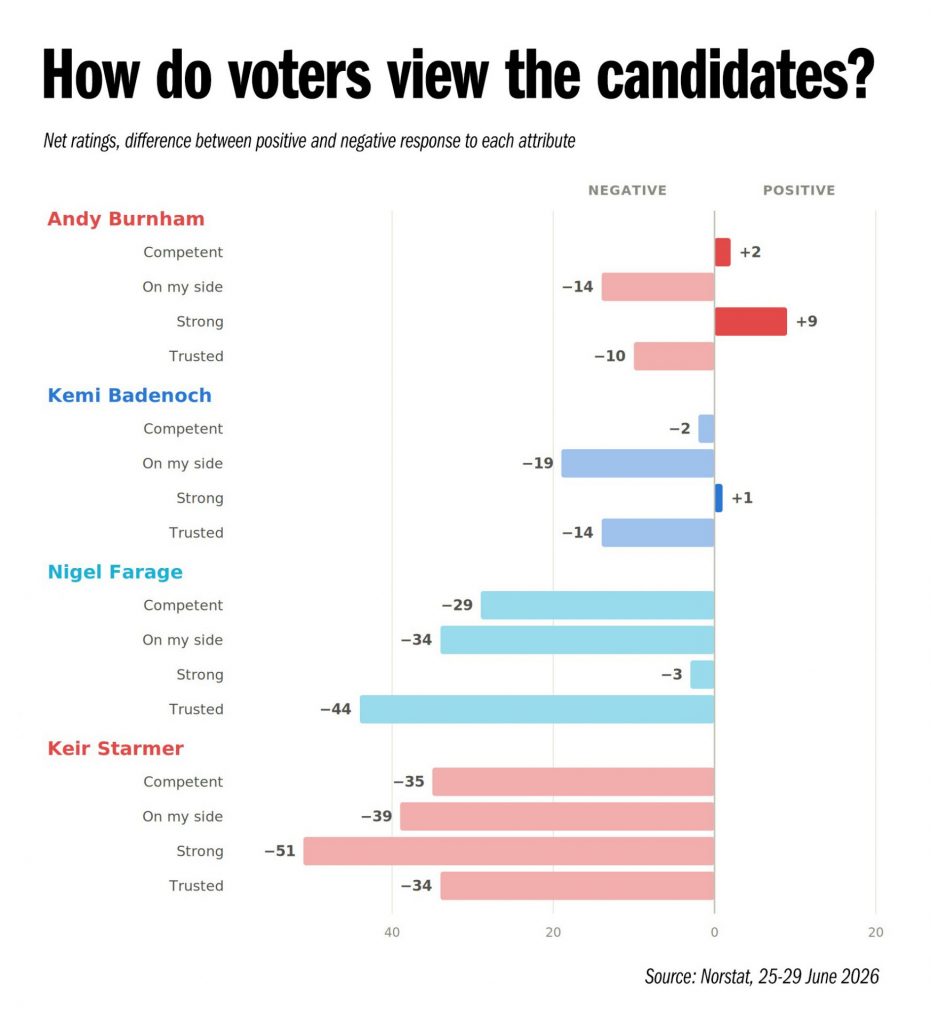
Burnham has the best scores on all qualities, with Badenoch not far behind – though none of the politicians win high marks for being truthful or “on my side”. Starmer comes last on three of the four qualities; Farage has the worst reputation for telling the truth.
This suggests that Farage is in trouble. Voters are evenly divided on whether he is strong or weak, but he lags far behind Burnham and Badenoch on the other three qualities. Once Starmer leaves the stage, Farage is destined to be the least popular of the leaders of the top three parties.
The survey was conducted before the latest stories about Farage’s money, and media speculation that his glory days are over. What Norstat’s figures show is that he did not have an unblemished reputation even before these stories. He was already vulnerable to the charges that he was untrustworthy, incompetent and not on the voters’ side.
Even so, Burnham will have work to do if he is to reconstruct an election-winning coalition of voters. Many voters have not made up their minds about him.
He has a big opportunity but also faces a severe test: to tackle the greatest weaknesses of Starmer’s premiership – and to demonstrate to voters that he is honest, competent and on their side.
Peter Kellner is the former president of YouGov