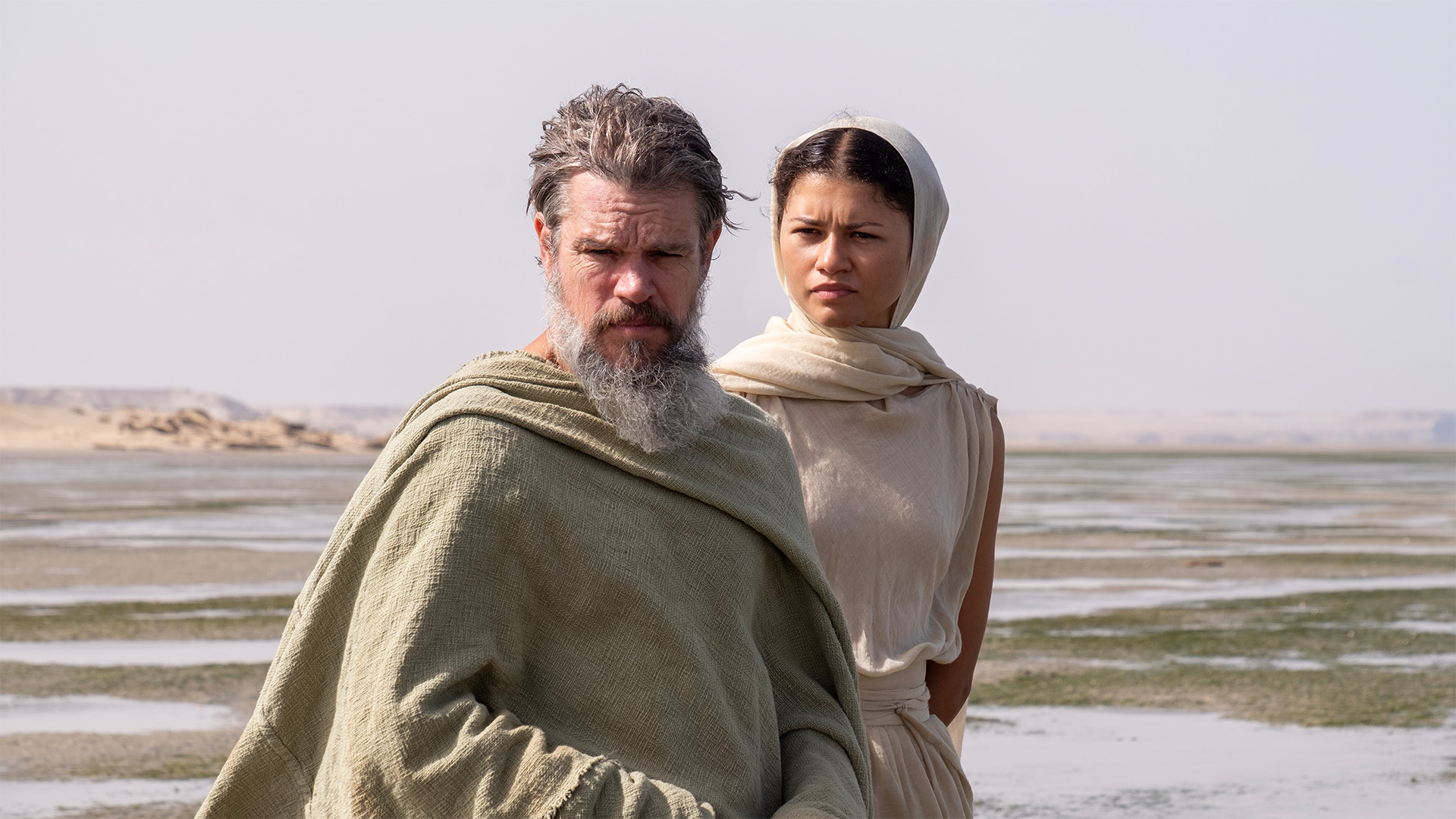
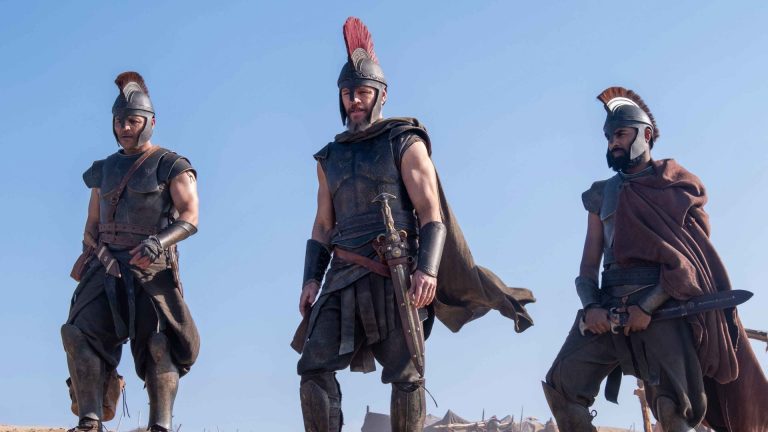
With a sleight of hand that says much about what is to follow, Christopher Nolan’s astounding movie opens with a scene drawn not from Homer’s epic, but the second book of Virgil’s Aeneid. On a shore blasted by a decade of war, the Greek soldier Sinon (Elliot Page), apparently deserted by his comrades, tries desperately to persuade the Trojan warriors that the monumental horse rearing up from the sand is a peace offering.
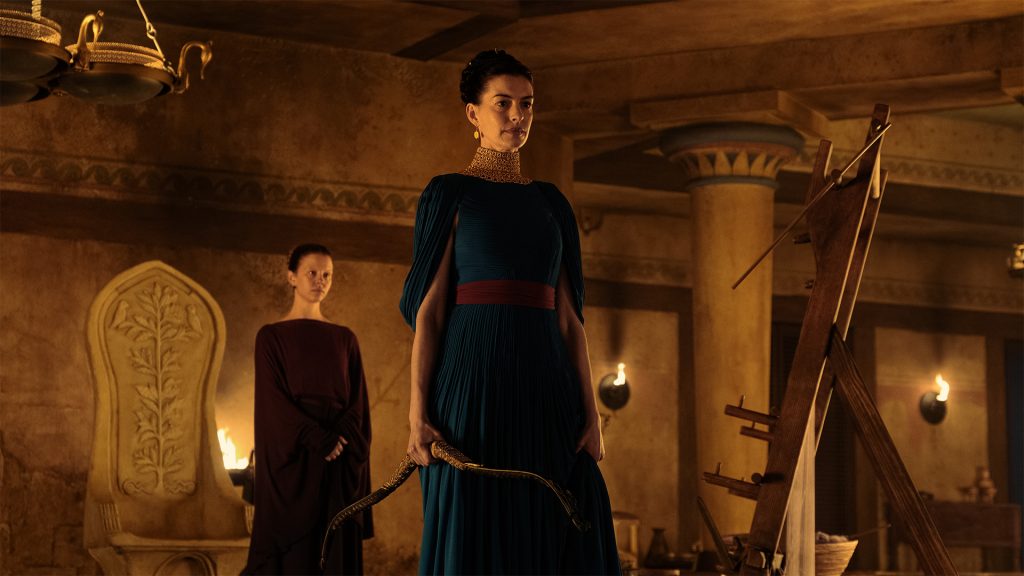
The story of the most famous military stratagem of them all is recounted by a bard (Travis Scott) at the palace of the absent king of Ithaca, Odysseus (Matt Damon), to a hall full of rowdy men – “suitors” to his queen, Penelope (Anne Hathaway), who hope that, after so long, she will give him up for dead and choose one of them as her new husband. Leading the pack is the cruel and covetous Antinous (Robert Pattinson), who mocks the faith of Telemachus (Tom Holland) that his father will soon return.
Instead, she calls a halt to the tale. It is not the story of Odysseus that she wants but Odysseus himself; to which end, her son slips away to Sparta in search of guidance from Menelaus (Jon Bernthal) and his queen, Helen (Lupita Nyong’o) – who does not conceal her fury at the terrible saga in which she has been embroiled and from which she bears the scars. This, Menelaus tells Telemachus, is “the face that launched a thousand ships”: again, a line taken not from Homer, but Christopher Marlowe’s Doctor Faustus (c.1592).
Thirteen movies in, we have grown accustomed to Nolan’s non-linear plotlines, time skips, and nested narratives. But Jennifer Lame’s editing takes this trademark aesthetic to new levels of hallucinatory precision: the jump cuts from, say, a sweeping ocean panorama to the close-up of an ageing face, suggest a profound and troubled subjectivity; a collective memory, embedded in myth, competing with the disjointed recollections of an individual in deep psychic distress.
I was struck, more than anything, by the sheer weirdness of this vision, by the audacity of Hoyte van Hoytema’s stunning cinematography and of Ludwig Göransson’s ambient and percussive score, and by the movie’s absolute indifference to the conventional Hollywood playbook. The membrane between the natural and the supernatural is always porous, matched by a compulsive oscillation between gruelling realism and otherworldly enchantment.
Suggested Reading

The Odyssey and our summer of myth
Intermittently at Odysseus’s side is Athena (Zendaya). “Why can’t gods speak in ways we understand?” he asks. “Who doesn’t understand thunder? Fire? A child’s smile? A good harvest?” she replies. In Nolan’s cosmology, the deities are everywhere – Odysseus spends seven years on the island of the nymph Calypso (Charlize Theron), daughter of Atlas – but it is men who seal their own fate by the moral choices that they make. “We can’t live by omens and sacrifices,” he tells his crew. “The gods help those who help themselves.”
Within this complex and volatile structure – an odyssey through the labyrinth of one man’s mind as much as a trek across the empty prairies of time and space – the director embeds a sequence of astonishing scenes from the journey back to Ithaca. In a gloomy cave, Odysseus and his men encounter the towering Cyclops, Polyphemus (Bill Irwin), who feasts upon them with terrifying nonchalance: the most powerful reimagining of the one-eyed monster since JMW Turner’s Ulysses Deriding Polyphemus (1829), which now hangs in the National Gallery.
On the island of Aeaea, the surviving crew members led by Eurylochus (Himesh Patel) go ahead of Odysseus and are fed by the goddess-witch Circe (Samantha Morton, Oscar-worthy). “Too much is never enough!” she rages, as they are transformed into pigs in a spectacle reminiscent of John Landis’s An American Werewolf in London (1981) – a movie which Nolan has cited as an influence, alongside Tarkovsky’s Andrei Rublev (1966), Kurosawa’s Ran (1985) and Scorsese’s The Last Temptation of Christ (1988).
Most powerfully, when Odysseus is lashed to the mast – insistent that he should hear the song of the Sirens which the others drown out with ears full of wax – we witness a soul in purgatorial torment, torn to pieces by the weight of history and the burden of shame. Damon has never been better in his portrayal of practised leadership underpinned by psychological collapse.
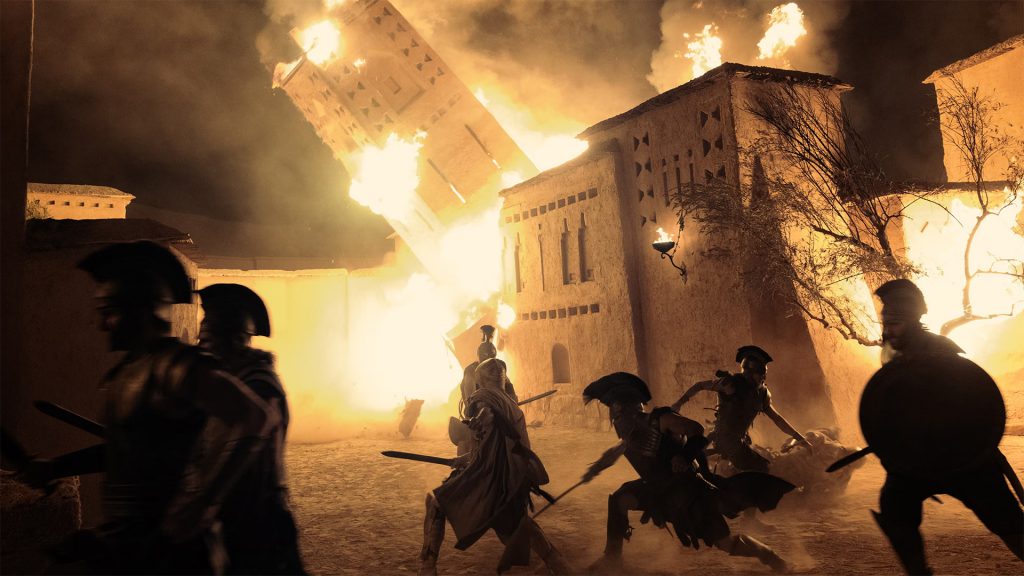
Why does he suffer? Because, in Nolan’s conception of Homer’s world, the sack of Troy represents Original Sin: a deceit that tramples upon “Zeus’s Law” (xenia), the system of order, hospitality and decent reciprocity to which the characters refer throughout the movie. As Penelope warns Telemachus, it is this that is collapsing at Ithaca in his father’s absence: “The structure is nothing without respect for its meaning.”
Yet it is her own husband, as mastermind of the horse, who has most egregiously vandalised this sacred code of meaning and trust. “You lied to everyone,” says Sinon, rising from the ashen ground in Hades. “We violated all that’s sacred between people and turned a fight into a hunt,” Odysseus admits. “To burn the walls of Troy is to burn the world entire.”
Which means that the gods, monsters and elements are not the only forces delaying his return.
“You weren’t ready to go home,” says Calypso. Not until he believes that he might redeem himself, after 20 years, can the timeworn king confront what he left behind and what is most dear to him. Deeper even than the catastrophe of total war is the apocalypse of the corrupted self.
As high as my hopes were for The Odyssey, I was not prepared for the grand Spenglerian vision of civilisational decay and cycles of human wisdom and forgetting with which Nolan has invested it. Yes, he is without doubt the David Lean of his generation, the master of the epic form, the IMAX magus. But he is also the greatest living filmmaker; and this is his masterwork.
THEATRE
The Oresteia (Bridge Theatre, London, until September 19)
Meanwhile, in other mythological drama news: Simon Stone’s radically modernised reworking of Aeschylus’ classic trilogy (Agamemnon, The Libation Bearers, The Eumenides), first performed in Athens in 458 BC, is recklessly innovative, horrific, often hilarious, and absolutely compelling.
To be fair to the Australian director and writer – whose reinterpretation of Ibsen’s The Lady from the Sea was a highlight of the Bridge’s slate last year – he is explicit that his own play is eclectically inspired by “Aeschylus & Others” and is certainly much more than a Periclean drama in modern dress.
Instead of the House of Atreus, we have the House of Middleton, and rural Kent between 2016 and 2026 in place of Bronze Age Argos. Stone’s version of Agamemnon is Christopher (David Morrissey), who runs a shady defence business, Middletech, with his brother Melville (Lloyd Hutchinson) – occupying the Menelaus role and complaining pointedly about the departure of his ex-wife, Helen.
Mary-Louise Parker is Christopher’s American wife Montie – a formidably sarcastic Clytemnestra – who is devoted to her activist daughter Isabel; off-stage for most of the three acts, a modern-day Iphigenia who spends her 21st birthday breaking into her father’s business premises. Her twin Alice (Rosie Sheehy as the play’s Electra) lives in Isabel’s shadow, is adored by Christopher but feels her mother’s emotional distance keenly.
Their younger brother Augie (Tom Glynn-Carney) is counterpart to Orestes, while Jerome (John Macmillan) broadly mirrors Aegisthus, cousin to Agamemnon, lover of Clytemnestra and her co-conspirator in the revenge that initiates the saga of intra-familial bloodshed and tragedy. Jerome’s son, Lorenzo (Archie Madekwe) is the voice of compassion, a one-man Greek chorus amid the primal violence.
As in past productions, Stone traps his characters in a glass cube that rotates onstage: a triumph of design by Lizzie Clachan which turns a chic mansion into a nightmare drawn from the lithographs of MC Escher.
Whereas Aeschylus sought, across three plays, to chronicle the transition from a system of familial retribution to the beginnings of public justice, Stone zeroes in on the psychological cost of the dynastic curse, especially to Augie who serves in Afghanistan and then returns, the demons of kinship compounded by PTSD.
Morrissey and Parker are superb – it is Montie who speaks to the play’s heart when she rages that “men keep killing” and “women forgive them” – but Glynn-Carney is nothing short of extraordinary as the primary load-bearer of the family’s horror, his psyche splintering into a million pieces as we watch.
Far from betraying its ancient source material, Stone shows how limitless is myth’s radioactive ore and its adaptive power. A remarkable and utterly distinctive counterpart to Nolan’s movie.
STREAMING
The Westies (MGM+)
How can one not instantly like a series with an opening credits sequence set to the Dropkick Murphys’ Dropped on My Head? JK Simmons is terrific as Eamon Sweeney, an Irish American crime boss in early 1980s New York who wants to hit the big time in collaboration with the Gambino family.
In Hell’s Kitchen – Sweeney’s home turf – the construction of the Javits Center promises unprecedented opportunities for graft. But this involves keeping the peace with rising underboss John Gotti (Hamish Allan-Headley), Sweeney’s main point of contact with capofamiglia Paul Castellano (Ron Lea).
It also means restraining his own wild crew of button men, who start the day with beers bought from a bodega at 5am – “breakfast of champions” – and take it from there, brawling, singing, and bellowing “Sláinte!” as often as possible.
For a start – as Sweeney keeps telling them – they have to stop kidnapping made mafia men. So, in the very first of eight episodes, he makes an example of one of his own wayward boys. “I loved Davey too, I did,” he says. “But he had to go.” With icy decorum, he turns up at the wake, sharply dressed and full of Gaelic charm, as if it is the most natural thing in the world.
His most promising protégé is Jimmy Roarke (Tom Brittney), who has his own work cut out keeping a lid on best friend Mickey Flanagan (Stanley Morgan), a Vietnam veteran recently released from Bellevue Hospital but still seriously unstable and hallucinating (“Are they stealing your thoughts?”)
In this respect, The Westies – inspired by a real-life New York crew, headed by the legendary Mickey Spillane (not the crime writer) – is like Scorsese’s Mean Streets (1973) reimagined by The Pogues. It also pays homage to Goodfellas (1990), Peaky Blinders (check out the slouch caps) and even, in one set piece road trip to Jersey, Trainspotting (1996).
While Jimmy faces divided loyalties, the past catches up with his girlfriend Bridget Walsh (Sarah Bolger), an IRA fugitive, when her former lover Brendan Cahill (Allen Leech) turns up in New York and asks her to store a fearsome weapon.
Titus Welliver is compellingly weary and gone-to-seed as the cop in Sweeney’s pocket, Glenn Keenan, who is reluctantly recruited to an FBI Gambino task force by agent Birdie Polk (Jessica Frances Dukes) As the plot thickens, the great Richard Schiff – recently seen on stage at the Hampstead Theatre as Niels Bohr – is introduced as a money launderer. Cocaine-dealing Colombians get stuck in, too.
Given that showrunner Chris Brancato (working on this occasion with Michael Panes) was a co-creator of Godfather of Harlem (2019-), one of the most under-rated crime series of recent decades, it should be no surprise that The Westies works as well as it does – and certainly deserves a second season.
BOOKS
American Trickster: The Hidden Lives of Carlos Castaneda, by Ru Marshall
Long before ayahuasca holidays for tech bros, digital shamanism, sage-smudging, Gwyneth Paltrow-endorsed woo, and the sinister rise of “conspirituality”, there was Carlos Castaneda (1925-98). A Peruvian-born anthropology grad student at UCLA, he transformed himself from an academic researcher into the best-selling author of psychedelic spiritualist books and, in due course, a frighteningly powerful cult leader.
As Ru Marshall’s remarkable biography shows, Castaneda was a keen observer of the earlier transcendental pursuits of Aldous Huxley, the Beats and Timothy Leary. His particular intuition, however, was specific to time and place: the widespread disillusionment with authority, hierarchy and conformity in America after Vietnam and, later on, Watergate.
In The Teachings of Don Juan: A Yaqui Way of Knowledge (1968), he recounted his alleged encounters in Mexico with an indigenous sorcerer, experiments with psychedelic drugs and shapeshifting into a bird.
As Marshall writes: “It was all a hoax, a trick.” Yet the book and its sequels sold at least ten million copies and made a star of Castaneda, admired by Federico Fellini, John Lennon, Joni Mitchell and Oliver Stone (“I was very influenced by Castaneda. That magic.”) Only the novelist Joyce Carol Oates dared to call out his conspicuous fraudulence, declaring in a letter to the New York Times in 1972 that she “would be very interested in whether other readers share my bewilderment.”
“If Oates’s letter caused concern,” Marshall notes, “Carlos didn’t show it.” And it is at this moment that the biography soars and shows how Castaneda was truly a forerunner of 21st-century post truth, cultism and political fantasy. The acclaimed guru’s response was not contrition but to rebrand himself as “a sorcerer” and double down on his status as a pseudo-spiritual leader, psychologically manipulating his followers – “witches”, “winds”, “cyclic beings” – and sexually exploiting his female acolytes with depraved abandon.
The indifference to scrutiny was the point; the impunity was the point. In 1998, Castaneda died of liver cancer in Westwood, LA, and is mostly forgotten today. But he was a founding father of the cult movements of our own century – NXIVM, OneTaste, the Zizians – and, in his shameless contempt for facts, decency and accountability, of MAGA itself.