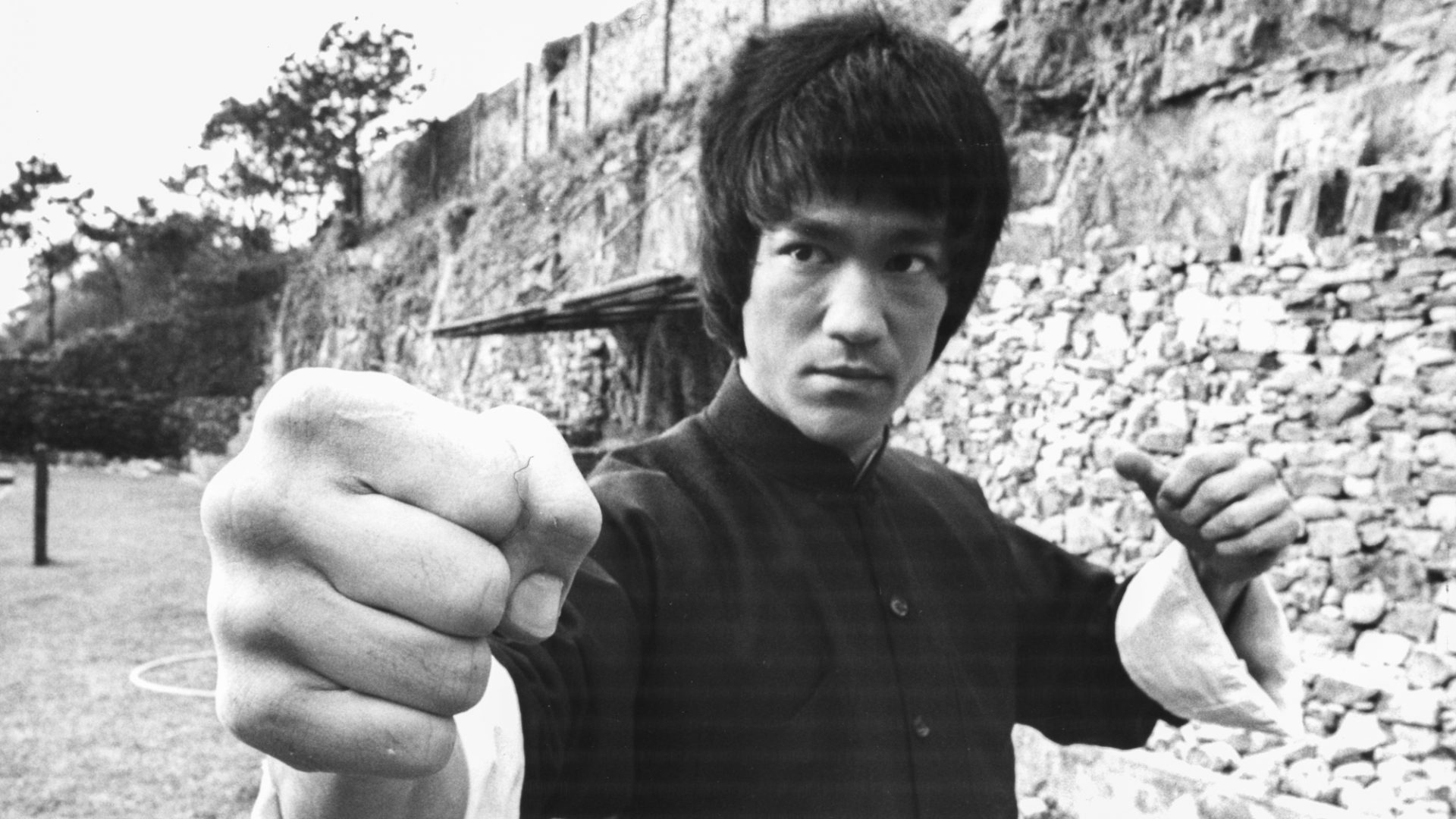
November 27, 1940 – July 20, 1973
It’s all in his notebooks. He almost always has one with him – small pads with the rings across the top, bound memo books that slip easily into the pocket, fancier journals for reflecting at the end of the day.
When 18-year-old Lee Jun-fan wins the 1958 Hong Kong Crown Colony Cha-Cha Dance Championship, it is partly because he has meticulously written down and memorised over 100 dance steps in one of the little books, all written in his small, neat hand.
When in 1961 he moves from Hong Kong to Seattle to start a new life in America, he leaves behind not just a career as a child actor (his first film appearance was at three months old, alongside his local celebrity father, Lee Hoi-Chuen) but also a dangerous interest in street fighting, using the martial-arts skills he has learned. He takes the notebooks, having written down the name and address of a family friend he can stay with, alongside his own creeds for success. One says: “Be a calm beholder of what is happening around you.”
In America, he studies acting at university, meditates by Lake Washington, opens his own kung fu studio. He dreams and schemes of expanding the studios as a franchise across America, his own kung fu empire, and those he teaches come to include Steve McQueen and Chuck Norris, whose names and phone numbers go into the notebooks. He adopts the name Bruce Lee.
Producer William Dozier, the man who had recently brought Batman to the screen, sees him giving a talk on the philosophy of fighting at a karate tournament and casts him as Kato in 1966’s The Green Hornet, a new action-packed series that introduces the western world to kung fu. Reviews of the show are mixed, but with one common consensus: there is something about Bruce Lee.
Hollywood, though, is no place for an Asian actor with dreams of being a leading man. The show is cancelled after a single series and Lee, now married with two children, has to make money with personal appearances across the country as Kato, opening up supermarkets and appearing at martial-arts demonstrations.
His ambition, and his interest in philosophies of both east and west, remain undimmed. He resolves to “be like water” – to embrace detachment, rid yourself of rigid dogma, to flow around your circumstances.
He is also big on focusing the will as a means to achieve change, and writes in his notebook: “I realise the DOMINATING THOUGHTS of my mind will eventually reproduce themselves in outward, physical action, and gradually transform themselves into physical reality”.
Suggested Reading
The night New York discovered Frida Kahlo
The goal he sets himself in January 1969 is bold and simple: “I, Bruce Lee, will be the first highest-paid oriental superstar in the United States. In return I will give the most exciting performances and render the best quality in the capacity of an actor. Starting 1970 I will achieve for fame and from then onward till the end of 1980 I will have in my possession $10,000,000. I will live the way I please and achieve inner harmony and happiness.”
On the back of one of his old business cards, he writes the words “Walk On!”, using this as a constant reminder of the need to keep moving forward.
The career for which most of us know Bruce Lee really begins in 1971. Having missed out on the TV series Kung Fu (David Carradine, neither Asian nor a martial artist, was cast instead) but training harder than ever, he returns to Hong Kong for The Big Boss. The audience love its compelling revenge story and the realism of its fight scenes.
The pages of his notebooks are now filling up with story structures, symbolism and character arcs. He stars in Fists of Fury and directs its fight sequences. Then, growing in confidence and believing he knows exactly how a martial-arts film should look on screen, he writes, directs, produces and stars in Way of the Dragon. Having full creative control means he can present his character, Tang Lung, as a funny, charismatic, three-dimensional lead.
Enter the Dragon is even better, even more geared towards an international audience. Made for the modern equivalent of $6m, it takes in what now would be $2bn. But part of that is because, six days before its premiere, Bruce Lee is dead; the victim of a swelling on the brain caused by an adverse reaction to a painkilling sedative.
His notebooks are still with his family, full of phone numbers, workout routines and philosophical meditations, all in his meticulously neat handwriting. “Absorb what is useful, discard what is not, add what is uniquely your own,” says one entry, from a man who imagined himself on the top of the world and then – all too briefly – made it there.