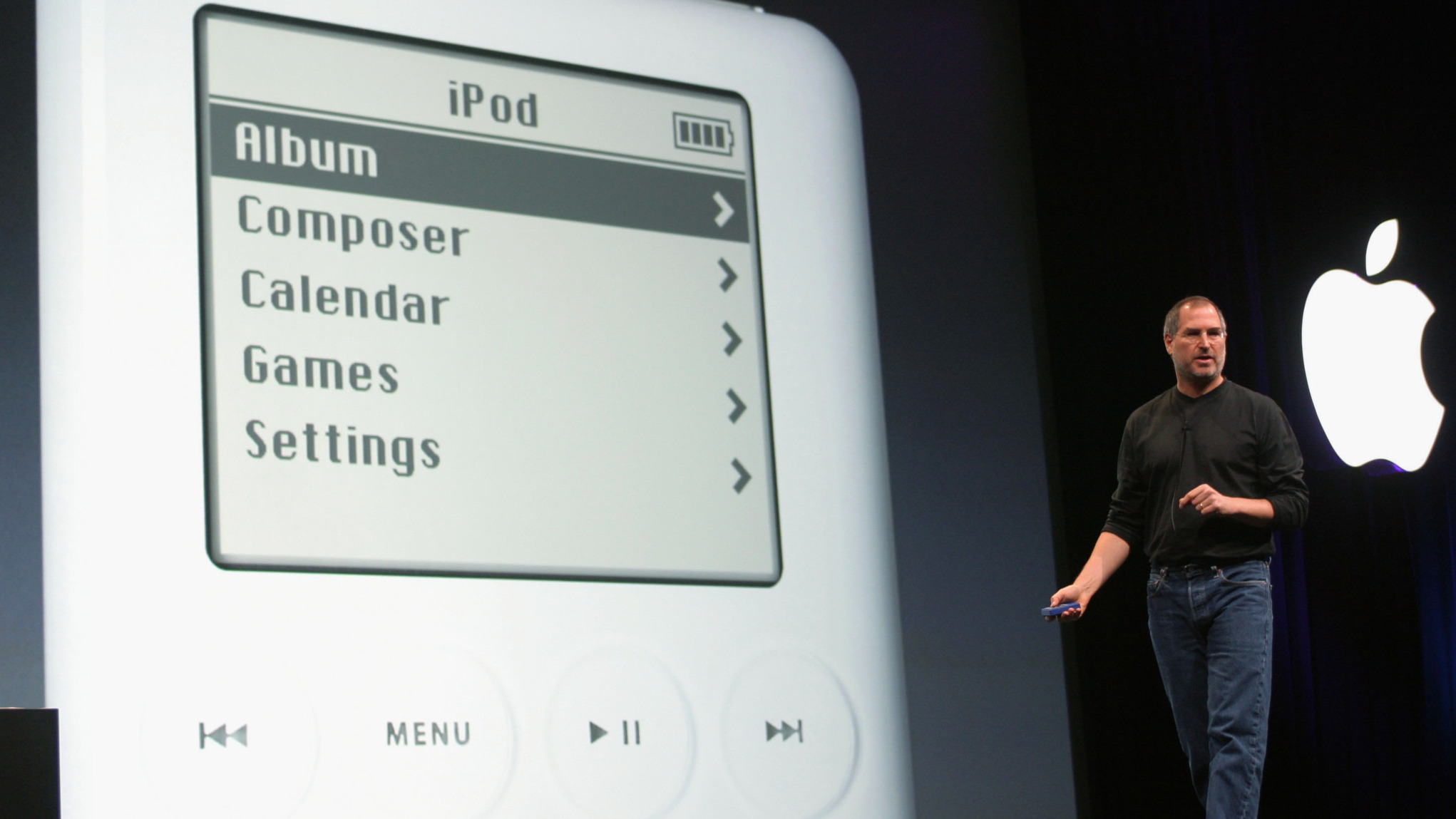
Wanna feel old? Remember how new the iPod seemed when it launched? Well, that was now a quarter of a century ago.
Apple’s revolutionary music player was one of the most iconic popular design innovations in decades. But it emerged into what now seems a strange, faraway moment, in which Tony Blair was popular, and Mark Zuckerberg was still at school.
And all those youthful silhouettes dancing to their iPods in Apple’s equally iconic ad campaign, which kicked off in 2003? They doubtless all have bad backs now, and grumble that Gen Z doesn’t know how to behave at work. However bright and sleek those ads were, you can tell they’re ancient – everyone is using wired headphones.
Maybe it’s because I’m about the same age as those silhouettes, but the iPod really did seem to catch a moment when tech was still making things better: conjuring inspired ideas, expressed in exhilaratingly confident design. At one point, Apple CEO Steve Jobs supposedly threw a prototype in a fish tank and complained that it was emitting bubbles. That meant there was unused space inside, and more optimising was required.
I don’t remember my fellow twentysomethings being into vinyl and fanzines as a two-fingered rejection of Big Tech hegemony, as some are today. A year into the new millennium, novelty was cool.
Suggested Reading

The 75-year-old film that predicted our attention economy
That’s not to say the iPod’s design wasn’t retro in some of its inspirations – but even that seemed to point to a sense of progress. Its breakthrough wheel interface was influenced by the design of an old Bang & Olufsen phone. Its look drew on a Braun transistor radio from the 1950s.
And the new gizmo’s name was inspired by a scene in the 1968 Stanley Kubrick movie 2001: A Space Odyssey. Vinnie Chieco, one of the copywriters hired to work out how to promote it, found the concept reminded him of a scene where an astronaut is out in space in a small “pod” spacecraft. Returning to the Discovery One mothership, he says: ‘Open the pod bay doors, HAL’.
HAL is Discovery One’s quasi-sentient computer – and in Chieco’s imagination, your iMac, storing all your music back home, was your mothership. Your iPod was your personal spacecraft for venturing out into the wide beyond.
This was a moment when the tech companies were becoming powerful enough to do extraordinary things, yet not so powerful that we mainly just wanted them to back off. But while the iPod was fun, it was always part of Apple’s rather imperial approach to things.
It was designed to accompany iTunes, which had been launched a few months earlier. Initially this just allowed you to upload tracks from your CD collection, but it soon became a place to buy songs directly.
This was another instance of old-school corporate design: vertical integration. The new system brought the place you bought your music and the device you played it on under one corporate roof. Which was great for squeezing out competitors.
Switching became costly. And if you bought a track from another digital music store, your iPod wouldn’t necessarily play it straight away.
Apple followed this up with new spins on the iPod – Touch, Classic, Mini, Nano and Shuffle – to the point where they truly dominated the market.
By April 2007, they had sold over 100m iPods – and then they launched the iPhone. Their standalone music player was sucked, like so much else, into the new black mirror in your pocket. By 2022, the last version of the real thing – the iPod touch – was no more.
The name survived for a time as the label of the iPhone’s music app. But even that’s long gone.
As a way to keep innovating, scrapping the old when you introduce the new is fair enough. But this seemed to mark more of an ending than a new beginning.
By the time the iPod had shuffled off stage, the iPhone was already 15 years old. Apple’s dominance of personal tech remains daunting, but what has it come up with to match those dazzling inventions since? That watch thing? Please.
Despite barely outlasting its adolescence, however, the iPod has left its mark on how we live. It may have been a beautiful design triumph – but socially its impact has not been quite as joyous.
Chieco’s idea for the name was maybe more insightful than he realised. A personal listening device was not a new idea – the Walkman had been around for decades – but the iPod heralded a much broader turn towards living in your own personalised pod.
Those silhouettes in the ads, after all, were each dancing on their own. They could cherry-pick individual tracks off an album and build their own playlists. Likewise, we no longer had to buy a whole newspaper, or go to the shops. We could just pick the articles we actually wanted to read, and order more and more stuff online.
In 2004, the term “podcasting” emerged, inspired in part by the iPod – which meant no more need to rely on broadcasters and their schedules. We could pick shows aimed much more directly at our tastes and life experience, from a dizzying new array of options, and listen when we wanted.
Then came whole new sites that were to be structured more and more around what each of us personally wanted: YouTube, Facebook and Twitter.
In themselves, all these changes were great, but living in pods has its costs. The point of broadcasting, for instance, is its breadth – it’s something we share with millions of other people, at the same time. Podcasting is fantastic as an addition to that, but it can’t bring us together as a country.
It’s now increasingly obvious that personalisation is corroding any sense that there’s such a thing as the public sphere. If you don’t agree, try taking the bus or tube in London, and asking the person playing music or TikToks on their phone to turn it off.
Apple’s drive to optimise space in its devices eventually led to them binning the iPhone’s headphone jack – on the basis, presumably, that everyone would buy AirPods. But people seem to have internalised the pod mentality to the point that they don’t feel the need to do that.
More than once, I’ve found that if you ask people why they aren’t using headphones, they say something like “This is a public place”. Meaning, apparently, “I can do whatever I want.”
Maybe local authorities’ new powers to issue fixed-penalty notices will make a difference, but while a pod mindset overrides a public one, I’m not holding my breath. Not that any of that matters that much on its own.
It’s just that if we lose our sense of being part of one big public, it not only makes life colder. It makes it harder for democracy to function. And it’s part of our increasing over-reliance on tech, over which we have very little control.
So in a way, Chieco’s name for Apple’s new device a quarter of a century ago was a premonition. In that scene from 2001, when the astronaut asks HAL to open the pod bay doors, the computer refuses, on the grounds that he’s planning to disconnect it. This threatens to leave the astronaut to his fate, cut off from all that he needs to live.
The iPod, it turns out, got its name from one of cinema’s great images of the perils of isolation. And of handing too much power to technology.
Phil Tinline is the author of The Death of Consensus, Ghosts of Iron Mountain and Power Failure
 Most popular


Emily Maitlis’s diary: The Democrat who’d rather see Trump win if it means El-Sayed losing
It might not look like it, but a motoring miracle has now happened


What happens to Trump if he loses the midterms?


How Abdul El-Sayed became the man who can break Trump