
It’s less than a decade since Netflix was showing a whole series about the Unabomber – aka Ted Kaczynski, the American anti-tech terrorist whose bombings wounded 23 people and killed three more between 1978 and 1995. The site is still offering a four-part documentary called Unabomber: In His Own Words. And over on Apple TV, there’s a 2021 movie called Ted K.
So clearly it’s high time to dramatise the story yet again. Netflix has just started streaming a new movie, imaginatively titled Unabomber.

However wrongly, some political killers are widely glamourised – think of Che Guevara, glowering from a million T-shirts, or the thirsting fans of the CEO assassin Luigi Mangione. But Kaczynski was a quiet Harvard maths prodigy turned troubled, middle-aged recluse.
He lived alone in the woods, supported by money from his family. He was the author of a forbidding, 35,000-word denunciation of modern life called Industrial Society and its Future. He may have had paranoid schizophrenia. Not, then, an especially relatable character.
Yet that 2017 Netflix series about him was reportedly a hit – and now here’s the new film, starring Russell Crowe. So what’s the fascination?
One thing that gives this tale such pull is the backstory the new movie pushes to the fore. Crowe hasn’t been cast as Kaczynski – he’s playing an eminent psychologist, Henry Murray, with whom the boy maths genius had a prolonged, traumatic run-in as a student.
Suggested Reading


Why Netanyahu hates the most powerful film of the year
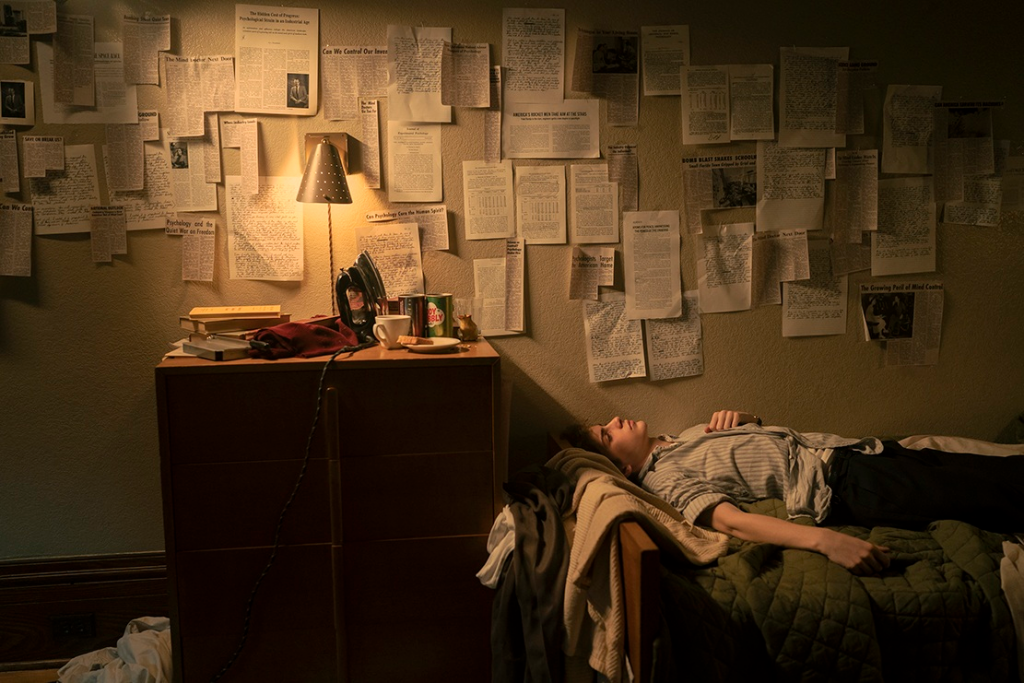
Ted arrived at Harvard in 1958, aged just 16. Over the next three years, he found himself being subjected to Murray’s stress experiments – 200 hours of having his youthful ideas persistently belittled.
As Alston Chase, author of Harvard and the Unabomber, has noted, Murray had worked for America’s wartime intelligence service in developing “a system for testing recruits’ capacity for clandestine warfare”. The experiment Kaczynski endured had roots in that military-oriented work.
In the movie, it is cast as a CIA-commissioned study “to show that all men can be broken”, emulating the way American POWs in the Korean war had supposedly been “reprogrammed” to support communism. But instead of being broken, the young Ted rebels against Murray, reprogramming himself into a calm, hardened ideologue.
Viewed like this, the young scholar’s turn to terror looks like revenge on the sinister power structure of the American cold war, encapsulated by the CIA and its obsession with “mind control”. Yet while Kaczynski did oppose such practices, he denied that his experience with Murray damaged him.
What this version of the story really speaks to is our abiding belief that an individual’s psychology can be twisted out of shape by scary men sitting at tables in low-lit rooms. Kaczynski’s lawyers, doubtless in good faith, seized on this as mitigation. But talk of mind control risks avoiding harder questions about why someone might commit such horrifying crimes.
Kaczynski’s opposition to this kind of manipulation had more to do with his overarching revulsion against the “technological system”, which in his view controlled human behaviour.
The film articulates this briefly, but never really probes its implications. In failing to do so, it misses a trick. Because it’s this theme in the Unabomber story that really resonates today.
Suggested Reading

The return of the 1971 film that saw Trump coming
At the very end, the movie drops a brief audio clip of a prison interview, in which Kaczynski talks about how he has become a “cult figure” to those pursuing “revolutionary activity”. This seems a fair description. Ever since his arrest in 1996, this angry old man’s ideas have attracted a surprisingly wide following – despite his murderous violence.
In Industrial Society and its Future, Kaczynski called for a return to “wild nature”. This caught the notice of the radical end of the environmental movement.
In America’s Pacific west, from the late 1990s on, some of those activists used arson to push back against deforestation. Figures such as the anarcho-primitivist Black Bloc organiser John Zerzan lauded Kaczynski’s ideas.
The co-author of Deep Green Resistance (2011), Derrick Jensen, corresponded with Kaczynski. The book called for industrial civilisation to be dismantled, and led to the founding of an activist network with the same name.
Rather less predictably, the Unabomber’s writing has been praised as prescient in the neoconservative journal First Things and on the Fox News website, as well as by Tucker Carlson. It has been translated by the Greek neo-fascists of Golden Dawn. The neo-Nazi mass murderer Anders Behring Breivik issued a manifesto which lifted text from Kaczynski’s.
The Unabomber himself rejected such right wing supporters. But strikingly, he also dismissed “leftism” as more symptom than cure – incompatible with “human freedom and with the elimination of modern technology”. The Cambridge academic Sean Fleming argues that this is because Kaczynski’s ideas are not, finally, pro-environment – they are specifically anti-tech.
In 1995, he predicted that the “unified system” of modern technology would make us ever more dependent on it – creating a world in which “human work will no longer be necessary”, leaving most people a “burden on the system”. The elite would then “exterminate the mass of humanity”, either directly or by reducing the birth rate.
When he hammered out lines like that on a typewriter in his Montana cabin, the internet was exciting and new. Technophobia seemed backward. One of the books on Kaczynski’s shelves was a dated 1950s polemic called Growing Up Absurd, which suggests that “a man is a fool to work to pay instalments on a useless refrigerator for his wife.”
But amid permanent online surveillance, power-drunk tech bros, mass protests against data centres and the fear AI could wreck everything, Kaczynski’s absolute opposition to technology has made him look, to some, like a prophet. Through the 2010s, as New York magazine reported, “Books and webzines with names like Against Civilization, FeralCulture, Unsettling America, and the Ludd-Kaczynski Institute of Technology have been spreading versions of his message across social-media forums from Reddit to Facebook for at least a decade, some attracting more than 100,000 followers”. Put his name in YouTube and you find popular videos called ‘The Unabomber Tried to Warn You’ and ‘Ted Kaszynski was Right All Along’.
In jail, Kaczynski continued writing, producing another book in 2016 called Anti-Tech Revolution: Why and How. He advocated attacking “vital organs of the system” like the electrical grid and the communications and computer industries.
As Fleming notes, while green activists “almost always target property rather than people”, Kaczynski advocated hurting human beings. His ideas influenced the Mexican anti-tech terror group ITS (Individualidades Tendiendo a lo Salvaje, or Individualists Tending to the Wild), which since 2011 has carried out bombings across Latin America aiming to kill those who advance the “technological system!.
Today, there are signs of increasing anti-tech violence in the United States and Europe. Over the last year, as monitored by the International Centre for Counter-Terrorism, anarchist groups have attacked an Equinix Data Centre in France, and power cables in Berlin. In Rome, a man was arrested “for allegedly preparing acts of terrorism inspired by Theodore Kaczynski”.
Flock AI-enabled surveillance cameras have been vandalised so often it is hurting the company’s finances. OpenAI CEO Sam Altman’s house was firebombed by a man who had previously called for “Luigi-ing” of tech bosses. This was a reference to Mangione, who shot a healthcare CEO dead in Manhattan in 2024 – and who had written about and discussed Kaczynski’s ideas.
Kaczynski was a misanthropic totalist – obsessed with slights against his freedom, and so ludicrously extreme in his rejection of modernity that it led him to maim and murder. The challenge for radical opponents of technology is to find ways to counter it without following him into a wilderness of blood.
Yet the fact that Netflix’s latest version of his story makes little of his ideas makes it less radical than the message emanating from the doom-mongering AI bosses themselves. In their recent warnings that the technology they’re building might destroy humanity, they’re starting to sound a little like their would-be nemesis.
Phil Tinline is the author of Ghosts of Iron Mountain: The Hoax That Duped America and Its Sinister Legacy
 Most popular

Emily Maitlis’s diary: Trump doesn’t fear the AI apocalypse – but he’s terrified about the midterms

The decline of the Daily Mail
If Shabana Mahmood is tough, why is she so slow to crack down on Danny Tommo and the far right?
What the rich and powerful are really saying about AI