The stakes in the 2029 general election are at least now clear: either Labour recovers or we get a Reform government led by Nigel Farage, which does to Britain’s democracy what Trump has done to America’s.
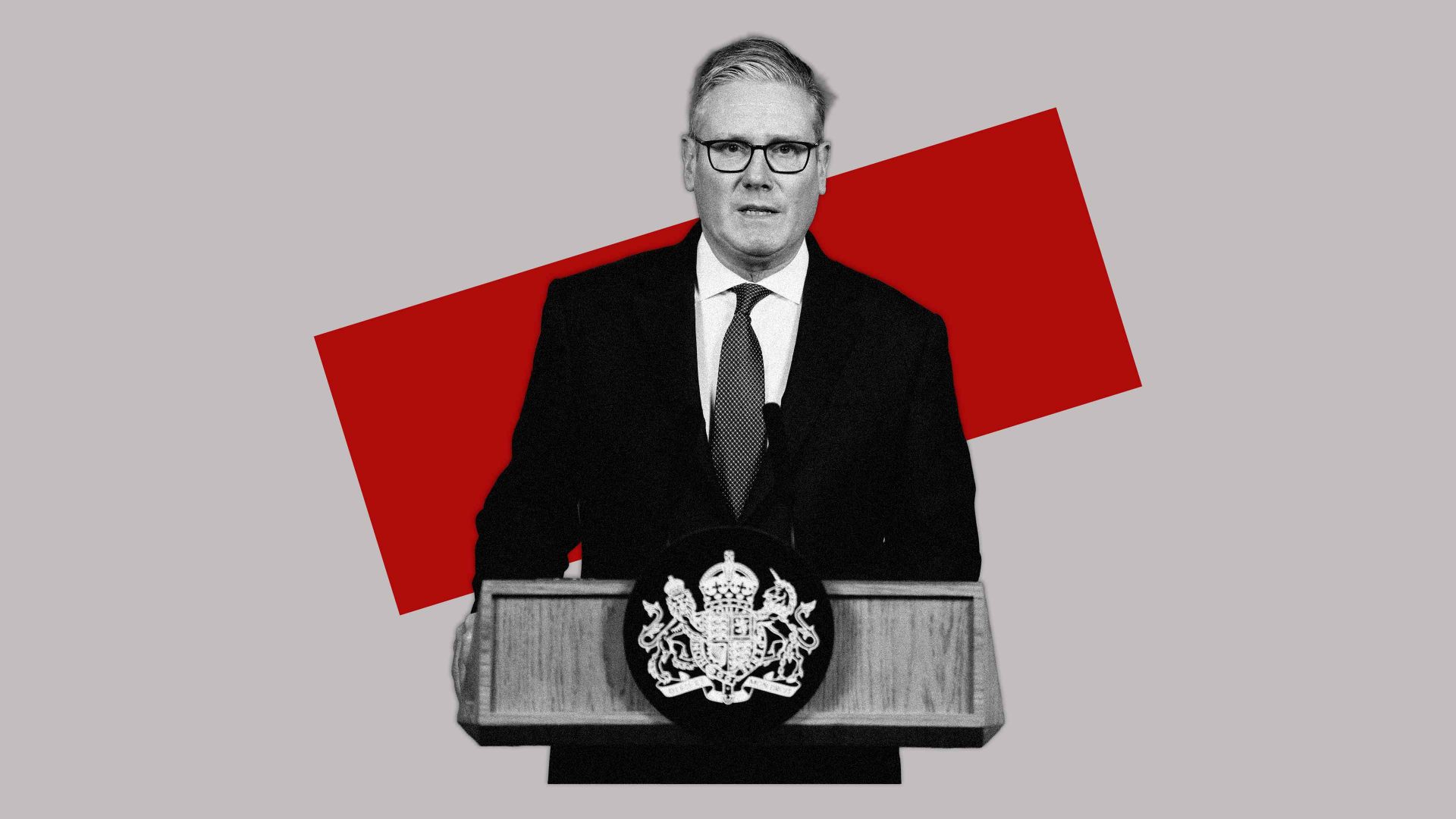
Keir Starmer, fighting for his political survival after Labour lost control of Wales, numerous councils and more than 1,400 council seats last Thursday, came out fighting on Monday. Or what counts as fighting in Starmerworld.
He labelled both Reform and the Greens as dangerous, and distanced Labour from the identitarian conflict they represent. He called for Labour to be a stronger version of itself, backed up with a pledge to nationalise British Steel, seek a youth mobility scheme with Europe, ban foreign fascists from attending a march in London, and seek strategic ties with the EU.
It was a rhetorical step to the left, but there was nothing really new. No acknowledgement that, at their root, Britain’s problems stem not just from Brexit but from decades of privatisation, which leaves rent-seekers and asset strippers in charge of public utilities, charging Britons to the hilt for services like water, energy and transport, while the exchequer starves.
Suggested Reading


A prime minister on the brink
Nor did Starmer acknowledge why his personal brand has become so damaged: from the winter fuel misstep, to the claim that Israel had the right to starve the population of Gaza, to accepting donations to pay for clothing, to the Mandelson scandal and its sibling, the appointment of Matthew Doyle as a Labour peer, he has given those who want to distrust him plenty of ammunition.
As a result, I am not confident that he has done enough to see off the threat of 81 Labour MPs signing up to a leadership challenge.
The soft left’s big demands were well articulated by Angela Rayner and Norwich MP Clive Lewis in the hours before Starmer spoke. Rayner wants Thames Water to be nationalised, “immediate action to cut costs… and put money back into the everyday economy”, an end to the leasehold system in England and Wales and a hike to the minimum wage.
All of which would cost money that Rachel Reeves is unlikely to release, requiring Starmer to override his chancellor and fundamentally alter both the fiscal and supply side philosophy of his government.
Clive Lewis raises an even more fundamental critique. With just 33% of Britons saying they would be prepared to fight for the country, compared to 70% in Finland, the difference lies in what they are defending, says the Norwich backbencher: a comprehensive welfare state and a cohesive society, which has resisted neoliberal ethics and fought back.
The germ of a solution for Starmer lies in his declared intent to place security – economic, energy and defence – at the heart of the government’s mission. The security agenda, defined in the broadest terms, from border control to rooftop solar to a crackdown on low-level organised crime, has the power to mobilise a broad swathe of voters sympathetic to Labour.
Suggested Reading

The left has no concept of radical evil
But the road to recovery does not lie through the promise of a ten-year Starmer administration. Nor does it lie through replacing him in the short term, through a chaotic and fractious left-right battle to reopen the terms of Labour’s mandate.
It lies – Lewis suggests – through enacting a radical programme that delivers to the working class people drifting away from Labour, without triggering a bond market response that sinks the government entirely.
For this you need calm, technocratic heads alongside politicians able to narrate, and the irony is that there are enough of both in the present Cabinet, were they given permission to set out their views and ideas in full.
Labour does not need time simply to stabilise and survive. It needs time for its next generation of leaders – whether that’s Burnham, Rayner, Streeting or any one of a promising bunch of thirtysomethings – to face up to the realities of the 2030s and outline an approach to meeting them based on something not often employed in the Labour Party: political theory.
Politics is about choices. Normally, when Labour is in power, the choices are shaped by growth, optimism and technological opportunity. But the stagnation of the world economy, the fragmentation of geopolitics, the long tail of after-effects from de-industrialisation and privatisation, mean the old strategies – redistributing the proceeds of growth and “win-win” globalisation – won’t work.
We are in a zero-sum game, both at a global level and domestically. At a global level, our growth has to be someone else’s loss, our stagnation someone else’s gain (in this case China’s and America’s). Domestically, the success of one group in commanding resources, legislative time and political clout, signals their loss by another group. That’s why identitarian claims have become so toxic.
Suggested Reading


It’s too soon for a leadership challenge to Starmer
No Labour generation since the 1930s has faced the problem of slicing a pie that is not growing. And while in the 1930s it was essentially the workers, the middle class and the bosses, later overlaid by a debate over appeasement versus rearmament, today it’s a lot more complicated.
Labour’s challenge is to chart a course whereby the working population, divided broadly into an unskilled and insecure stratum and a professional “lanyard class”, consents to pay for a welfare state that is getting ever more costly due to demographic change and intergenerational poverty.
One of the virtues of door knocking, whatever party you are in, is that over time it reveals a relentless progress of regression: flats that were newly built ten years ago are now shoddy; voters who were struggling with ill health ten years ago now bear the imprint of a decade of service failures. Those who were engaged with politics are increasingly no longer. Ignorance – the worst of Beveridge’s four giant evils – has been given rocket-boosters through TikTok and X.
The solutions, for Labour, are constrained. Faced with Green voters signed up to the “omnicause” of trans rights, antimilitarism and Palestine, manual workers drawn to the rhetoric of ethnic civil war, conservative Muslim independents and a Plaid surge gathering both conservative dairy farmers and vegans, Labour’s language and aspirations must remain strictly universalist.
Yet the fragmentation of universalism – indeed its damnation in the eyes of those radicalised to the right and left – leaves Labour with a hollowed out narrative style.
There is a solution, and it must be embraced in two stages. First, Starmer’s cabinet colleagues must convince him to make the 2029 election about Labour vs Reform, pitched around a simple message to the progressive majority: divided we fall. Whether through electoral alliances, the adoption of the single transferable vote system, or simply the point-blank ultimatum “vote Green, get Farage”, Labour must assemble a new voting coalition in England.
As always, given the preponderance of progressive votes in Scotland and Wales, it is not decisive who captures them there. What matters is Labour’s ability to glue back together and indeed expand the voter coalition that delivered the 2024 landslide in England.
Suggested Reading


British politics will only get worse
By the time people vote in 2029, they’ll be thinking about the 2030s. Trump will be gone. The UK energy mix will be massively skewed to nuclear, wind and solar. The AI jobs massacre will be under way. We’ll be spending close to 3% on defence. And the fiscal projections for a UK with its current welfare obligations will be catastrophic.
Starmer needs to say to his would-be challengers: take time, and make space, to work out your solutions to those problems, and the narrative with which you’re going to sell them. Let us – the sixty-something survivors of Boomer social democracy – deal with the nightmares of the present: Ukraine, Iran, Trump, the bond market and antisemitic hate.
So contrary to MPs’ demands it’s not a “timetable for departure” we need from Starmer. It is a concept of generational change, that allows him to fulfil the mandate he was granted in July 2024, to counter-attack Reform in the old Labour heartlands, and to win back those whose votes for the Greens were made out of protest rather than conviction. This is a doable task and he should be given time to try it.