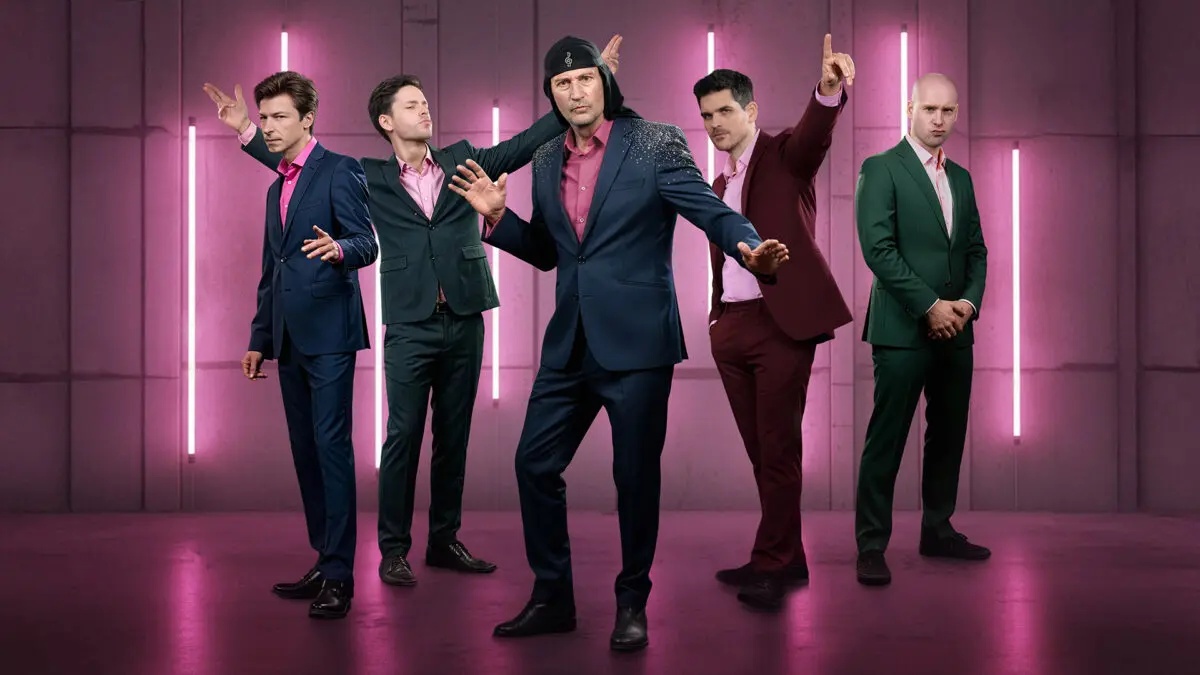
There is perhaps no other band like Laibach. The Slovenians’ nearest British equivalent might be the KLF, but even that is misleading, for Laibach have never been just pranksters or art terrorists. While they have used esoteric humour in their music, at their core they are serious about their work and politics.
Readers of a certain age may remember them from the 1980s, when they gained a certain notoriety. Stories about the band abounded: the music business ally who claimed the only time they cracked a smile was on a visit to the set of Stanley Kubrick’s Full Metal Jacket in east London’s undeveloped Docklands, where the wrecked warehouses and rubble-strewn streets supposedly reminded them of home. The support act who warmed up the crowd for Laibach by emerging in lederhosen, carrying a hatchet, and then chopped logs for 20 minutes.
Suggested Reading

The new Michael Jackson biopic is worse than bad – it’s dangerous
They became known for their industrial/Wagnerian covers of contemporary hits. The banal party song Life Is Life and Queen’s One Vision were given makeovers which caused some critics to accuse Laibach of being pro-totalitarian, even pro-Nazi. Admittedly, their penchant for wearing uniforms on stage may have had something to do with this.
But really Laibach are conceptual artists who instead of resorting to slogans use irony and juxtaposition to cajole the listener to reflect on wider issues, and perhaps their own role in them.
Talking about the group in 2024, their fellow countryman, philosopher Slavoj Žižek, suggested that their approach was “complex… Laibach is not simply making fun of totalitarianism. Laibach is bringing out the authoritarian feature which is present in most societies, even in the most democratic societies. I think that Laibach is deeply aware of this deep ambiguity of even the most democratic power, and are trying to bring this authoritarian streak out even with a certain open fascination.”
But then they were formed under an authoritarian regime. Weeks after Marshal Tito died in 1980, Laibach were born as a musical wing of the art project NSK (Neue Slowenische Kunst, or “New Slovenian Art”). For much of that decade, they were banned from performing under the name Laibach in Yugoslavia but this did little to halt their rise to prominence – they signed to Mute in the UK and toured western Europe and the US.
Suggested Reading
The night that Purple Rain broke Prince
The break-up of Yugoslavia and the subsequent war simply meant Laibach adjusted their crosshairs. Their 1994 album was entitled NATO and included covers of The Final Countdown by Europe and Status Quo’s In the Army Now. Around this time, they declared their own separate state – NSK – and issued its own money, postage stamps and passports.
Since then there has been a concept album about Religion (1996’s Jesus Christ Superstars), and an album entirely comprised of national anthems. This was entitled Volk, which you probably know means “people” in German. You probably didn’t know that it also means “wolf” in Slovene. Then in 2015, they ventured to North Korea.
While other musicians have travelled to that land and produced culturally sensitive work, Laibach recorded their version of The Sound of Music soundtrack. The film, it seems, is one of the few western flicks allowed in the Democratic People’s Republic, but Laibach’s aim was to draw parallels between the Von Trapps living under Nazi occupation and the North Korean people.
And now they have released a pop album. Really. Co-produced by one-time mashup meister Richard X, Musick both celebrates and critiques the algorithm-controlled, AI-infiltrated music of our culturally saturated times. With various dance divas sharing vocal duties alongside Laibach’s gruff-voiced Milan Filas, it’s reminiscent of ’90s Euro house outfit the Real McCoy (remember Another Night?) It’s very silly. And deadly serious.
The centrepiece of the record is Singularity, which sums up 2026 pop in three tragic-hilarious minutes, lamenting that: “It’s a world of echoes we can’t break/ Every tune’s a copy or remake/ We are dancing to the old refrain/ On the verge of singularity”. Tying it all up in a neat conceptual bow, the singalong chorus interpolates/steals from Mozart’s Eine kleine Nachtmusik.
Suggested Reading

How I fell in love with K-Pop
In a statement accompanying the album, the band says: “The tracks are designed to bypass algorithmic detection, to implant doubt – the most essential virtue of thought – and to reinstate the disruptive, playful folly of the court jester in a system that demands seamless predictability.”
And this is the serious point. Once Laibach tweaked the noses of the authoritarian rulers of Yugoslavia, now their sights are trained on the totalitarians of tech. On Allgorhythm, a diva’s voice trills: “No matter what you do/ No one cares about your point of view/ What matters is their algorithm works for you” before the most cheesy Euro dance pop chorus imaginable. Loitering underneath, though, is the chord progression from Pachelbel’s Canon, which as every pop scholar knows, was used in the Pet Shop Boys’ bittersweet hymn to the “freedoms” of western capitalism, Go West.
In the pre-streaming era, it might have stood a chance of becoming a novelty hit – it’s catchy as anything in the current Top 40. It won’t, of course. The domination of the Big Tech’s algorithms has squeezed out any chance that Laibach could ever infiltrate mainstream pop.
But Musick sticks its tongue out determinedly at our digital overlords. It’s the funniest, most subversive, outright best pop album you probably won’t hear this year.
Musick is out now on Mute Records.
Beth Simpson is a music journalist whose work appears in Classic Rock, Classic Pop and others