
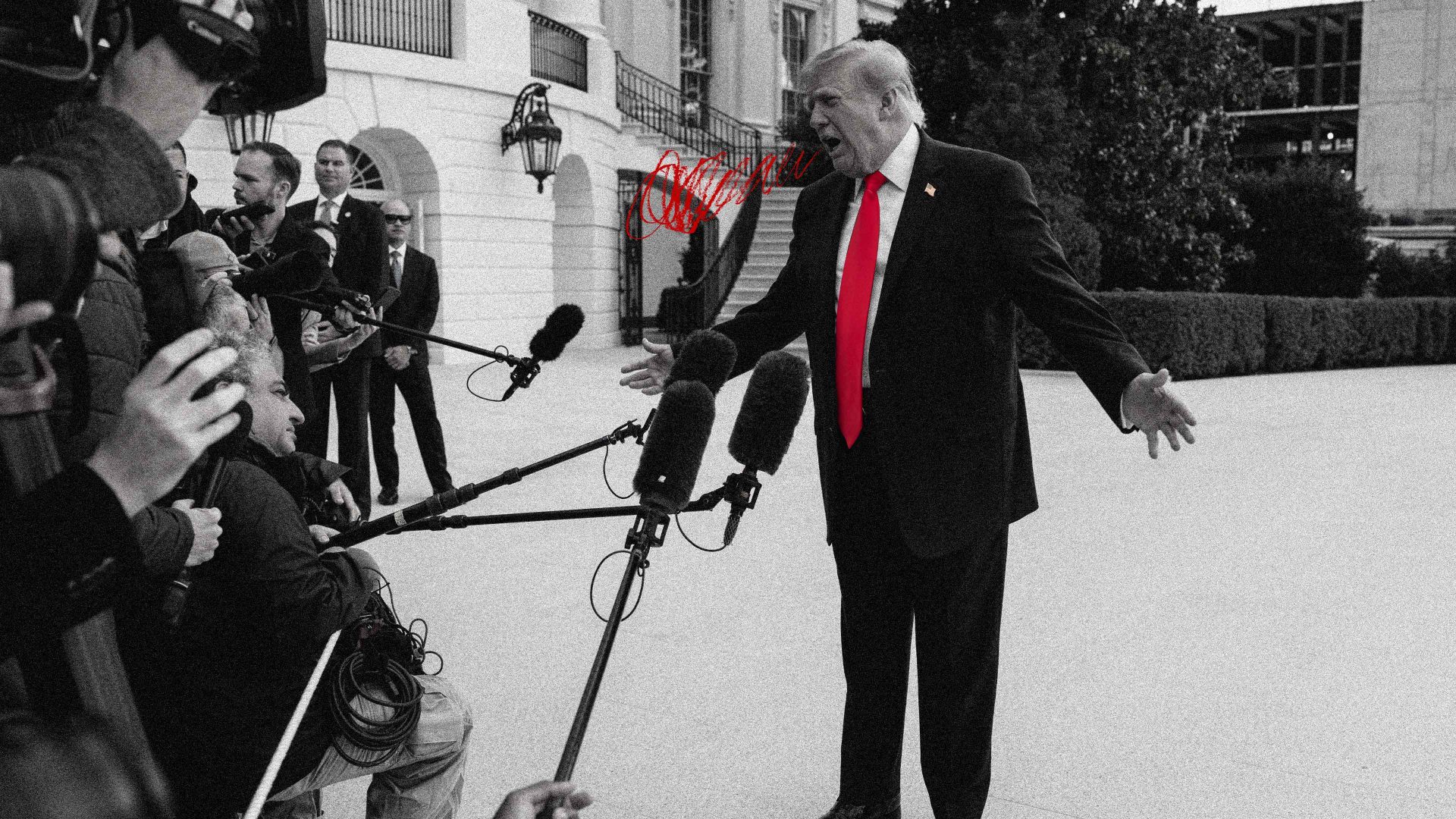
The good news is, ironically, the same as the bad news. But let’s start by looking at it from the optimistic side: on paper, Trump and the Republicans are totally fucked. With the whole House of Representatives and 35 Senate seats up for grabs in the midterm elections on November 3rd, they are both wildly, historically unpopular.
The polling averages show that Democrats are leading across the nation, often by double-digits. At the end of September, Quinnipiac polls showed the Dems up by 12 points. In September, the Yougov/Economist had congressional Republicans more than 20 points underwater on overall favourability, while Emerson had the Dems 11 points ahead and Angus Reid showed them 16 points ahead.
Democrats only need to flip three seats to take control of the House, and if things keep going the way they have been it seems very unlikely Republicans will be able to stop them. At the beginning of October, Yougov/CBS projected that the Dems would take control of the House by 229 seats to 206.
The Senate is trickier – the Republicans have a 53-47 majority, so even with a massive swing, the Democrats’ path to flipping enough seats to get to 51 is a bit tortured. But the signs are positive. The Democrat James Talarico is consistently polling ahead of Ken Paxton in the Texas senate race.
It’s still looking tight – but this is Texas we’re talking about here. The fact that it’s even in play at all is a very bad sign for the GOP, though this is partly down to Paxton’s flaws as a candidate. His personal favourability polls are now 18 points in the negative.
But the same pattern is playing out in other senate seats that had previously been solid red. The Dems lead by seven points in Alaska and also in Ohio, where the veteran former senator Sherrod Brown is running to take back his seat.
The Dems are comfortably ahead in North Carolina, according to one poll by eleven points. In Michigan, the progressive candidate Abdul El-Sayed is consistently polling ahead – by anything from 1 to 7 points, depending on which poll you pick. The Dems also have a slim lead within the margin of error in Maine (two points, says the Maine People’s Resource Center) and also in Iowa.
Nebraska’s senate seat is also within the margin of error, where the challenger Dan Osborn is running as an independent and the Democrats have endorsed him. Possibly most stark of all, the senate race in Kansas is currently in a virtual tie – Kansas, which Trump won two years ago by fifteen points. That’s the same Kansas that hasn’t elected a Democrat to the senate in almost a century.
Drilling deeper into the polling gives more detail on just how much the Trump administration burned its political capital in the first half of term two. Fifty-six per cent of Americans say he’s doing worse in his second administration, and just 22% say better, says the Economist.
Suggested Reading

Is this the real reason Trump keeps falling asleep in public?
Even 12% of self-described MAGA voters said they believe his second term has been worse. A dismal 27% of Hispanic voters and just 32% of voters overall (New York Times/Siena again) say they strongly or somewhat approve of the job Trump’s doing, leaving his net approval 26 points underwater.
Voters overwhelmingly blame Trump for their economic woes. A recent Associated Press poll found that only 17% (that’s “one-seven”) approve of his handling of the cost of living. Roughly half of Americans, in the same poll, said they’re either “very” or “extremely” concerned about being able to afford fuel.
It’s not hard to see why this is happening. Trump ran as an isolationist, then dragged the US into a catastrophic war with Iran. He promised to lower fuel prices, and they have never been higher – the average American driver is paying $67 more per month for petrol and $139 more for diesel this year than last.
His tariffs have hit Trump’s own natural vote-base hardest: farmers, already squeezed on exports by the trade wars that have broken out with both Canada and China, now also face drastically rising fertiliser costs thanks to the closure of the Strait of Hormuz. Truckers – also a favourite Trump constituency – have had to deal with a diesel price shock, as well as mass layoffs and bankruptcies across the industry.
Trump has also publicly nailed his colours to the mast as a booster of the AI industry and data centres, at the moment when both have become hugely unpopular. And while it’s dropped from the headlines after Iran, there’s still the whiff of Epstein files around him.
A series of government-funded TV ad spots in late September featuring the president – one of which described the upcoming election in terms of “the final battle,” drew harsh criticism, even from diehard Republicans. Senate majority leader John Thune told reporters: “I like the message, but it shouldn’t be paid for with taxpayer dollars.” What courage.
But “final battle” might not be far off the mark. For more than a decade, Donald Trump has defied the laws of political gravity, but now it looks as if his fortunes might be about to take a plunge. Interviews with former Trump voters experiencing crushing disillusionment are such a regular trope these days that they are practically their own genre of content. Even his crypto bro supporters are abandoning him, after the value of their memecoins plummeted.
Republicans in tight races can see what’s coming and are getting jumpy. The Michigan senate candidate Mike Rogers, Wisconsin gubernatorial candidate Tom Tiffany, and Iowa senate candidate Ashley Hinson are among those who have publicly broken with Trump over Iran.
Suggested Reading
Meet the monster who created Donald Trump
Other Republicans have sought to distance themselves from a leader who’s increasingly seen as politically poisonous. The Florida GOP congresswoman Maria Elvira Salazar, for example, is facing a massive swing among Hispanic voters in a district Trump won by 15 points two years ago. In September, she dropped a dramatic ad that addressed Trump directly, saying, “the same Hispanics who helped you get to the White House in 2024 feel betrayed today.”
This kind of public distancing can be a risky move: Tom Cotton, a GOP senator who also had the audacity to speak critically of Trump, found his private phone number posted on TruthSocial. More fearful GOP politicians have just quietly dropped mentions of the president from their website and campaign literature.
So that’s the good news.
The bad news is composed of the exact same picture. Trump is losing it. He’s increasingly deranged, detached from reality. Faced with the prospect of an electoral wipeout, a humiliation, a return to earth with a thump, we have to ask: what might this maniac do with his back against the wall? His loss in 2020 led to the incitement of the January 6th riot at the Capitol. Six years on, Trump is dramatically less stable and more impulsive than he was and has fewer people in the administration who are able to restrain him.
He’s already resorting to straight-out bribery and threats. In September, at a rally in North Carolina, Trump told the crowd that if they didn’t vote Republican he would withhold disaster relief funding. A few weeks later, he threatened Ohio with the same. He keeps dangling his $5,000 “Trump dividend” handouts, even though nobody is really even buying it any more, and he’s now even feuding with Fox News for “not covering our packed house and incredibly enthusiastic (beyond!) Rally that took place in Ohio last night, or the ones in Alabama, Texas, or Oklahoma over the past two days” – oblivious to the fact the network is likely protecting Republican interests by not broadcasting his unhinged ramblings in full.
Trump’s fading political mojo is pushing him into darker places. In an October interview with Time, the president “would not rule out declaring a national emergency or invoking the Insurrection Act around the midterms.” He’s been dancing around the edge of that for a while – he refused in May to rule out sending ICE agents to polling stations.
Suggested Reading


Will the Democratic Socialists save or spoil the midterms?
In September, the FBI director Kash Patel also refused to rule out sending federal agents to polling-stations. This week, the attorney-general Todd Blanche said the Trump DoJ would indeed be sending “election monitors” out – remember, in January Trump told the New York Times he regretted not sending the national guard to seize voting machines in swing states in 2020.
He’s already demonstrated a willingness to illegally deploy the national guard multiple times in his second term, including in DC and Chicago. And a 2025 executive order decreed that the DoD would “begin ensuring that each State’s Army National Guard and Air National Guard are resourced, trained, organized, and available to assist Federal, State, and local law enforcement in quelling civil disturbances.”
Just this week, at a convention in Dallas, he called on the crowd to raise their hands and repeat after him a pledge to “go out [to vote] with my family, my friends. I’ll do it any way. I don’t care if I’m registered or not. I’m going to try and cheat like hell,” he added. The crowd, a little awkwardly, repeated it back.
All this means November’s midterm election is shaping up to be a wild and potentially catastrophic stress-test of US democratic institutions and its body politic. The spectre of military crackdowns and violence looms ever larger in the background, especially the more it becomes clear how much Trump and his party are flailing. If the polling is accurate, this election will be a metaphorical bloodbath – but it has the potential to turn into a real one, too.
Best case scenario, Republicans get completely blown out and the trickle of rats abandoning the ship becomes a horde. Worst case… well, put it this way: on the morning of November 4th, we may wake up knowing for certain, one way or the other, if American democracy has a future or not.
 Most popular

I was at Eton with Charles Spencer – this is how it explains his battle with the royals


Emily Maitlis’s diary: My deep dive into Jeffrey Epstein’s hidden empire – and the network that let him get away with it


The linguistic logic behind dropped syllables
Putin’s wartime economy is heading for catastrophe