PICK OF THE WEEK
The Invite (general release)
“One should always be in love. That is the reason one should never marry”: Olivia Wilde’s third feature, an adaptation of Spanish director Cesc Gay’s Sentimental (2020), opens with the famous epigram by her near-namesake, Oscar; a signpost to what lies ahead in this fantastic comic drama.
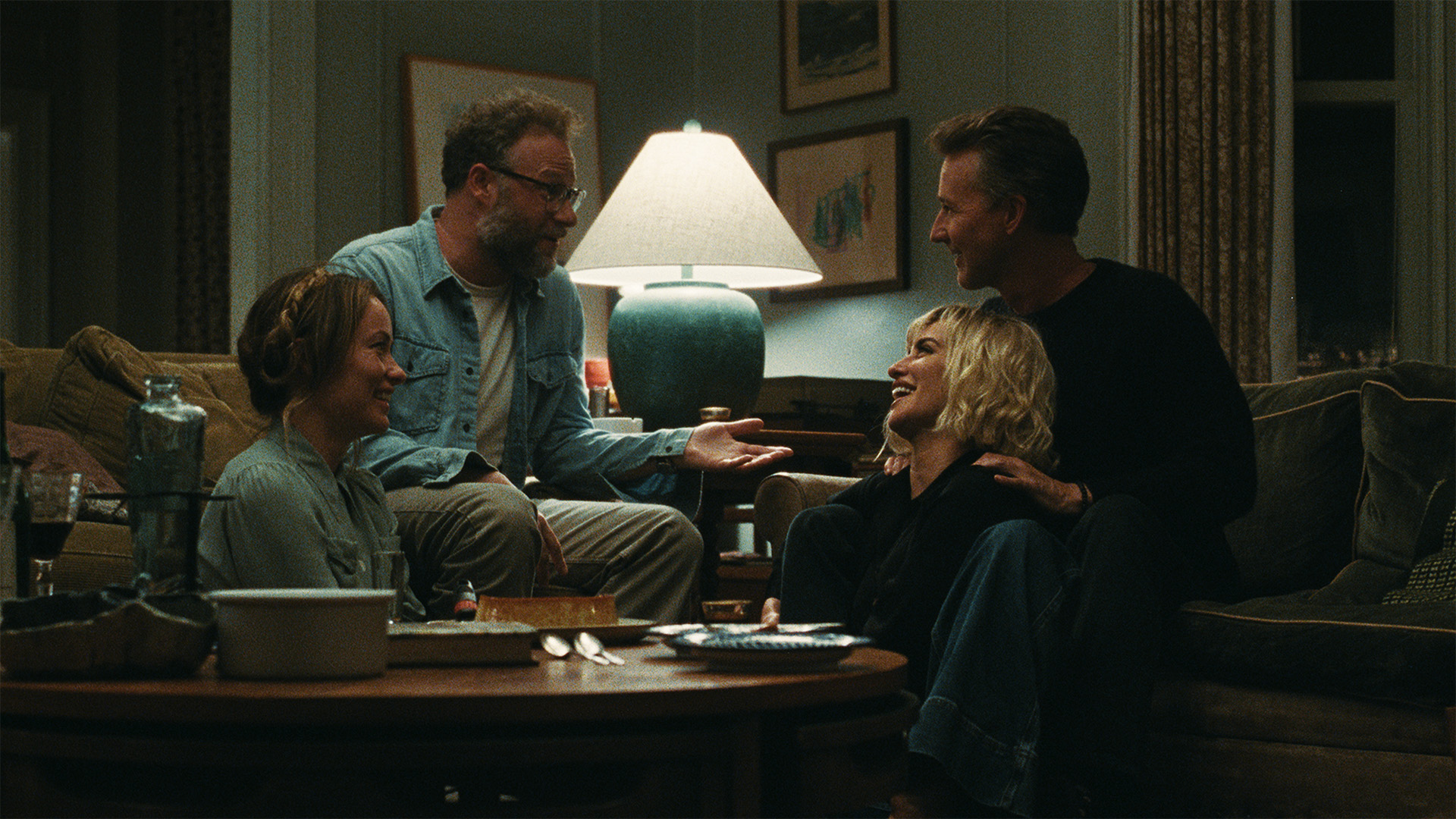
Joe (Seth Rogen) is a visibly crushed music teacher struggling with a collapsible bike on the train as he heads home from a liberal arts school in the Bay Area. Once in the hall, he lies on the floor as his wife Angela (Wilde) shouts “Shoes off, please!” – and tells him that their neighbours are coming round for cheese and wine.
Cue the first of many rows. When she asks him to go out and come back in again – “do a reset” – he fires back: “Is this from a podcast?” (It is.)
Their guests are Pina (Penélope Cruz), a psychotherapist and sexologist, and Hawk (Edward Norton), a retired firefighter now mastering the art of “Rolfing” massage: as smooth and confidently bohemian as Joe and Angela are a hot mess of social anxiety, neurotic babble and mutual recrimination.
Joe plans to complain about the noise that Pina and Hawk make when they are having sex. Angela, a former art student who has buried herself in home improvement (“renovation without change”), hopes only to impress the two sophisticates – and, having laid on a lavish spread, is dismayed when Pina announces immediately that she eats no meat, no cheese, no gluten and so on.
Hawk wants to hear the 2008 hit record that Joe made when he was briefly in a successful band, The Onslaught – which Joe physically tears from his guest’s hands. Angela is mortified. But nothing, it would seem, can faze Hawk: “We love a contentious environment!”
Soon, it becomes clear that this is by no means all that he and Pina love; that they are vigorous swingers (“no more than six”); and that they want Joe and Angela to join them in a foursome. This is quite the mic drop, and their hosts’ expressions as the invitation sinks in are priceless.
Pina offers New Age slogans to frame the prospect: “Sex is not something you do. It’s a place you go.” Angela tries awkwardly to reply in kind: “Namaste.” As for the burly and bearded Joe, he simply cannot believe that he too is being ushered past the velvet rope of free love: “Including me?”
Announcing itself as a sex comedy about modern polyamory, The Invite develops into something much more subtle, ambiguous and moving. It owes an obvious debt to Edward Albee’s Who’s Afraid of Virginia Woolf? (1962) and to Woody Allen’s greatest Manhattan movies (appropriately, it is dedicated to Diane Keaton, who died in October).
All of the performances are superb, but Rogen is phenomenal, his caustic wit matched only by intimations of despair and a longing for what he has lost. The best film of the year, so far.
Suggested Reading

Larry David, the surprising standard-bearer for American hope
THEATRE
Springwood (Hampstead Theatre, London, until July 25)
Another, very different story of two couples in a claustrophobically domestic setting is recounted in Richard Nelson’s terrific production of his own play – a dramatisation of the visit in June 1939 of George VI (Andrew Havill) and Queen Elizabeth (Rebecca Night) to the Roosevelt family estate in Hyde Park, Dutchess County, New York.
By this point, Franklin D. Roosevelt (Robert Lindsay, excellent) was well into his second term, in contrast to the king (known by intimates as Bertie), who had only succeeded his brother Edward VIII two and a half years before and was still acclimatising to the formidable challenge of the role; a burden greatly magnified by the apparent inevitability of a second world war which, by then, was less than two months away. He was also the first monarch to travel to America since its independence in 1776.
At the heart of Nelson’s play – and why it works so well – is the tension between the intimacy of the encounter and the global strategic forces that groan monstrously beneath the characters’ feet. For a start, FDR’s menage at Springwood – still owned by his mother Sara (Eileen Nicholas) – is overtly unconventional.
The 32nd president takes few precautions to conceal his relationship with his distant cousin Daisy (Rachel Pickup), while first lady Eleanor (Jemma Redgrave) usually sleeps at a separate property with two women, described in the play as “furniture makers”.
This was, in fact, an accurate description of Marion Dickerman and Nancy Cook, founders of Val-Kill Industries, a furniture-making business. But, in context, it serves as a euphemism which takes the royal couple a while to decode. Bertie also refers to Daisy as “the governess”, until a moment of farce makes it impossible for him to keep up the pretense.
Though the detail of the (often hilarious) dialogue is obviously fictionalised, its spirit is historically accurate: the visit was intended to test FDR’s readiness to assist Britain in the approaching conflict and to urge him to commit himself to doing so. In Springwood’s most powerful scene, Roosevelt seeks to put the stuttering king at ease by showing him how polio has wrecked his legs.
The price of leadership, he says, is to be what the people want you to be. “Young man,” he says, “that’s what I’ve learned it takes to be a president. And I’m going to hazard a guess that it takes the same damn thing – to be a king.”
This was the high season of US isolationism, the neutrality acts and an earlier iteration of America First. As late as October 1941, only five weeks before the bombing of Pearl Harbor, the pro-Nazi Charles Lindbergh was still able to fill Madison Square Garden.
In June 1939, all FDR could offer the king was personal warmth, friendship and the promise that he would do all in his power to bring the American people round to his point of view – eventually. Never before had a hot dog picnic been so rich in geopolitical significance: a point grasped by the (sunburnt) queen who frets over it until Eleanor explains why it matters so much that she and the king are seen to be eating regular American food. In the angst of protocol and etiquette is embedded the seeds of a mighty transatlantic alliance that will, six years later, save Europe from fascism.
FILM
Nirvanna the Band the Show the Movie (selected cinemas)
One of next month’s big releases, already generating Oscar buzz, is Tony, starring Dominic Sessa as the young Anthony Bourdain, co-written and directed by Matt Johnson, a rising force in Hollywood since the success of Blackberry (2023).
But first: this glorious slice of shameless cinematic nonsense. Drawing upon his long-running cult web and TV comedy series with longstanding collaborator, Jay McCarrol – an accomplished writer, musician and composer – Johnson has turned their original joke about two slackers in Toronto seeking to land a gig for their group “Nirvanna” (the extra ‘n’ makes all the difference, apparently) at The Rivoli club into a full-length feature. It borrows the gleefully low-fi aesthetic of the online original, expects no prior knowledge from the movie audience and is infectiously, magnificently silly.
Matt’s initial scheme is that they should attract the venue’s attention by parachuting off the 550-metres high CN Tower into the SkyDome stadium in the middle of a baseball game – a stunt which is thwarted when its roof closes before they can make their dramatic landing. His plan B, scribbled out on a whiteboard, is that they should instead travel back in time, transforming the RV in the yard into a counterpart to Michael J Fox’s DeLorean in Back to the Future (1985). They worry about using the familiar music from the movie: “This is going to be a copyright nightmare.”
But – and I know you’re already wondering – how to make the “flex capacitor” work? It turns out that the magic ingredient is Orbitz, a long discontinued Canadian soft drink (“A bolt of lightning in every bottle”), that sends the RV catapulting back to 2008: where Bill Cosby is still on magazine covers, offensive comedy and pop lyrics are the norm, and passers-by dress very differently. “Real Goths!” says Matt. “Look at the Gothness of it.”
By means that would probably not persuade quantum physicists, the creatively frustrated Jay detaches himself from his friend and follows a new timeline in which he is a solo pop star, advertising TAG Heuer watches and selling out mega-shows. Is this the end of their crazy partnership?
Like a gonzo Abbott and Costello, Matt and Jay riff on the comedy of long-term friendship and the comic tradition of Wayne and Garth, Bill and Ted and Jay and Silent Bob. There is just enough pathos amid all the gleeful absurdity to keep you engaged. But high-octane, Olympic-standard fun – with plenty of falling over – is what it’s all about.
Suggested Reading

Sandra Oh kills it in a West End show of rare power
POETRY
Allen Ginsberg at 100 (Queen Elizabeth Hall, London, July 12)
“I saw the best minds of my generation destroyed by madness, starving hysterical naked”: well, you know how it goes on, and, if you don’t, you’re missing out. More than seven decades since its publication in 1955, Howl is still electrifying, nerve-shredding, visionary.
So: hats off to the Southbank Centre for hosting this evening in celebration of Allen Ginsberg’s 100th birthday (which actually fell on June 3). Elegy for Neal Cassady, which was first published in 1972, paying tribute to the man who inspired Jack Kerouac’s Dean Moriarty in On the Road (1957), is reinterpreted by composer and artist Scanner (Robin Rimbaud) and photographer Antonio Pagano.
Sonic Youth’s Thurston Moore, Irish pianist Mary Dullea and Tony-award-winning performer Stew are all on the bill, while director and writer Mark Leipacher joins forces with bassist Gary Crosby to honour Howl itself. Almost 30 years since his death, the Beat legend, who managed to enchant William F Buckley, hung out with John and Yoko, and sang with The Clash, still has so much to offer contemporary culture. Book now.