PICK OF THE WEEK
Life, Larry and the Pursuit of Unhappiness: An Almost History of America (HBO Max)
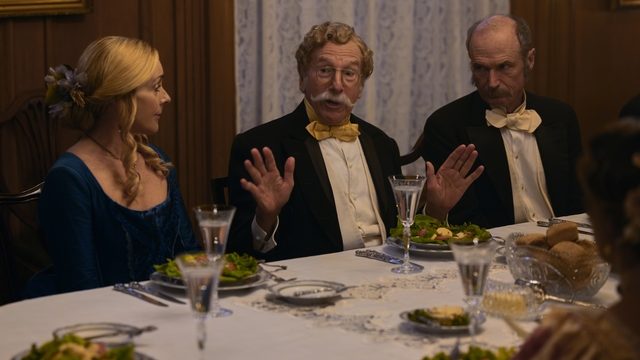
If you are depressed by the prospect of Donald Trump’s “Freedom 250” celebrations on July 4, this will lift your spirits. Two years since Curb Your Enthusiasm ended after 12 seasons, Larry David returns with a glorious seven-part sketch series that satirises great moments in American history.
His partner in crime is none other than Barack Obama – like his wife Michelle, an executive producer on the show – who introduces episode one with a hymn of praise to the “events, people and ideas that helped shape and preserve our grand experiment in self-government.” Then, changing gear, the 44th president reminds us that there have always been “naysayers” in this “work in progress”, “miserable, intolerable… did I say petty?” He’s talking about David, of course. But that’s not the only person he’s talking about.
And then we’re off on a whirlwind tour of the last 250 years, narrated by Samuel L Jackson, in which, like a misanthropic Time Lord, David brings his distinctive persona to bear on key episodes in the story of the republic. One moment he’s the founding father, Robert R. Livingston, proposing an unworkable first draft of the declaration of independence that includes bans on sharing desserts, taking deep breaths outside and talking about “a new health routine”; the next he is sitting next to Rosa Parks on the bus.
Imagine, if you will, Larry David shouting at his fellow indigent Americans at a soup kitchen after the 1929 crash for trying to “chat and cut” into the line; or as a heckler at George Washington’s second inaugural address, asking the president if he’s thought about a potential successor who turns about to be “an insecure lying asshole who would even cheat at golf!”; or the man who wasn’t invited to the Boston Tea Party; or the third Wright brother at Kitty Hawk (watch out for Jon Hamm as Orville); or as Deep Throat driving Bob Woodward to distraction in the underground carpark with irrelevant information; or as the man who gives Abraham Lincoln (Bill Hader) tickets to the theatre.
David’s genius is to undercut the solemn mythology of these moments with his trademark arguments about the minutiae of social etiquette or the precise meaning of particular words or facial expressions. Yet the effect is paradoxical – because satire of this sort is born of true patriotic confidence.
Just as Obama reminds us that a president can be smart and ironic rather than a literalist bully, so David continues the great tradition of American self-mockery: the tradition of Mark Twain, Ambrose Bierce, Dorothy Parker, EB White, Tom Lehrer, Kurt Vonnegut, Garry Trudeau, Richard Pryor, Nora Ephron, Percival Everett and so many others.
All of which is pretty, pretty good. Improbable as may seem, the comedian who made his name by being hilariously anti-social turns out to be a standard-bearer for American hope.
Suggested Reading


Sandra Oh kills it in a West End show of rare power
THEATRE
The Guilty (Donmar Warehouse, London, until August 15)
“Can you help me?” From the first moments of Chloë Moss’s enthralling drama – adapted from Gustav Möller’s movie Den Skyldige (2018) – police control operator Joe (Russell Tovey) is fielding calls from desperate and not-so-desperate members of the public, doing his best to sift the genuinely urgent incidents from neighbourhood gripes (“I can’t send the fucking police until you send me the address”), and despatching units across London as quickly as he can.
Felix Barrett’s production, claustrophobic and nerve-shredding, is perfectly suited to the Donmar, which has always been an immersive venue (long before that word was debased by overuse).
It also helps that Tovey is as good as ever, using his physicality and psychological range to signal Joe’s hectic oscillation between knotted control and a sense of powerlessness. Since his breakout role in Alan Bennett’s The History Boys in 2004 – alongside Dominic Cooper, James Corden and Sacha Dhawan – he has evolved into one of the most accomplished and versatile actors of his generation, a reputation burnished by the brilliant Talk Art podcast he has co-hosted with Robert Diament.
Joe, we learn incrementally, has been suspended from active duty and is facing a hearing the next day over an incident whose nature is not disclosed until late in the play. He also becomes increasingly invested in the abduction of a woman, Emily, who calls him from a van on the A406, and in the well-being of her young children. Alone in a room with three screens and his private mobile, he sees proxies everywhere for his own shattered home life, imperilled career and general suspicion that “the world’s fucked, completely and utterly fucked.”
Do not be deterred by Antoine Fuqua’s so-so 2021 movie version of the Danish original, starring Jake Gyllenhaal. This is in a different league, not least because of Anna Watson’s lighting (the edge of the stage flashes red every time the phone rings), Gareth Fry’s enveloping sound, and the host of disembodied voices that we hear in the course of the drama (I shall not spoil their very striking origin, revealed in a true dramatic coup).
Clocking in at just over an hour, The Guilty feels like a journey into the tormented soul of man tasked with saving others, increasingly uncertain that he can even save himself. It is a tour de force by Tovey and another triumph for Barrett, following his fine West End staging of Paranormal Activity. Go see.
Suggested Reading
Inside Marilyn Monroe’s image machine
EXHIBITION
Frida: The Making of an Icon (Tate Modern, London, until January 3)
It is a cause for celebration that this exhibition, co-curated by Tobias Ostrander and Beatriz García-Velasco, has already achieved the highest pre-opening sale of tickets in Tate’s history, beating the record set by the late David Hockney. Such is the magnetic power of Frida Kahlo (1907-54) one of whose self-portraits broke the auction record in November for an artwork by a female artist.
More than thirty of her own paintings and works on paper, some from private collections, are on display, and quite mesmerising they are, too. El Corazón (The Heart), painted in 1937, is a hallucinatory depiction of the skewered, armless artist, flanked by empty outfits, weeping as she contemplates the philandering of her Marxist muralist husband Diego Rivera. Ten years later, Autorretrato con el pelo suelto (Self-Portrait with Loose Hair), an oil-on-masonite painting, shows Kahlo wearing traditional Mexican clothing, simultaneously defiant and vulnerable.
La flor de la vida (Flower of Life), painted in 1943, is a primitivist depiction of an inverted mandrake with male and female organs, symbolic, perhaps, of Kahlo’s androgyny and bisexuality as well as her debt to Mexican folklore and its distinctive aura of the uncanny.
Death always lurks at the edges of her canvases, as do the enduring health problems she suffered after contracting polio aged six and the terrible injuries she sustained in a bus accident in 1925.
The rest of the show – more than 200 works by her contemporaries and those she has inspired – is less compelling. The self-conscious public identity that Kahlo curated during her life, and vividly captured in many photographic portraits, suggests at least a subconscious awareness that she was destined to become an icon.
Yet, as is clear from her angry response to André Breton when he sought to claim her for surrealism, she refused to be press-ganged into any movement. Many of the later works by other artists on display show how thin the line between homage and idolatry can be; and all too often she is simply recruited to this or that branch of contemporary identity politics by creatives of varying talent, without any meaningful recognition of her individuality. The final gallery – devoted to “Fridamania” – amounts to little more than a room full of branded content and merch.
That said, her own work is worth the trip: her uniqueness shines through like a light born of unquenchable creative fire.
PODCAST
Being Greek (BBC Sounds)
The Italian scholar Carlo Ginzburg, who died on June 17, was perhaps the greatest pioneer in the field of so-called “microhistory” – the academic study of the marginal, the forgotten and the oppressed – that was most beautifully exemplified by his 1976 masterpiece, The Cheese and the Worms: The Cosmos of a Sixteenth-Century Miller.
Using the records of the prosecution for heresy in 1598 of Domenico Scandella, known as Menocchio, who lived in the small village of Montereale Valcellina in north-eastern Italy, Ginzburg ensured that a forgotten individual’s deeply eccentric worldview was retrieved from obscurity and that “[t]he substance of a possible footnote had become the focus of a book.”
Though set in the world of ancient Greece, Mary Beard’s splendid new Radio 4 series is undertaken in a very similar spirit. Her objective is to look “beyond Mount Olympus, beyond the shiny marble temples and beyond the swords and sandals” of mainstream classicist narratives to tell the stories of six people “who underpinned that cultural achievement and underpinned the politics.”
Drawing upon Lysias’s On the Murder of Eratosthenes (c.403 BC), the first episode reconstructs the tale of Euphiletos, tried in Athens for the murder of his wife’s lover, who had seen her at a funeral and made contact via a slave. The details of ordinary domestic life, the challenges facing adulterers meeting for a tryst in a small Athenian house, and the conventions of marriage are explored vividly.
In the second, Beard examines the life of Myrrhine, priestess at the temple of Athena Nike on the Acropolis, who appears to have inspired the comedy Lysistrata (411 BC) by Aristophanes. Next, she heads for the north-eastern Peloponnese in search of the women of Mycenae who lived in the warrior society of Bronze Age Greece to which Homer gave voice (essential background for Christopher Nolan’s The Odyssey, released on July 17).
As always in her broadcasting and popular books, Beard combines academic rigour with an infectious gift for engaging a non-specialist audience. Her guests include Martin Scorsese, chipping in to her account of a gangster’s exploits in ancient Greece. As EP Thompson famously put it, and like Ginzburg (RIP), she deftly rescues her subjects from “the enormous condescension of posterity.”