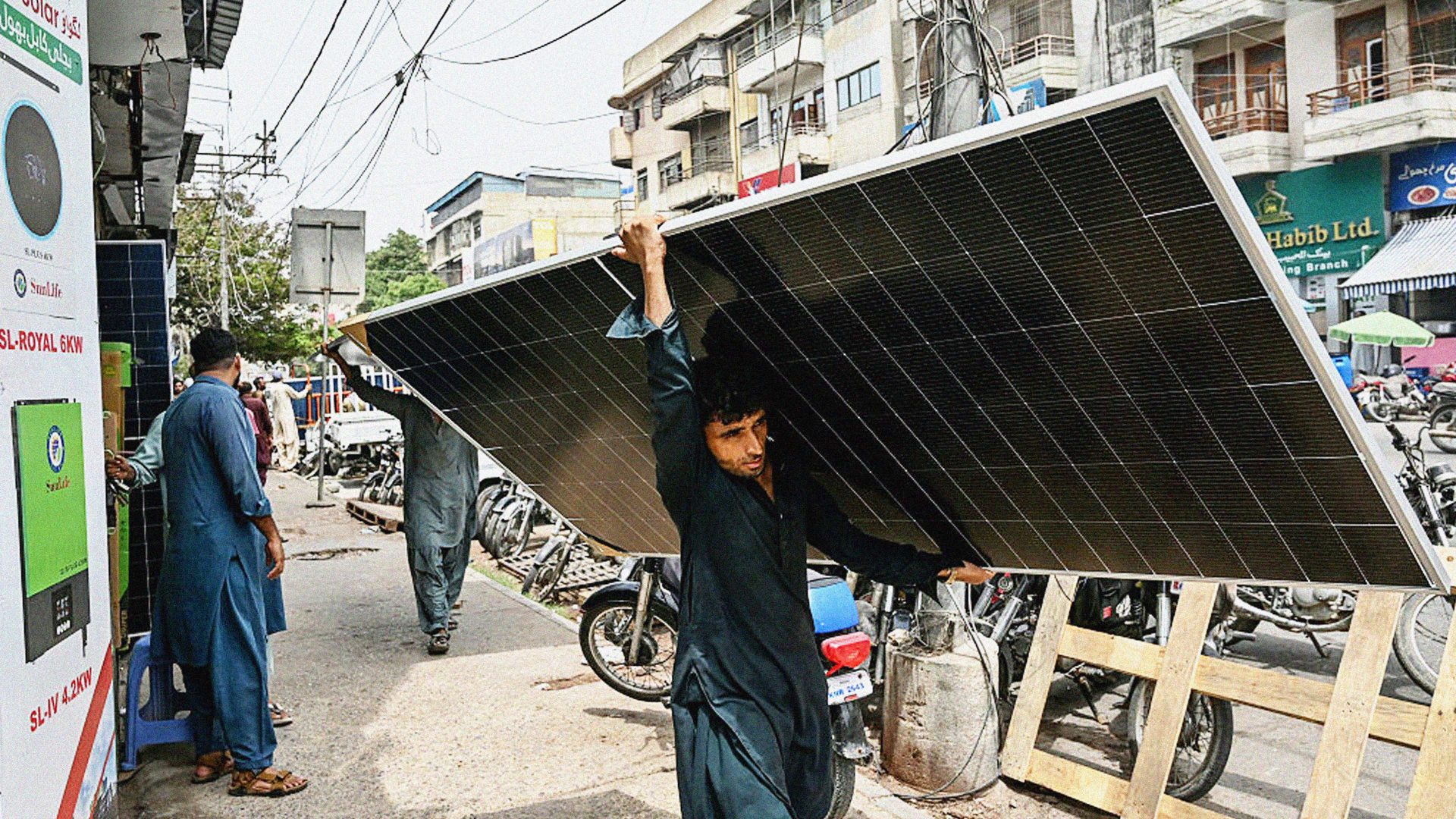
In 2025, Pakistan imported more Chinese solar panels than any other country on earth. No subsidy programme drove it. There was no national rooftop scheme. No feed-in tariff. People just did it.
This is what makes this so remarkable: we are used to energy transitions that happen because governments engineer them, with incentives and mandates and targets. Pakistan’s solar boom is the opposite. It is probably the fastest deployment of distributed solar anywhere in the world, and it happened largely in spite of the state rather than because of it.
But Pakistan is also a cautionary tale for what happens in an unmanaged transition and by no means is this a blueprint for other countries to follow. But it shows just how rapidly solar can be deployed around the world.
Pakistan, a country of around 241 million people with a long history of power cuts, now absorbs a remarkable share of China’s solar manufacturing output. Pakistan imported roughly 7.6 GW of solar panels in 2023, then 16.4 GW in 2024, then 16.9 GW in 2025. Around 55 GW have now arrived in total, which makes Pakistan the second-largest importer of solar panels in the world in 2025.
And it is showing up in the grid data. By the summer of 2025, solar had become Pakistan’s single largest source of electricity, generating around a quarter of the total during peak months. Official numbers understate the boom of solar because most of the panels were installed on rooftops and behind meters, in a distributed system no one is fully measuring.
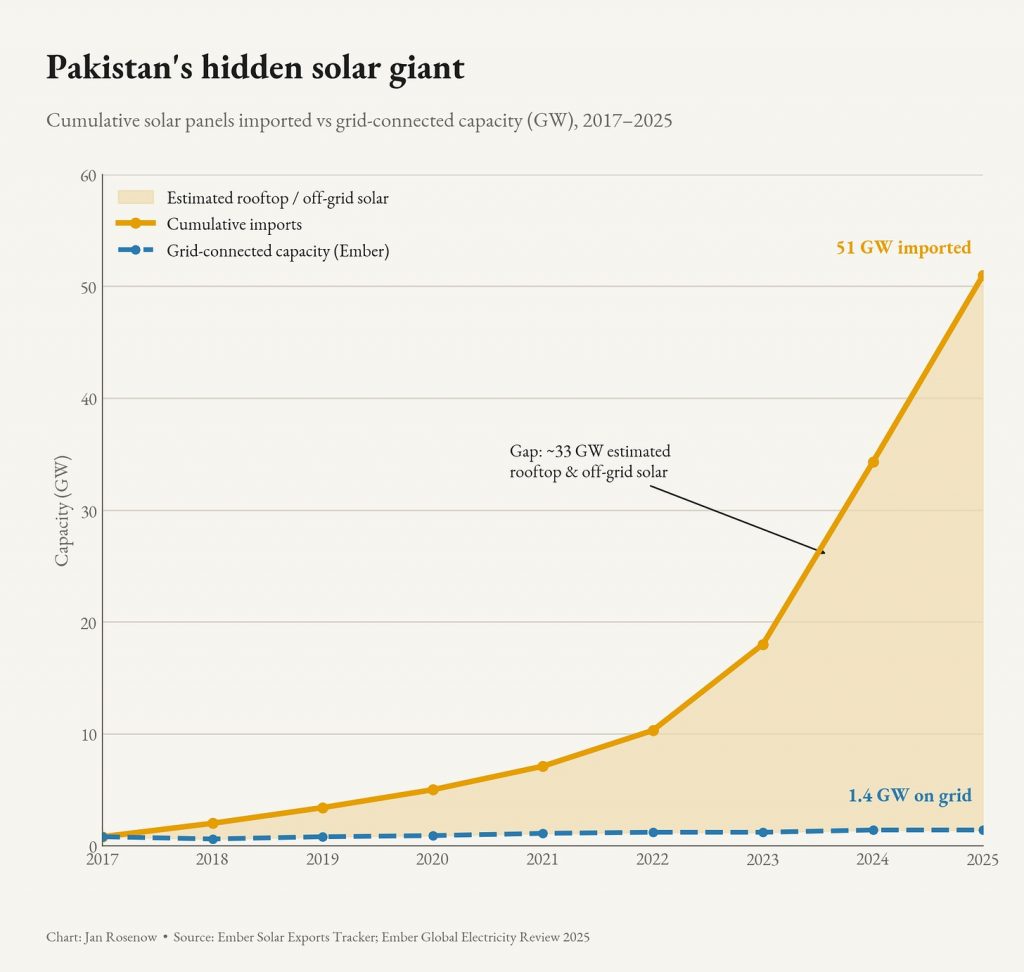
Most of that hidden capacity is overwhelmingly residential. Of an estimated 33 GW of distributed solar, around half sits on the roofs of homes, with the rest split across industry, agriculture and commerce. This is not a story of big developers and utility contracts. It is millions of households deciding, one by one, that the grid is no longer worth waiting for.
Suggested Reading
Forget about privacy – unless you’re a billionaire
Pakistan’s solar boom is a story about broken trust in the grid. For decades the deal on offer was: pay for electricity, then often sit in the dark anyway. Load-shedding, the rationing of power when supply cannot meet demand, has been a daily fact of life in Pakistan. How long the lights stay off depends on where you live, and the gap between a wealthy Islamabad suburb and rural Balochistan is enormous.
For years, the outages were blamed on a simple shortage: not enough power stations. That was once true. It is not any more. Pakistan now runs a capacity surplus of 10 to 12 gigawatts, and in 2024 its power plants ran at barely a third of their capacity.
The problem is no longer how much electricity the country can make. It is that it cannot afford to run the plants it has, or to deliver the power and collect the bills. Expensive imported fuel pushed generation costs up. Contracts with private producers guarantee them capacity payments whether their plants run or not. Those payments are now around 2.5 trillion rupees a year for electricity that is often never generated.
The public utilities cannot recover enough to cover those bills, so the debt piles up into a circular debt of close to 2 trillion rupees. Faced with that, the system rations supply, cutting power longest where losses are highest and bill payment is lowest.
Scheduled outages in April this year were permitted by the regulator for several hours a day – now a common feature in Pakistan. The distribution companies serving Islamabad and Karachi keep cuts to a handful of hours a day. In Sukkur and Quetta, rural customers can be without power for up to two-thirds of the day.
In Europe, by contrast, customers typically face around a few minutes of outages per year (both planned and unplanned). The average American, battered by hurricanes in 2024, lost about 11 hours over twelve months, and closer to two hours in a normal year. In some parts of Pakistan people can lose more than that before lunchtime. A household in Quetta can face 16 to 20 hours of outages in a single day. When that is the alternative, a roof full of panels and a battery offers energy resilience.
It was not only outages that drove solar demand. Electricity in Pakistan also became very expensive, very fast. The average effective tariff roughly tripled in a decade, from about 12.5 rupees per unit in 2015 to over 34 rupees in 2025. As mentioned, Pakistan’s power sector now carries a circular debt of well over 2 trillion rupees, and around 37% of a typical bill is now made up of surcharges tied to that debt.
Suggested Reading
We regret to announce that your train has been delayed by 10 years
So households and businesses were being asked to pay more and more for electricity that arrived unreliably, while watching the price of solar panels collapse. China’s manufacturing glut pushed module prices to record lows at exactly the moment Pakistani consumers were most desperate for an exit. A rooftop system could pay for itself in two to three years. For a factory facing industrial tariffs, the payback was faster still.
This is the engine of the boom. When grid power is expensive and unreliable, and the alternative is cheap and getting cheaper, people vote with their wallets. A bottom-up solar revolution sounds like an unambiguously good news story. It partly is. But it also creates a genuine problem.
When the customers who can afford solar leave the grid, fewer kilowatt hours are consumed from the grid. But many of the high fixed costs remain. As a result, costs, including the capacity payments owed to idle power plants, get spread across a shrinking base of remaining customers. Their bills go up. That pushes more of them towards solar. Which shrinks the base again. This is the classic utility death spiral, and Pakistan is one of the clearest real-world examples of it now unfolding.
The state is trying to slow the exodus by changing the rules around metering charges. You can read this two ways, and both are true. It is a regressive move that makes solar less attractive and protects a failing centralised model. It is also a rational attempt to stop wealthier consumers from offloading the cost of the grid onto everyone who cannot afford to leave it.
The regulator’s own projection is that without reform the losses would reach hundreds of billions of rupees over the next decade. The uncomfortable reality is that a transition this fast, and this unplanned, breaks things on the way through.
And the equity concern is real. Solar adoption in Pakistan rises steeply with income. Wealthier households are far more likely to have already left, which is exactly why those still on the grid end up carrying more of its cost.
Pakistan’s sudden shift to solar is a preview of what may happen elsewhere around the globe. Most of the world’s future electricity demand growth will come from countries that look more like Pakistan than like Germany. Hot, growing, energy-hungry, often saddled with creaking grids and expensive imported fuel.
The conventional assumption was that these countries would electrify the way the rich world did, through large centralised power stations and slow grid expansion. Pakistan suggests another path is not only possible but may be unstoppable once the price signals line up. Cheap panels plus an unreliable grid equals mass distributed solar, whether or not anyone planned for it.
The optimistic view is that a country that spent decades short of power has, in the space of three or four years, built one of the most solarised electricity systems in the developing world, funded overwhelmingly by private money.
But Pakistan is also a warning. Solar deployment is the easy part now. The hard part is the system around it: the grid, the tariffs, the market design, the question of who pays for the shared infrastructure when generation becomes something millions of people own themselves. Pakistan ran ahead on deployment and left the institutions trailing. The result is a boom and a crisis happening at the same time, in the same place.
Jan Rosenow is professor of energy and climate policy and leader of the energy programme at the Environmental Change Institute, University of Oxford
 Most popular

Emily Maitlis’s diary: Trump doesn’t fear the AI apocalypse – but he’s terrified about the midterms
The decline of the Daily Mail

If Shabana Mahmood is tough, why is she so slow to crack down on Danny Tommo and the far right?
What the rich and powerful are really saying about AI