
PICK OF THE WEEK
James McNeill Whistler (Tate Britain, London, until September 27)
At a crossroads in space and time stood the unique figure of James McNeill Whistler (1834-1903), whose creative audacity, instinctive internationalism and luminous talent are all showcased in this magnificent exhibition – the first major European retrospective of his work in three decades. In life and art alike, he blazed across eras, around the world, scorning aesthetic boundaries and social expectations at every turn.
It is, of course, a coup for Tate Britain that his most famous work, Arrangement in Black and Grey: Portrait of the Painter’s Mother (1871) is on loan from the Musée d’Orsay in Paris; its first display in the UK for 20 years. The painting more commonly known as “Whistler’s Mother” is indeed a monumental presence. Anna McNeill Whistler, aged 67 when she posed for the portrait, looks back as if contemplating the lost antebellum world of America into which she was born and the conventions of the age that her bohemian son, a disciple of Charles Baudelaire, was so eager to disrupt.
But – among such a dazzling variety of styles, sketches, artefacts and themes – the presence of this particular canvas shows how misleading it can be when an artist’s reputation becomes too closely identified with a single work. In the first gallery, we see, for example, how great an influence eastern art had upon Whistler; not least the work of Japanese master Utagawa Hiroshige (the subject of a landmark exhibition at the British Museum last year).
Born in Lowell, Massachusetts, he was later enrolled at the Imperial Academy of Arts in St Petersburg, where his father was working (Whistler Jr was later dismissed from West Point military academy). Paris, Algiers, Amsterdam, Venice, Corsica: he was as temperamentally itinerant as he was voraciously eclectic in his quest for an artistic voice.
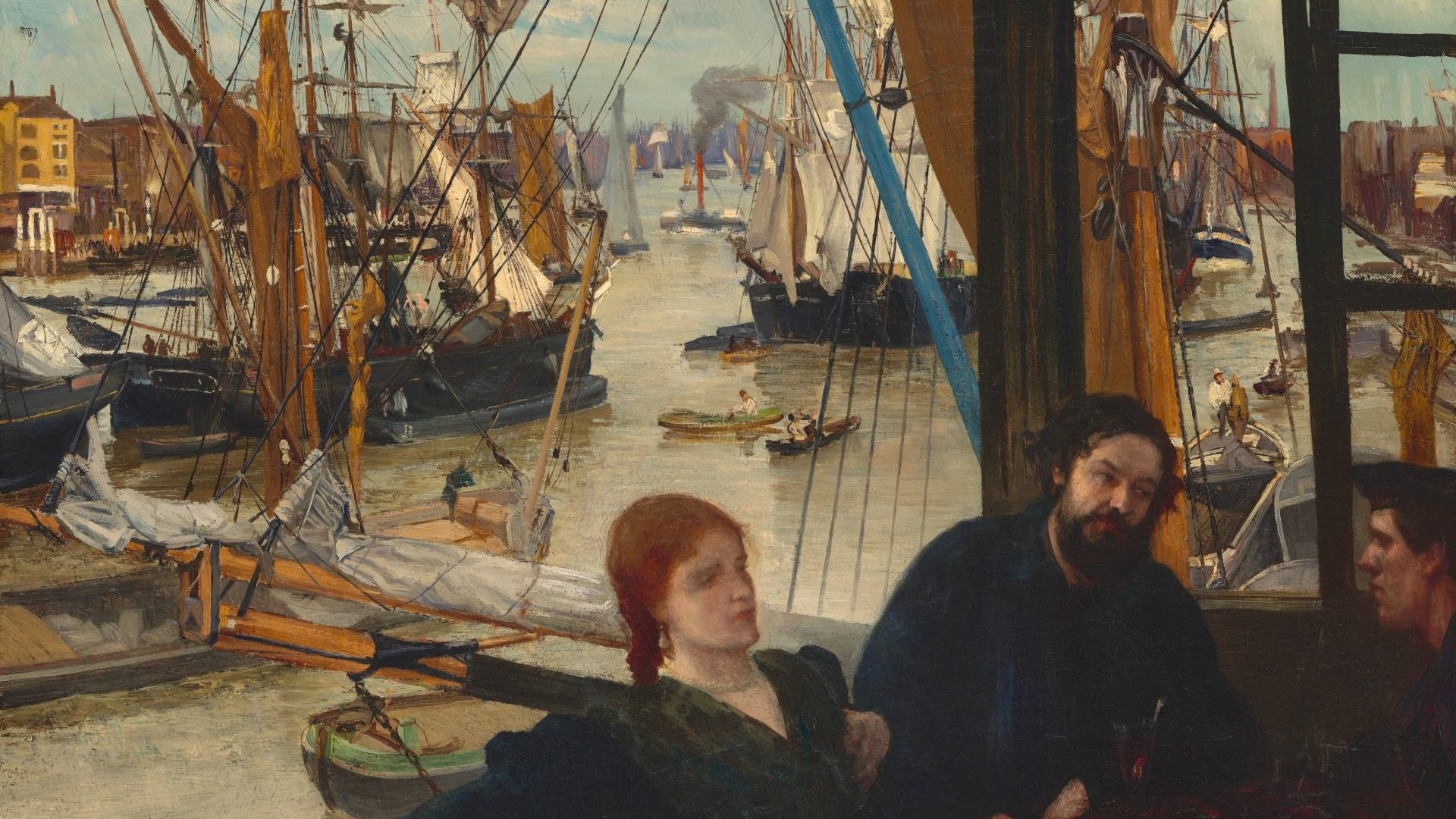
Though Velázquez and Rembrandt were lifelong inspirations, he was in dialogue with, rather than in thrall to, the two masters. In my favourite piece, Wapping 1860-4, his lover and model Joanna Hiffernan, the artist Alphonse Legros and an unidentified man lounge on the balcony of the Angel Inn on a stretch of the Thames known as the Pool of London, while the ships and boatmen in the background suggest the transient reality of the city. The oils whisper of the coming of full-scale modernism.
The recreation of Whistler’s work on ship owner Frederick Leyland’s dining room (Harmony in Blue and Gold: The Peacock Room 1876-7), which led to a furious row between artist and patron, is tremendous. But the best of the galleries is devoted to the largest number of the Nocturnes ever assembled.
In these 16 sublime pieces, naturalism is entirely subordinate to tone, mood and ethereal suggestion. The darkness of the fog, the hazy shape of Battersea Bridge, the Prussian and cobalt blues: they capture London in a way that more closely evokes music than figurative accuracy (hence, their collective name, borrowed from Chopin).
Whistler spoke of painting as “the poetry of sight”. Yet it was one of these paintings that drove John Ruskin to accuse him of “flinging a pot of paint in the public’s face”. Foolishly, Whistler sued for libel, winning the case but awarded only a farthing in compensation, leaving him penurious.
The disastrous episode symbolised the cost of the artist’s conscious decision to cultivate a public persona, prophetic of contemporary celebrity, and to pick fights with his most illustrious contemporaries (when Oscar Wilde said of one of Whistler’s aperçus, “I wish I had said that,” he replied: “You will, Oscar. You will.”)
Yet he was so much more than a dandy, a showman and a contrarian. As curator Carol Jacobi writes in the exhibition catalogue: “His technical inventiveness abridged reality into a post-impressionist, aesthetic realism that accounts for his unsettled life in his own age and his importance for the next.” An absolute must-see.
Suggested Reading
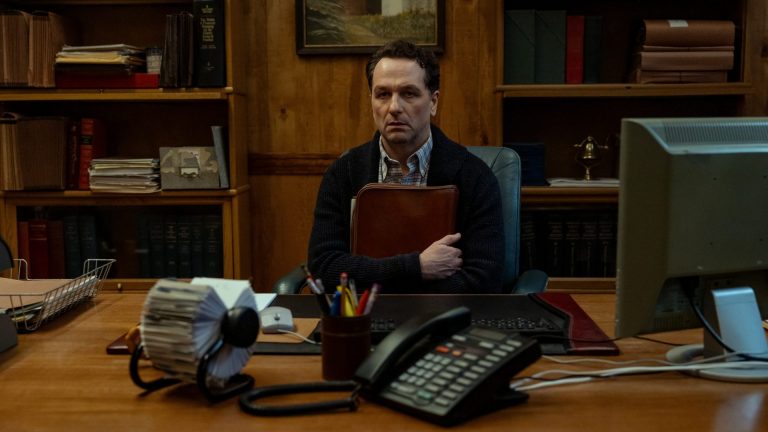

Widow’s Bay, the best horror-comedy since An American Werewolf in London
STREAMING
The Boroughs (Netflix)
“The owls are in the walls, Gracie” is a great, Lynchian line with which to kick off a supernatural thriller; though, in truth, this very entertaining eight-episode series, set in a retirement community, is less like Twin Peaks than Stranger Things – only with stents.
No coincidence, really, given that the Duffer brothers, Matt and Ross, showrunners on the latter smash-hit franchise, are on board as executive producers. But The Boroughs, co-created by Jeffrey Addiss and Will Matthews, is not (thus far) an exercise in colossal world-building but a tightly focused adventure yarn that channels the spirit of Steven Spielberg, The Goonies (1985) and even, in the very specific role played by old-fashioned television sets, Poltergeist (1982).
When retired engineer and widower Sam Cooper (Alfred Molina) arrives at a residential care facility in the middle of the desert, he is thinking only of ways to leave. “Welcome to the Boroughs, where you’ll have the time of your life!” says the greeter. “Ironic slogan for a place where people come to die,” he mutters.
Sam’s genial neighbour Jack Willard (Bill Pullman) urges him to look on the bright side: “Single fellas like ourselves are like Wonka tickets round here!” Golf-crazy stoner Art Daniels (Clarke Peters) and his wife Judy, a former journalist, also weigh in with good cheer and the offer of friendship. But Sam is initially unimpressed by what lies ahead of him in “God’s waiting room.”
In the best tradition of the genre, it is shared adversity – in this case of an apparently paranormal kind – that brings the gang of grey rebels together. Bizarrely, quartz items go missing from their homes. “There is a thief out there who is stealing our worthless shit!” observes retired music manager Renee (Geena Davis, excellent). But what kind of thief?
Wally Baker (Denis O’Hare), a retired doctor with stage four cancer, remarks archly that they seem to be in an “unfolding creature feature”. But to warn the facility’s management of an other-worldly threat would be to risk immediate confinement in its pastel-painted mental health lock-up, “The Manor”.
The Boroughs is the latest in a run of prestige television series featuring top-rank performers that have zeroed in on the adventures of older characters: Only Murders in the Building, A Man on the Inside and The Thursday Murder Club.
It’s impossible to say more about why the show is such fun without spoiling precisely what the intrepid monster hunters find in the catacombs below the facility. Imagine a writers’ room with H.P. Lovecraft chipping in, and you’ll get an idea of why Art so forcefully declares in the sixth episode that “shit is crazy as hell around here.”
Suggested Reading
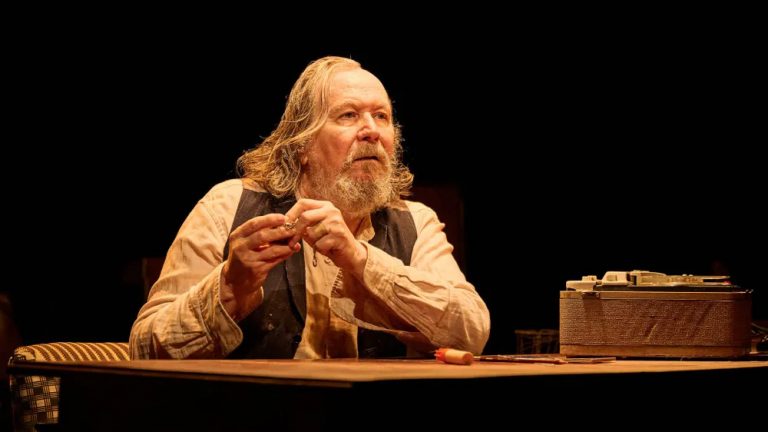
Gary Oldman’s Beckett masterclass
FILM
The Balloonists (selected cinemas)
In March 1999, Swiss explorer Bertrand Piccard made his third bid to circumnavigate the world in a balloon – a feat never before accomplished. After two failed, very expensive attempts, he sensed that this would be his last chance; an anxiety made heavier by the weight of dynastic expectation upon his shoulders.
This particular burden is a through-line in John Dower’s compelling documentary. In 1931, Bertrand’s grandfather Auguste had become the first person to enter the stratosphere in a hydrogen balloon; in 1969, his father Jacques broke a record of his own, as the first scientist to reach the floor of the Mariana Trench – in a submarine of his own design, no less.
So when the young Bertrand physically witnessed the take-off of Apollo 11 at Cape Canaveral and then watched Neil Armstrong’s first steps on the moon, his emotions were mixed: “I was a bit depressed because I thought ‘everything has been done’.”
Except it hadn’t. In the 1990s, the race to complete the first non-stop 26,000 km journey around the planet was fiercely contested – not least by Richard Branson, who had money to throw at his ambition. After Piccard’s first two Orbiter missions failed, and his co-pilot Andy Elson left to make his own bid for glory, he recruited Tony Brown, a former flight engineer on Concorde – only to fall out spectacularly with him. “Tony felt that I was the diva in the team,” recalls Piccard, without, it must be said, much visible contrition.
How to salvage Orbiter 3? Step forward Brian Jones, an Englishman who was already an adviser to the team but certainly not expecting to be competing himself for a place in the aviation history books.
As the two men recalled the extraordinary challenges of the journey – the vagaries of satellite communications, a deadly moment when a filter iced over and the they faced lethal hypoxia, shortage of fuel, navigation entirely at the mercy of the weather – I was reminded of Man on Wire (2008), James Marsh’s Oscar-winning account of Philippe Petit’s 1974 tightrope walk between the towers of the World Trade Center. Even after many years, the memories of human accomplishment at this level of endurance, danger and solitude can be almost unbearably intense.
Interestingly, it is the less flamboyant Jones who sheds tears as he recalls what he did; precisely, perhaps, because it was an experience so distant from anything he had ever envisaged and, specifically, because he was so fearful of widowing his beloved wife Jo.
For Piccard, the journey was a matter of familial obligation. His father said to him: “Until now I was proud to be the son of my father, and now I am proud to be the father of my son.” Greatness has many spurs and comes in many forms.
BOOK NOW
RBO/SHIFT Festival (Linbury Theatre, Royal Opera House, London, June 4-7
Curated by associate director of the Royal Opera, Netia Jones, this new annual festival explores the connections between the art form and the technological revolution, with a particular emphasis upon AI.
It is uplifting to see one of our greatest cultural institutions hugging the cactus of digital disruption and seeking ways of enriching opera with cutting-edge tech. The line-up – including composer George E Lewis, Jason Baldridge of Google DeepMind, technology philosopher Karen Palmer, vocal artist Harry Yeff (Reeps100), and the Alexander Whitley Dance Company – is first-class. Book tickets here.