PICK OF THE WEEK
Krapp’s Last Tape (Royal Court Theatre, London, until May 30)
It is 68 years since the play to which Samuel Beckett gave the working title “The Magee Monologue”, in honour of the actor Patrick Magee, premiered at the Royal Court. On the night of October 28, 1958, Gary Oldman was eight months old and living in New Cross, about six miles southeast of Sloane Square – and a world away.
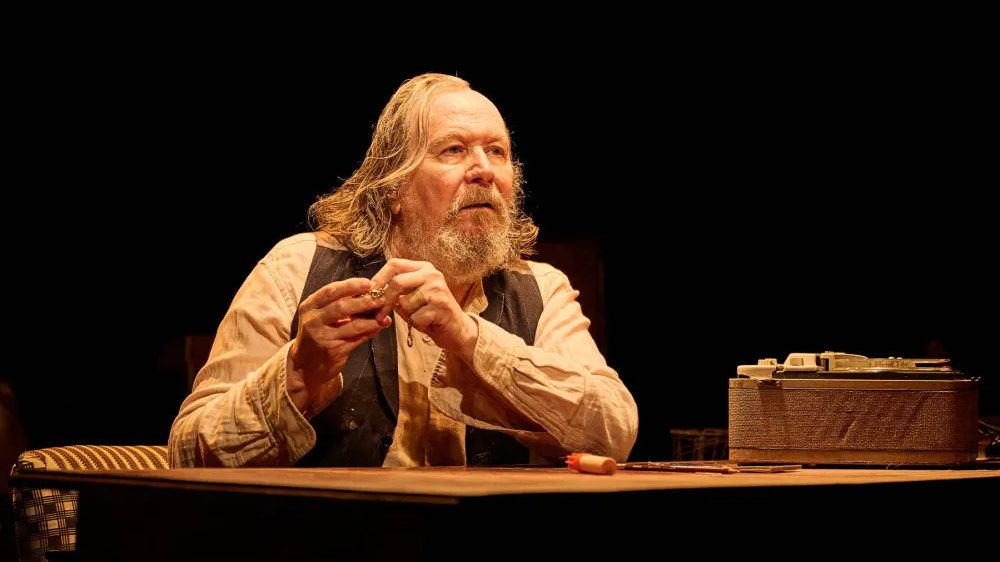
Now, the knighted movie star and Oscar winner returns to the London stage for the first time since 1987 to play a role which he fills with distinction: Krapp, the 69-year-old man wearing “[r]usty black trousers too short for him”, fidgeting and rummaging around in the den where he keeps the tapes of earlier monologues.
My first glimpse of Oldman’s stratospheric potential was in Mike Leigh’s Meantime (1983), in which he played the aggressive young skinhead Coxy. As he remarks in the Royal Court’s programme: “I can’t believe I am now one year shy of Beckett’s ‘wearish’ old Krapp.”
In a production first performed last year at York Theatre Royal, directed and designed by the actor himself – and preceded by Leo Simpe-Asante’s interesting and experimental Godot’s To-Do List – Oldman gets to the heart of the enigmatic old man. The tape recorder he uses to play his recordings is the same stage prop used by John Hurt in 2000 and Michael Gambon in 2010.
I was lucky enough to see both productions and, with respect to two late titans of the theatre, Oldman, who more closely resembles a shabby Aleksandr Solzhenitsyn than Slow Horses’ Jackson Lamb, surpasses them. In his interpretation Krapp is broken but still ribald, full of rage and true to the emotional power of the piece which, as Beckett’s finest biographer James Knowlson wrote in 1996, is “unusual in [his] theatrical opus for its tender lyricism.”
Structurally, the play is a set of Russian dolls: we hear Krapp aged 39, reflecting upon an earlier recording he made “at least ten or 12 years ago.” His 69-year-old self scorns “that stupid bastard I took myself for 30 years ago, hard to believe I was ever as bad as that.”
These memories are shards of glass, offering only splintered reflections. He recalls the women in his life (“What remains of all that misery? A girl in a shabby green coat, on a railway-station platform?”) and the failure of his literary ambition (“17 copies sold, of which 11 at trade price to free circulating libraries beyond the seas”). He evokes a mystical experience: “that memorable night in March, at the end of the jetty, in the howling wind, never to be forgotten, when suddenly I saw the whole thing. The vision at last.”
Though categorised as a late work of literary modernism, Krapp’s Last Tape prefigures the deconstruction of identity that characterised post-modernist culture. Beckett was aesthetically suspicious of new technology, but he intuitively understood its power, and the ways in which it would fragment the soul.
The modern counterpart of Krapp’s “spools” are the filtered Instagram stories and TikTok reels with which we voluntarily disaggregate ourselves. In the very first line of stage direction, Beckett writes that his drama is set “in the future”. And so indeed it is.
Suggested Reading

Kokuho, the dazzling, savage Japanese epic you must not miss
FILM
Normal (selected cinemas)
Ulysess Richardson (Bob Odenkirk) arrives in Normal, Minnesota (population 1,890) to act as interim sheriff – “like a substitute teacher,” he explains to his new colleagues – after his predecessor dies in murky circumstances. He’s not looking for trouble, though; aspiring only “to leave the town just the way I found it.”
Too bad: trouble is coming his way, whether he likes it or not. The movie’s first act is an entertaining homage to Fargo (1996): in a wink to the audience, we learn that the late sheriff was called Anthony Gunderson, sharing a surname with Frances McDormand’s police chief Marge Gunderson in the Coen brothers’ classic. There are moments of wonderful midwestern weirdness, including a moose carrying a paint pot.
Lodging in a grotty motel, Ulysess tries to persuade himself that the task of law enforcement here is straightforward: “good people, small problems.” He has two deputies: Blaine Anderson (Ryan Allen) who is already campaigning for the top job once Ulysses’ eight-week stint is up; and the hilariously maladroit Mike Nelson (Billy MacLellan), who wears a squeaky leather jacket. All of which seems of a piece with the sleepy life of a US heartland community. I mean, Henry Winkler plays the mayor: all very reassuring.
So why is the armoury at the sheriff’s headquarters quite so heavily stocked, including a shelf groaning with C-4 high explosive? Why are the walls of the local bar decorated with loaded guns? Even the yarn shop has a police scanner and a CB radio.
When an in-progress bank robbery is called in to the sheriff’s office, Normal performs a sharp handbrake turn, shifting from the brooding atmosphere of a neo-western to a full-on, shoot-’em-up B-movie with yakuza killers, gold bullion, grenade-launchers, exploding civic officials and (often gruesome) fight scenes. Yet again the 63-year-old Odenkirk shows that, almost 40 years since he was recruited by Saturday Night Live as a writer, he is now as much an action star as a comedy veteran.
This propulsive power bears the distinctive touch of director Ben Wheatley, best-known for high-octane movies such as Kill List (2011) and Free Fire (2016), as well as his under-rated JG Ballard adaptation High-Rise (2015). Odenkirk himself collaborated on the story with Derek Kolstad, writer of the first three John Wick movies as well as Nobody (2021) and Nobody 2 (2025) – the franchise that took the actor who played Saul Goodman/Jimmy McGill in Breaking Bad (2008-13) and Better Call Saul (2015-22) and turned him into an action lead.
At the preview I attended, Wheatley cited the influence of Stanley Kramer’s High Noon (1952), Sam Peckinpah, John Woo and Warner Bros cartoons. Odenkirk, clearly having the time of his life, revealed that the movie went down a storm in the town of Normal, Illinois (his home state). There is already talk of a sequel. I can’t wait.
Suggested Reading
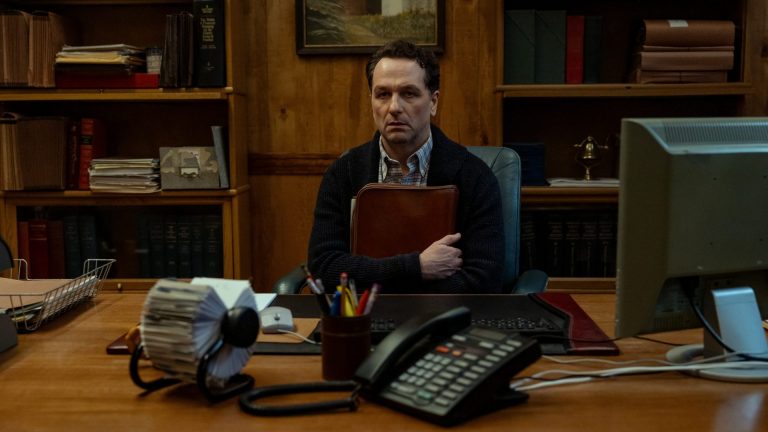
Widow’s Bay, the best horror-comedy since An American Werewolf in London
FILM
The Christophers (selected cinemas)
To be honest, I would watch anything that starred two such generation-defining talents as Ian McKellen and Michaela Coel; but to see them together in a cinematic chamber piece, directed by Steven Soderbergh and written by Ed Solomon, is a rare treat indeed.
Coel plays Lori Butler, an art restorer sleeping in her studio and making ends meet by working in a Chinese food van by Tower Bridge. When she is approached by art school contemporary Sallie (Jessica Gunning) and her brother Barnaby (James Corden), who need her help to dupe their elderly artist father Julian Sklar (McKellen) into leaving them a hefty inheritance, she is initially wary.
According to the plan hatched by this unlovable duo, Lori will become Julian’s assistant – with a covert mission to get her hands on the third, unfinished series of “The Christophers”, legendary portraits Julian painted of a younger lover (modelled, perhaps, on David Hockney’s images of Peter Schlesinger) and to use all her artistic powers to complete them. When he dies, the siblings will sell them for a fortune – the existing canvases are each fetching more than £3 million – and give Lori a slice of the action. Ethics aside, she needs the money; and also, it transpires, has a personal grievance against Julian.
When she meets him at his home – two adjoining townhouses – the atmosphere is frosty. Long past his best (“I’ve done nothing but shit for 30 years”), he is reduced to recording sarcastic messages on a Cameo-style platform and is remembered as the brutal judge on a crass show called Art Fight rather than the ground-breaking painter he once was.
The notional job interview is mostly an exercise in eccentric grandstanding: “I like my flattery, I just have to believe it”; his osteopath Cyril “smells of radishes. Why?”; “I was bisexual, Lori, when it actually cost you something to be so — are you any good with humidifiers?”
A lesser ensemble would have squeezed out of all this an entire movie about culture wars and the generational, racial and patriarchal tensions that undoubtedly arise between Julian and Lori. But The Christophers has higher ambitions.
As appalled as she is by his performative nonsense, she is intrigued by him, the waning of his artistic fire and the relics of his life that line his ramshackle home (fantastic production design by Antonia Lowe). He, too, finds her candour and refusal to defer to him appealing and enlivening. “To be honest,” he says, “I’d rather have your brains, not your pity.”
What ensues is not only a movie about art, forgery and the difference between the two, but an absorbing game of chess between two powerful personalities: a gentler version of Joseph L Mankiewicz’s Sleuth (1972), if you like.
I shall not spoil the psychological, emotional and intellectual twists that follow. Suffice to say, 37 movies in, Soderbergh is on a tear. And Coel and McKellen are simply magnificent.
Suggested Reading
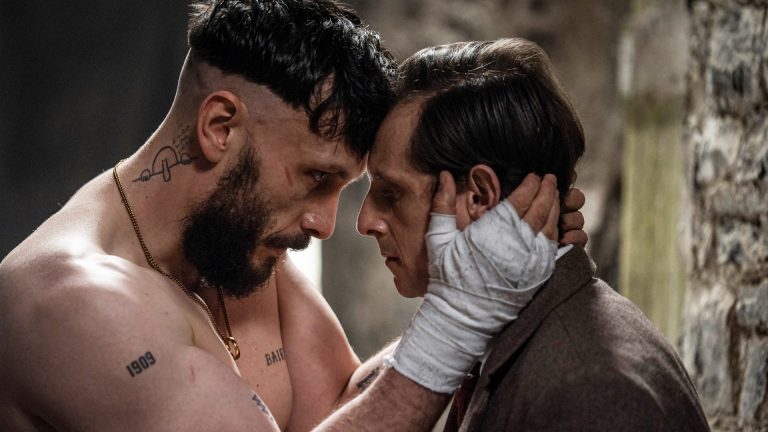
Richard Gadd’s Half Man is brutal, thrilling and unforgettable
FILM
Leaving Las Vegas (4K UHD/Blu-ray, STUDIOCANAL, May 18)
The demon drink has inspired many classic movies – Billy Wilder’s The Lost Weekend (1945), Blake Edwards’ Days of Wine and Roses (1962) and
Louis Malle’s Le Feu Follet (1963) among them – but Mike Figgis’ 1995 masterpiece is the pick of the bunch.
This exquisite restoration brings out the vivid, often hallucinatory quality of Declan Quinn’s Super 16mm cinematography, which meshes hauntingly with the descent of sacked Hollywood writer Ben Sanderson (Nicolas Cage) into terminal alcoholism. In Las Vegas, he unexpectedly forms a bond with sex worker Sera (Elisabeth Shue) – a connection that soon blossoms into love.
Figgis, who also wrote the enchanting soundtrack featuring Sting, manages to portray Sin City simultaneously as the Hades of Ben’s psychotic decline and as the shimmering backdrop to his necessarily short-lived romance with Sera. Cage’s Oscar-winning performance remains his greatest, but, as I watched the movie again for the first time in some years, I was struck by the astonishing grace, nuance and power that Shue brings to her role, and how, in fact, she is the tragedy’s true anchor.
There are plenty of first-rate extras, too. A must for every cineaste’s collection.