At 11am, two hours before the start of the Unite The Kingdom rally, Rollie Kahaani catches the scent of prey. A tilt of the head in the direction of an oncoming commotion is all that’s required for her senses to snap into focus.
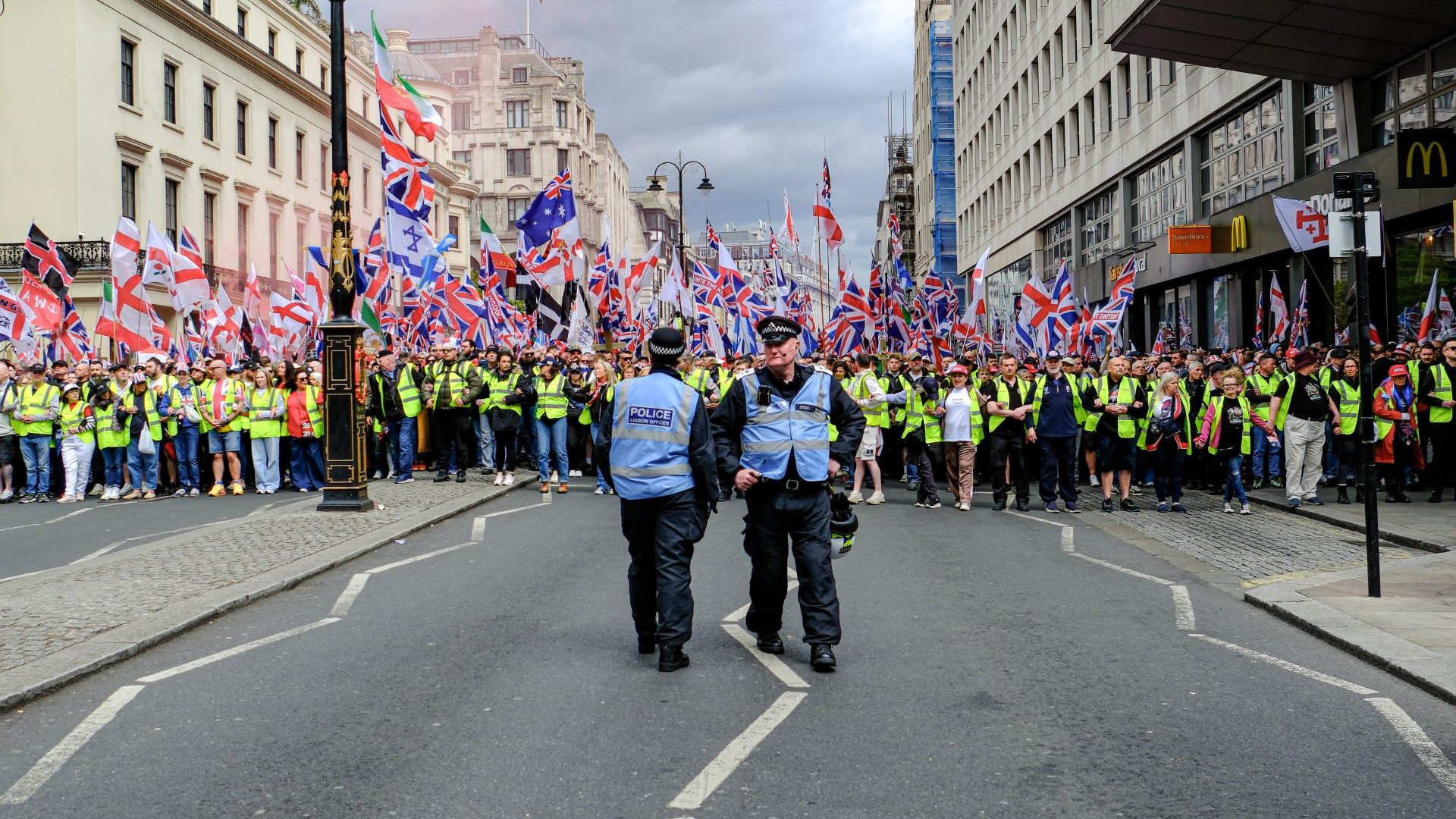
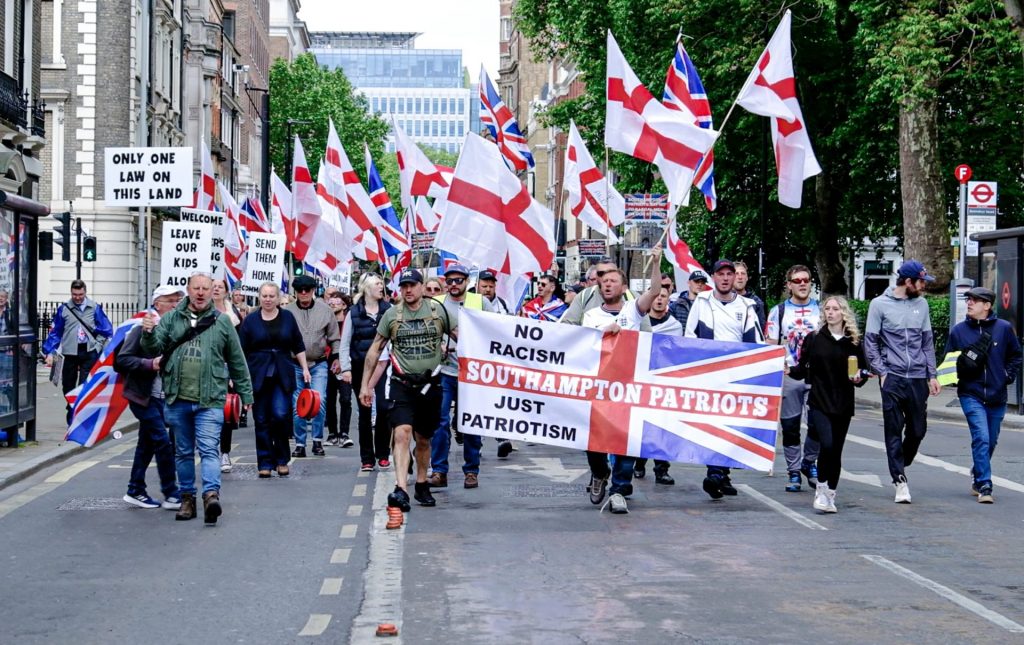
To her right, a group of two dozen protestors progress with purpose down Bloomsbury Way. Arms swinging like metronomes, from beneath a flutter of English and union flags, their raised voices carry to a crowd of many thousands held stationary 100 yards east. In unison, the group sing the praises of Tommy Robinson. Of the people arriving in Kent on small boats, they chant, “Where are their passports? They’re in the sea!”
Representing a demographic against which today’s march holds a grudge, the 22-year-old Kahaani has been training her Fuji H-X2 camera on dark surfaces for almost five years, her photographs appearing across social media as well as her own website. After documenting more than 100 far right rallies, she knows from experience that the group in whose path she is now standing lies at the firmer end of the illiberal ecosystem. Crouching down, just feet from a banner that shows where the group are from, she starts taking pictures.
“One of the reasons I wanted to photograph them, when I realised they were [from] Southampton, is that there are certain areas in the country that are like hotspots for the far right… and Southampton is one of those places,” she tells me, two days later, on a Zoom call. “I was, like, ‘I need to get them, because some of those people are a little bit more serious’.”
She is serious too. Raised on a council estate in the north east (she’d prefer I didn’t say where), by age 17 Rollie Kahaani had swapped her “horrible” hometown for the squats of Camden. Helping to run a soup kitchen in a liberated property down near Mornington Crescent, her considerable charm was put to use persuading an almost perfect stranger to lend her £300 with which to purchase her first camera. As an Englishwoman of Pakistani descent, in no time at all, she was sticking her lens where it wasn’t always welcome.
A veteran of far right happenings in bare-knuckle barrios in Serbia and Poland, she says her scariest scrapes have occurred on English soil. While photographing riots on Teesside, Tyneside, and in County Durham, in the wake of the Southport murders in the summer of 2024, Kahaani was chased and manhandled by people whose vocabulary was not in the least bit inclusive. In these war zones, she credits the police with saving her from a machete attack. She has no doubt that a Molotov cocktail that landed at her feet had her name on its label.
Suggested Reading
Tommy Robinson’s pointless, confused, US-funded march
“The riots were insane,” she says. “Those were actual pogroms that came to our houses. I watched maybe a hundred homes get broken into. I saw people [of colour] getting dragged out of their houses, getting attacked with metal bars. They were dragged out of their cars… I thought that things like that didn’t happen in this country. One thing I learned is that they really do.”
Having noticed her pictures on social media, following a short period of negotiation, Rollie allowed me to be her shadow at the London rally. Her instructions were as follows: one, I keep my mouth shut at all times; two, in the event of difficulties, I resist the temptation to intervene.
With my head on a swivel, for more than three hours, I observed her interacting with dozens of robust rejectionists. Reflecting on the experience, six days later, I still can’t decide if the universal friendliness with which she was received is in any way significant.
On the gentle incline of Kingsway, a beer was proffered by a man who may himself have enjoyed one can too many. Seated at an outside table behind two lads who happily shared information about the timings of the march, down on the Aldwych, a family of four tried to encourage their union-flag-adorned dog to sit still for her camera.
On the pretence of cadging a light with which to ignite a cigarette – there was a lighter in her bag – at the mouth of Southampton Row, easy conversation was made with a young woman standing in the vicinity of a banner bearing trenchant views about the role of “Zionists” in the Great Replacement Theory.
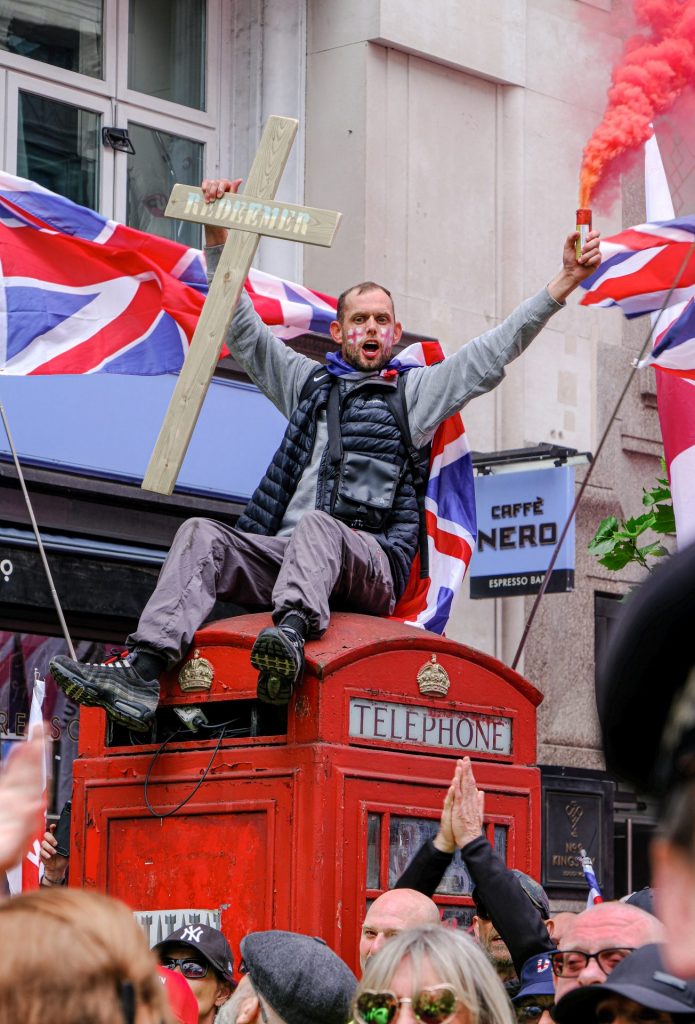
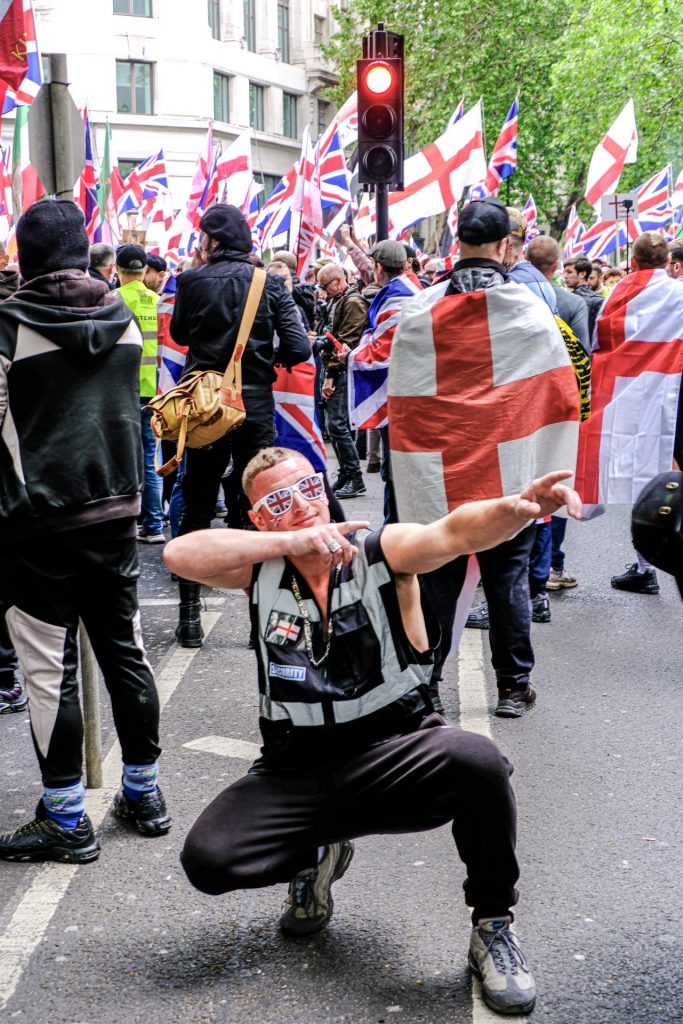
“[The day] was very interesting because that was actually the first far right demonstration I’ve gone into where I haven’t been called a racial slur at all,” Kahaani tells me. “Usually it happens at least once… a lot of the people I spoke to said they were there simply because they love their country. So many people kept saying to me, ‘I’m not racist, you know, I don’t hate Muslims’. [Hearing this] I thought, ‘Well, then you’re kind of in the wrong place, aren’t you?”
For a woman for whom photojournalism has yet to pay a living wage – she hopes one day it will – on the pavements of Bloomsbury, it’s me who looks like a layperson. As Rollie Kahaani blags her way past an otherwise implacable line of Unite The Kingdom stewards, in the shadow of Fleet Street, I’m left in her wake to wave around my NUJ press card as if it were a wooden gun.
“I’m gonna lose her!” I exclaim, no more than 40 times. After a good deal of undignified pleading, a warden at last decides that the surest way of shutting me up is to allow me to join the photographer in the no man’s land behind which a boisterous army is held in check in the hour before the march’s lunchtime commencement.
The hustle is accounted for on Zoom. “I need to be in some kind of heightened state to be good at what I’m doing,” Kahaani says. Fair enough. At least this explains why I came close to losing sight of her half a dozen times.
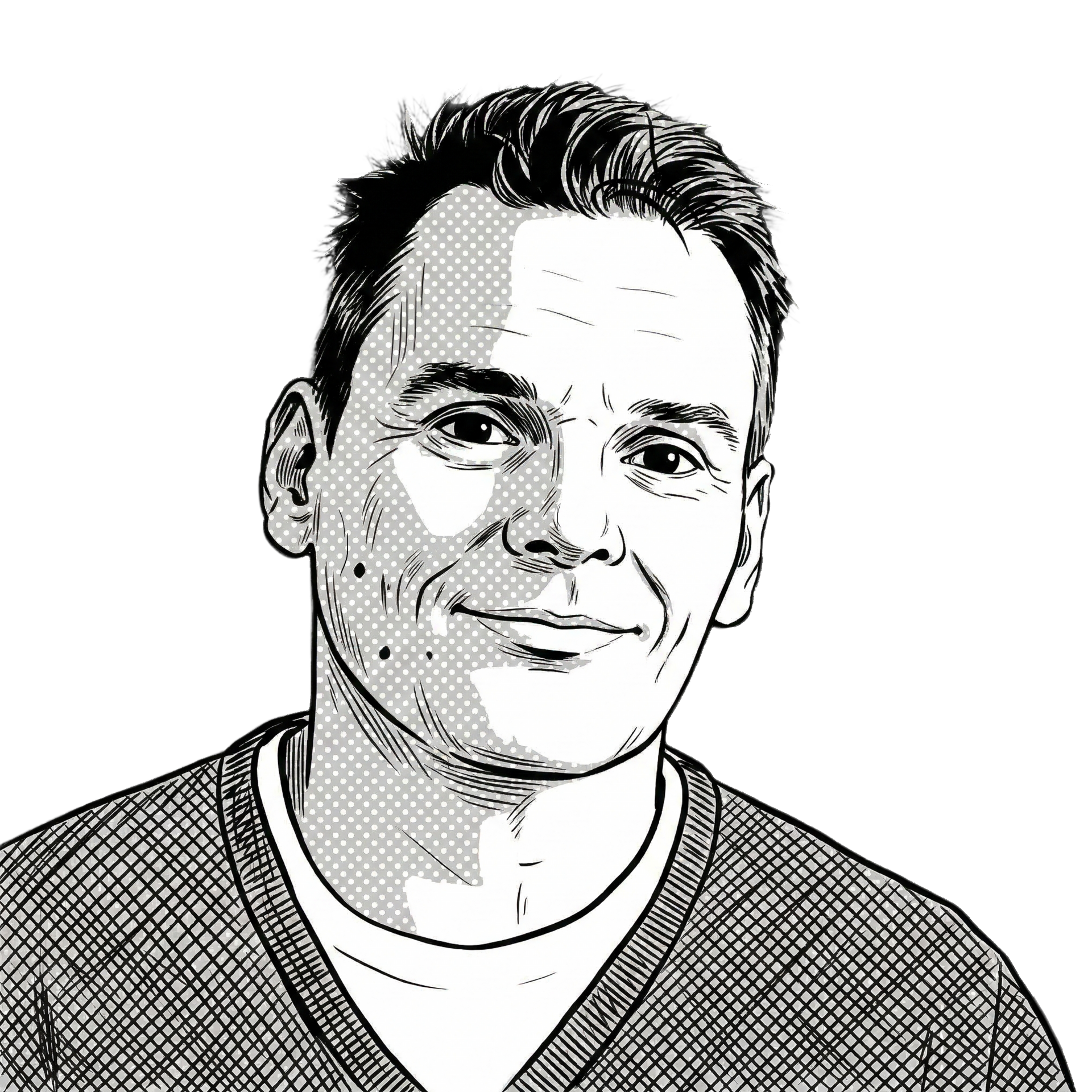
In breach of our original agreement, in quieter moments, the chat comes easy. “How are you doing?” I’m asked. “Are you okay?” I am, but if you want the truth of it, out in the field, the dynamic between us is that of expert and interloper. As an arriviste who has parachuted in from nowhere, I can only marvel at the reams of knowledge behind her eyes. By any reckoning, in this context, she’s worth a hundred of me.
The following day, on Instagram, Rollie Kahaani posts a measured summation of the weekend’s event. “I’m not going to lie or exaggerate what I witnessed,” she wrote. “There is enough fearmongering already. Quite honestly, yesterday was one of the calmest right-wing marches I’ve witnessed, with [almost] no visible police presence. I wouldn’t say something like that lightly. I’m a P*ki. Many of these people disagree with my existence.”
Despite agreeing with this assessment, as a white writer, I have deep misgivings about expressing myself in anything like the same way. I don’t think I have the right to partake in this evaluation. Instead, with attendant danger, a well-intentioned temptation to express solidarity by maximalising every mass gathering of union flags and tattoos as if it was the end of days rises to the fore. With this, valuable words that ought really to be held in reserve for when things turn genuinely nasty are wasted.
“I’ve seen the worst of this,” she goes on. “There’s so much division and fearmongering that all of my community, all the South Asian people that I know, they are terrified. And I think we need to stop the fearmongering. It’s not necessary… lying takes the value away from the really grim things that have happened on our streets.”
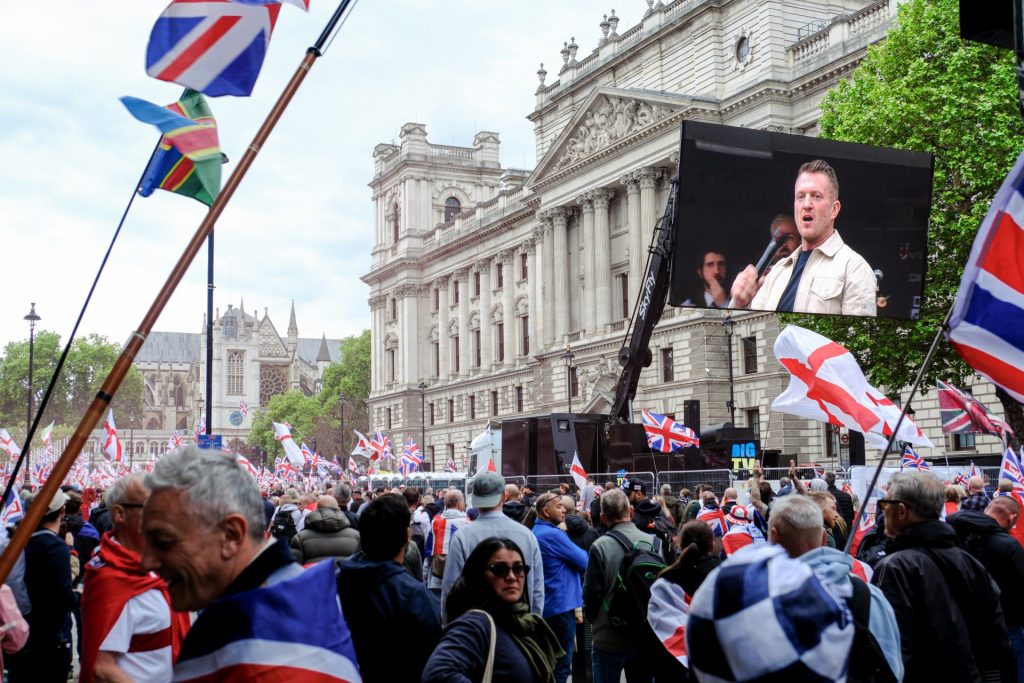
If I had to give it a name, I’d say that the Unite The Kingdom gathering was a non-violent as opposed to a peaceful march. Tempers were raised only slightly by the sight of a Led By Donkeys electronic billboard-on-the-side-of-a-van proclaiming, “immigration is good”. In response to a protestor’s threat to “smash it up”, a bored-looking copper suggested he wind his neck in.
Notwithstanding a lone banner about “white replacement”, none of the decals, voices or words emblazoned on union flags (that I saw) exceeded the boundaries what might be said by politicians sporting teal rosettes. Fluttering among the red, white and blue were dozens of banners bearing Iranian green and gold. Marching down the Strand, in keen need of a restroom, I saw as many Muslims as I do on the pavements of the Edgeware Road.
Suggested Reading
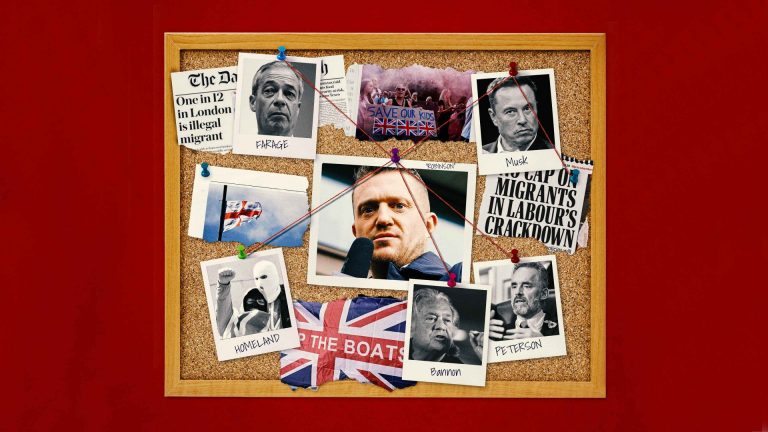

Tommy Robinson’s long shadow
For a young woman with an appetite for life’s sharper edges, none of this stuff was even remotely up to code. “Being on the ground, I feel exactly where I need to be,” Kahaani says. “I do kind of live for the chaos. When I’m photographing very calm things, I don’t function as well… There’s just something about the chaos, and something about there being loads of stuff going on all at once, that I respond to.”
Alas, by this metric, her day was up on bricks by the time we reached Whitehall. Grifting away from a stage in Parliament Square, the low-voltage rabble-rousing of Katie Hopkins and the surprisingly non-charismatic Tommy Robinson was like oratorical kryptonite to a crowd that minutes earlier had energy to burn.
For the first time all day, at last, I felt certain of what I was seeing. The self-appointed leaders of this strange movement are losing their audience.
For sure, they’d lost the woman with the camera. Sniffing the air in a fruitless quest for fresh action, Rollie Kahaani offered an economical assessment of the merry dance that had led her to the stoic heart of the British state.
“This is boring,” she said. “I’ll see you later.”
Rollie Kahani’s photographs are at www.rolliekahaani.com. Ian Winwood is the bst-selling author of Bodies: Life & Death In Rock Music