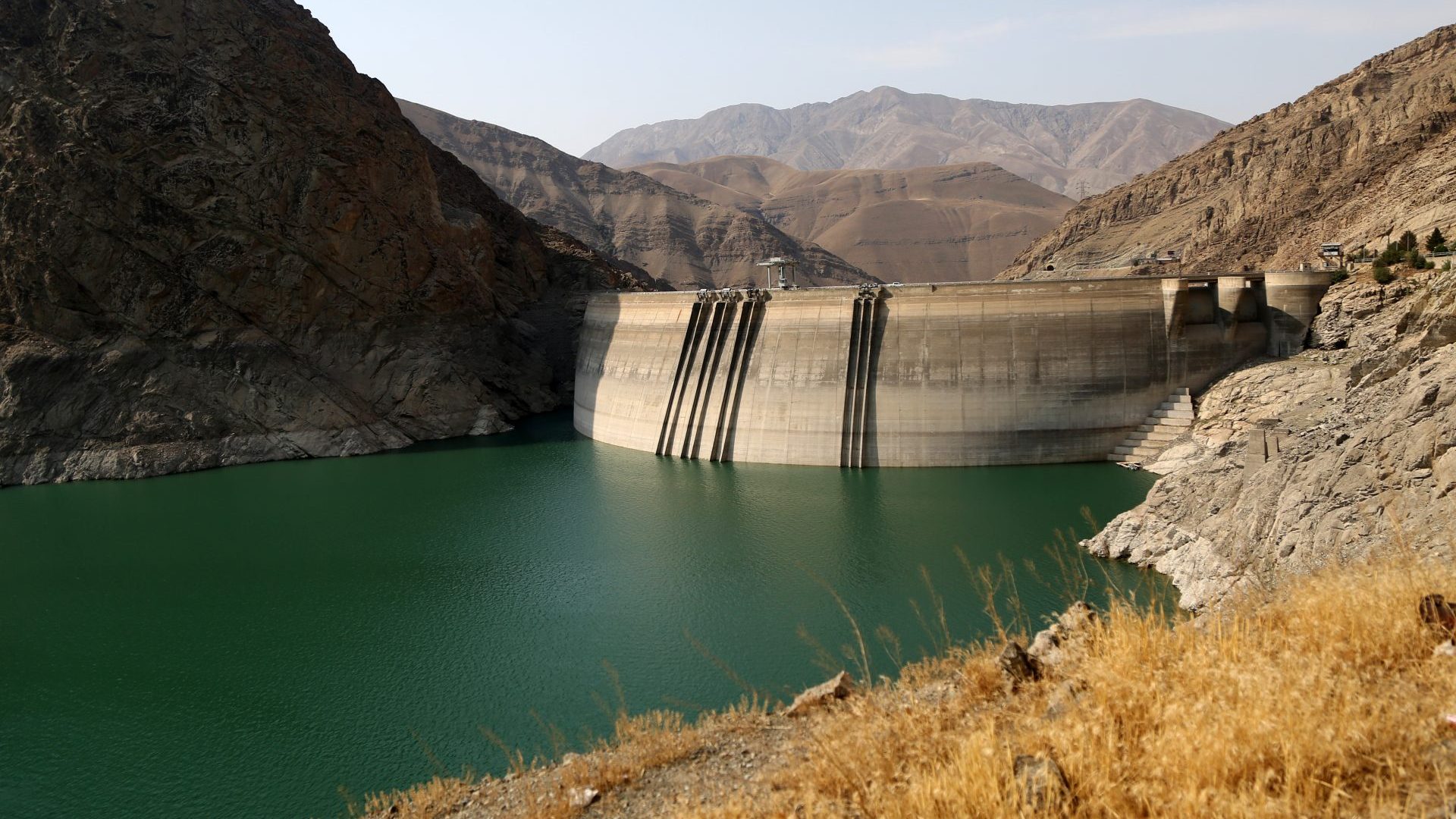
The Amir Kabir dam could be the set of a Bond movie. With sheer concrete walls flanked by vertiginous rock, it is a triumph of 1960s civil engineering. It is meant to supply Tehran with both its energy and its water supply. Right now, it contains just 3% of its total capacity.
The causes are all human. Since the dam was built, Iran’s average temperature has increased by 2 degrees Celsius due to climate change. Global warming has increased the likely frequency of severe drought in Iran from one year in 50 to one year in 10. And there have been five consecutive years of drought in this decade.
Rising temperatures speed water evaporation, drying the soil and forcing farmers – whose crops consume 80% of Iran’s water supply – to bore deep wells, which choke off traditional irrigation tunnels dug into the mountainsides since the Iron Age.
As the earth dries, dust pollutes the atmosphere. The water shortage in Tehran, home to 10 million people, is so bad that Iran’s president, Masoud Pezeshkian, has initiated plans to move the capital somewhere else.
Suggested Reading

Caroline Lucas: No10 ignored MI5 and MI6 warnings on climate change
But Iran’s water agony is just one symptom of a planetary water crisis, which is hiking geopolitical tensions and could, say analysts, produce mass population movements this side of 2050.
From Iran to Sudan to Montana in the US, the question of who controls fresh water, and what it is used for, has begun to shape geopolitics in the way oil did in the 1970s.
In December the United Nations will convene a water conference in Abu Dhabi. In the run-up to that event, a series of consultations and seminars have produced depressing amounts of “development theatre”. At a seminar in Dakar in January, bureaucrats from countries across the global south pledged to “institutionalise multi-level water cooperation frameworks to improve transboundary cooperation”, and “adopt a human rights-based approach and fully implement existing tools”. The African Union has declared 2026 the year of “water security and sanitation”.
Meanwhile, one in four people on the planet lacks access to safe drinking water at home, 3.4 billion lack safe sewage systems and 100 million still drink direct from streams and ponds.
The stakes in the new water statecraft are vividly displayed in the clash between Egypt and Ethiopia over the Grand Ethiopian Renaissance Dam (Gerd). Opened on the Blue Nile officially in September 2025, the dam produces 5.5 gigawatts of electricity, supplying half of Ethiopia’s needs and some of Kenya’s. But it gives its owners power to regulate the water supply both to Egypt and Sudan.
Suggested Reading

Three years to save Europe
Unless the three countries share data, not only about releases of water from Gerd but also the long-term effects of the dam on the Nile itself, Egypt will be in a state of permanent apprehension and grievance.
The resulting diplomatic standoff has lasted a decade, prompting Egypt at times to threaten to bomb the installation, and Donald Trump to stage one of his familiar “dealmaking” interventions, resulting in the breakdown of talks aimed at creating a trilateral control regime for the Gerd’s water releases.
Cairo and Addis Ababa are now locked in a zero-sum game for control of the Nile, with Egypt reportedly trying to use access to the Mediterranean as a bargaining chip.
Spin the globe eastwards and there’s another cross-border dam dispute, this time involving nuclear-armed superpowers. China is building the biggest dam ever, at the Yarlung Tsangpo Gorge in Tibet. Because a U-bend in the river coincides with a 50-metre drop, the plan is to bore tunnels from the high part to the low part and let the water surge through turbines buried in the mountain in between.
Once complete, the complex will generate three times the electricity of the Three Gorges Dam – but India and Bangladesh, which lie downstream, are furious. India claims the Chinese dam could reduce water flows to its Brahmaputra river in the dry season by 85%, while both New Delhi and Dhaka are worried, as with Egypt, about the effects on agriculture and local groundwater. China stopped sharing data with India on the water flow in 2022.
In response, India is building 204 dams in the region just south of the Chinese border, which should generate 65 gigawatts once complete.
These hydropower complexes in the global south should be welcome, because they will substantially reduce the world’s reliance on fossil fuels. But in each case we see the upstream state building the capacity to hold the downstream state to ransom.
The technical term for rivers that cross borders is Transboundary River Basins, or TRBs. And according to a team of researchers at universities in China, Sweden and Japan, around 40% of such basins risk triggering diplomatic conflict (or worse) between now and 2050.
Their map of potential flashpoints shows that large parts of the American and Canadian Midwest, the Sahel, southern Africa, Spain-Portugal, and most states bordering the Danube could get dragged in, as climate change makes rainfall scarcer and evaporation quicker.
But while authoritarian nationalist governments are adopting gigantism in water politics, there are few solutions on offer at the level of the village and the city.
Suggested Reading
A biodiverse bridge between two worlds
Scientists have begun to worry about the phenomenon of “Day Zero Drought” – when a combination of low rainfall, scarce groundwater and high consumption lead to a city running completely out of drinking water, a condition that then takes weeks or months to resolve. Both Cape Town and Chennai have come close to Day Zero over the past 10 years – but predicting these events depends on how trends like temperature, river flow and water scarcity interact.
The most authoritative attempts to model how these interact – by scientists in South Korea – shows north Africa and the Middle East as the most at risk from water scarcity over the next two decades, with the Amazon basin most at risk from declining river flow. Plot this data against where the population lives and a map appears that looks scarily like every current war zone in the global south.
Though they may not know it yet, the people killing each other today – from Mali to Afghanistan – are essentially already fighting over access to water, and at some point this will become overt.
The United Nations exists to overcome such complex, transnational, human versus nature conflicts. Yet the strategies open to it are minimal.
One reason agriculture is depleting water supplies so fast is that water cannot become a commodity: it is supplied to global populations at prices well below its replacement cost. The planet is literally being drained in the name of human rights and human development. All attempts to put a realistic price on water have ended in riots and the fall of governments that have tried to do so.
There is a UN convention on watercourses, whose aim is to establish principles of cross-border collaboration. But China, India, Ethiopia and Egypt have all declined to sign it.
There is, of course, the Sixth Sustainable Development Goal, agreed in New York in 2015, which mandates UN members to achieve clean water and sanitation for everybody on earth by 2030. With four years to go that is certain to be missed. And with powerful states using water to solve their energy problems rather than household water poverty, future progress looks slow.
Suggested Reading
How do you farm if you don’t have any land?
Last December the Slovenian philosopher Slavoj Žižek suggested that only something akin to communism could solve a multi-generational global problem such as the water crisis.
It is not about resurrecting Stalinism, he said, but declaring a permanent state of emergency in order to dispose of the “water mafias” that have appeared in places like Iran, and imposing rational limits on urbanisation, agriculture and development.
I would not go there voluntarily, but the experience of Tehran – where on some days nothing comes out of the tap, and where buildings have begun to sink as the earth dries out – shows there are limits on the normal solutions we reach for when it comes to problems like this.
One of the scariest charts I’ve seen is the Korean team’s predictions for the “far future” – the year 2150 and beyond. It shows most of Chile and Brazil, much of Canada and the American Midwest, most of north Africa, southern Europe and the Middle East as uninhabitable.
And though 2150 seems like a long time in the future, it is the same length of time as between today and the premier of Chekhov’s The Seagull.
Failing Žižek’s state of emergency, there are measures democracies can take in the short term: better and bigger reservoirs; replacing “planning permission” with evidence-based diktat in urban development; recycling; sustainable usage rules and technologies that reduce agricultural and industrial dependence on water.
And once you’ve seen the maps projecting certain death in the far future, you become less horrified at the idea of the birth rate slowing to below two per couple, as female education brings to a halt the massive population growth of the past 50 years.
Water is everywhere around us, and makes up 60% of the human body. Compared to rising temperatures and changing storm patterns, which we can feel, the second-order crisis produced by evaporation rates, urbanisation and cross-border hoarding move so slowly that they are harder to notice.
Yet as Tehran, Chennai and Cape Town can each attest, once you hit a Day Zero Drought, it’s too late. If Tehran becomes the first historic capital to be abandoned in modernity, then studying what went wrong there in detail would be its legacy to the rest of us.
Probably the most useful thing participants at the UN Water Conference could do is to stop issuing platitudes and start issuing warnings. As the multilateral, rules-based global order fragments, it will fall to regional blocs and alliances to adapt.
Europe, which has operated river-usage conventions since 1815, when the Congress of Vienna internationalised governance of the Rhine, stands well placed to change. The UK, which is projected to need 5 billion litres a day extra by 2050 – half of it in the south-east, which is already short – needs massive investment in desalination plants and water pipelines.
Achieving that with a bunch of asset-stripped, inefficient, private water monopolies is going to be hard. If Wales and Scotland were to quit the UK, I would upgrade that prediction to impossible.