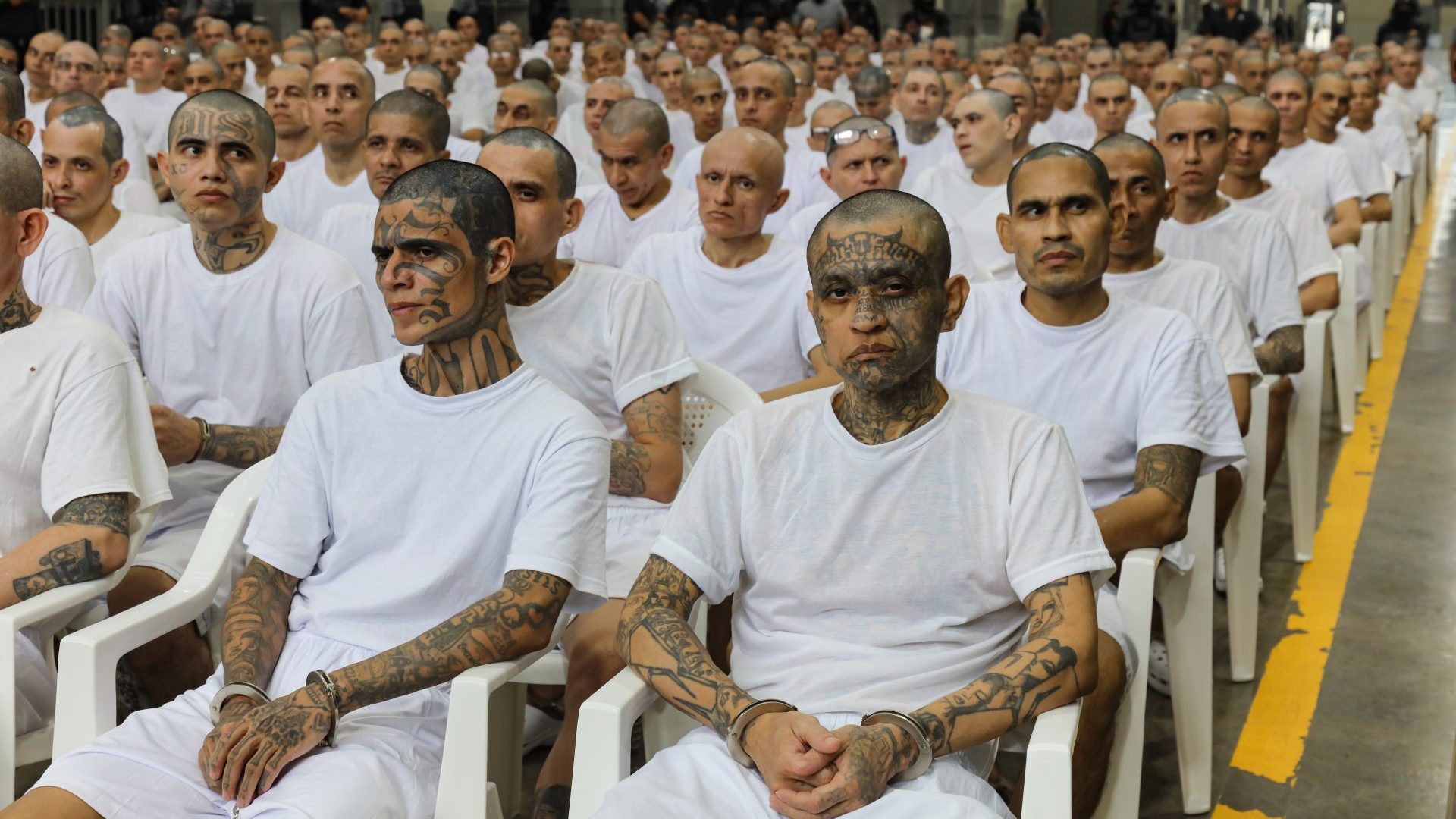
The men sit in rows: heads shaven, wrists cuffed, ankles shackled, dressed in white. Surrounding them are police officers, faces obscured by balaclavas and helmets, standing watch with weapons and batons at the ready.
The shackled men look up at large screens in front of them. Staring back are dozens of Zoom windows showing other men, clad in matching white uniforms, bound by the same handcuffs, and sitting on identical plastic chairs.
This is justice, streamed.
A group of 486 alleged gang members are being tried together in a single proceeding in El Salvador – one of the largest mass trials in the country’s history. The charges are staggering: more than 47,000 crimes over a decade, from murder and extortion to drug and arms trafficking. It is the latest escalation in El Salvador’s sweeping crackdown on gangs.
Suggested Reading

Venezuela: where even a text message can land you in jail
Once home to one of the highest homicide rates in the world – with 103 killings per 100,000 inhabitants in 2015 – the murder rate is now falling sharply as the government has ramped up its campaign against organised crime.
In March 2022, president Nayib Bukele’s administration introduced a controversial state of emergency, allowing it to suspend fundamental constitutional rights and arrest those suspected of gang affiliation or support.
But while official figures show a sharp decline in homicides, rights groups argue that the price has been the dismantling of basic legal protections.
Indeed, in practice, the crackdown has meant detentions on an enormous scale, often without warrants or meaningful access to legal representation. Since the measures came into force, more than 91,300 people have been arrested, including thousands of children. Around 1.7% of the population is currently sitting behind bars.
Security forces routinely fail to present warrants or provide reasons for arrests. Many detentions also appear to have been driven by informal “quotas”, imposed by commanders of the National Civil Police.
According to Human Rights Watch, detainees often appear to have no connection to gang-related violence, with arrests frequently based on appearance or anonymous complaints rather than evidence. Bukele himself has acknowledged that at least 8,000 innocent people were swept up in his crackdown and later released.
Suggested Reading

The choreography of fascism
Worryingly, rights groups have also documented more than 500 deaths in state custody, as well as reports of torture.
And now the courtroom has become something closer to a broadcast studio. The new mass trials law makes El Salvador the only country in Latin America to allow proceedings on this scale. Bukele, in office since 2019, has gone to town publicising the trial, even granting journalists – who are increasingly treated as enemies of the state – controlled access to the prison.
The defendants in question are alleged members of the Mara Salvatrucha (MS-13), including founders and senior commanders. Of the accused, 413 are being held at the Centro de Confinamiento del Terrorismo (Cecot), Bukele’s vast high-security mega-prison. Others are detained in maximum-security facilities in Zacatecoluca and Izalco, while arrest warrants remain outstanding for 73 additional fugitive suspects.
Together, the men stand accused of 29,000 homicides, along with femicides, forced disappearances and drug trafficking. Among the most serious allegations is the killing of 87 people in a single weekend in March 2022, the event that prompted Bukele to declare the state of emergency in the first place.
Suggested Reading

Trump is quietly destroying Cuba
Prosecutors say the trial will “settle a historic debt”. A single defendant, if convicted on multiple counts, could face up to 245 years behind bars.
Experts at the United Nations have condemned the trials, warning that they “undermine the exercise of the right to defence and the presumption of innocence of detainees”.
For human rights observers, the risk is that justice becomes less about determining individual guilt and more of a charade. “Salvadorans have the right to have the heinous crimes of gangs investigated, prosecuted, and punished,” said Juanita Goebertus Estrada, Americas director for Human Rights Watch. “But these mass trials make it impossible to establish individual accountability with solid evidence and real guarantees of defence, and therefore risk turning justice into a charade.”
The concern, experts say, is also not only the number of defendants, but the opacity of the process itself. “There is no way to see and verify that the information the prosecutors present is true. Secrecy is now the norm in El Salvador,” said Ana María Méndez, director for Central America of the Washington Office on Latin America.
And yet, for many Salvadorans, the results are hard to ignore. Bukele’s aggressive anti-crime strategy has resonated widely. It has turned him into one of the region’s most popular leaders.
Harriet Barber covers human rights abuses, migration, women’s rights and politics in South America