
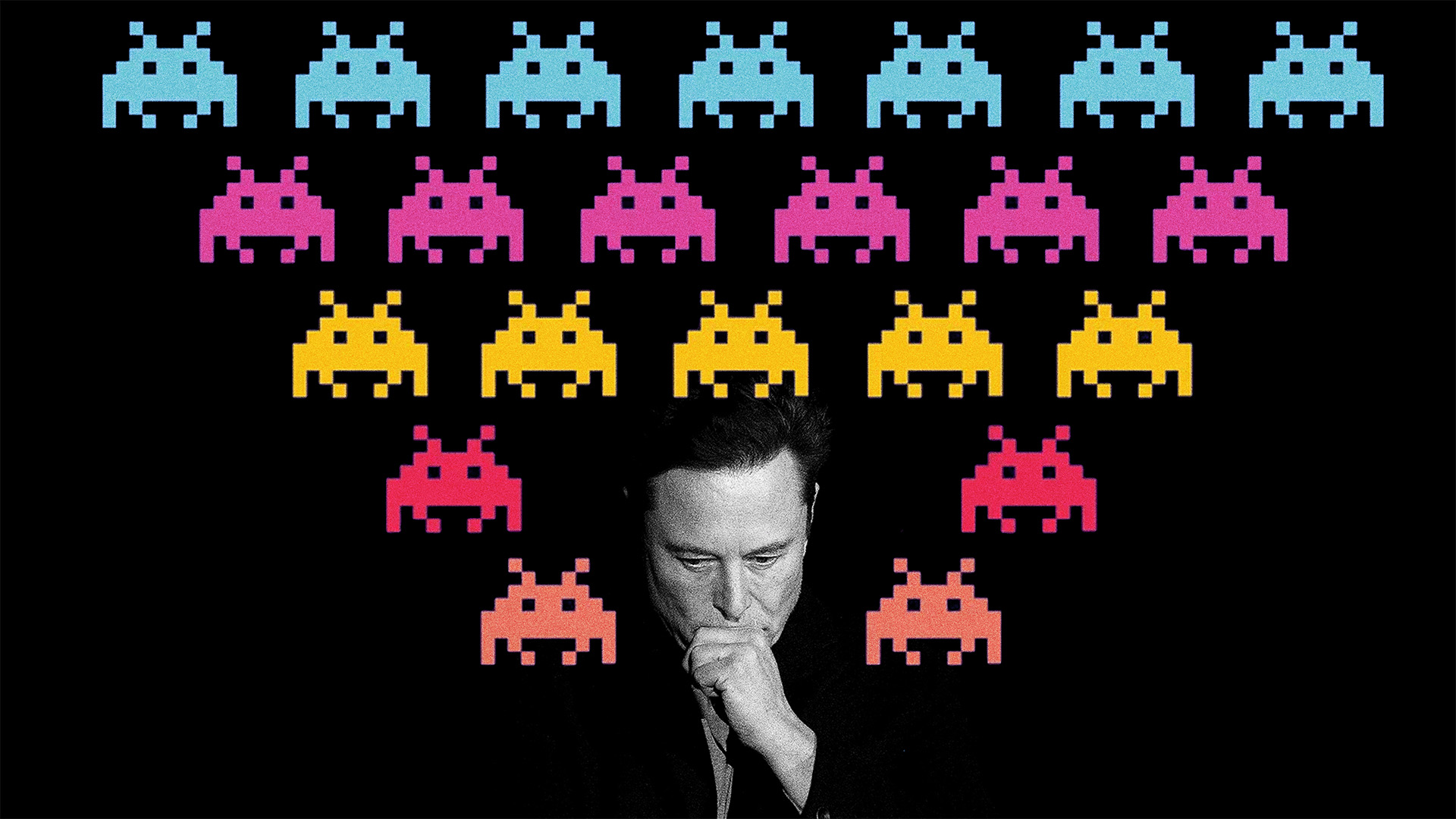
We are not short of reasons to dislike Elon Musk. Another one is soon to be added, as his rocket company SpaceX is about to be floated on the US stock market, which will make him even more absurdly wealthy and no doubt even more obnoxious.
Amid all that talk of his money, his latest weird posts on X and his proto-fascism, you could have been forgiven for missing a piece of Musk-related news that cropped up back in late January. SpaceX applied to launch 1 million satellites into orbit in the coming years. These would be in addition to the thousands it has already launched, which form the backbone of the Starlink internet service.
The reasoning behind this, according to Musk, is his eventual ambition to build data centres for AI in space. The satellites would effectively act as a solar-powered networked alternative to standard data centres, which currently require huge, energy-intensive structures on earth. It is currently unclear whether it would in fact be physically possible to establish a data centre in space, but such petty constraints tend not to concern Elon when it comes to hyping his own grand vision. And if the floatation of SpaceX goes according to plan, money won’t be a problem.
Suggested Reading


Will we all end up as Chinese AI death clones?
On one level at least, it sounds like a positive – if very scifi – vision. Why wouldn’t we want to eliminate the electricity-and-water-guzzling datacentres of 2026 with a distributed, solar-powered version floating many miles above us, hidden from view?
Well, for one, allowing the world’s richest man to effectively privatise the most-accessible bits of the cosmos feels a bit on-the-nose. Space, while famously being really very big, doesn’t allow for an infinite number of satellites in orbit around the Earth.
If Elon gets a million of his up there first, that precludes anyone else from putting satellites in those orbits, effectively allowing SpaceX, Starlink (and, should the data centres thing work, xAI) to colonise our immediate cosmic surroundings in service of one man’s vision and, ultimately, bank balance.
Peter Plavchan, professor of astronomy at George Mason University, has described it as “the ultimate first-mover territorial claim strategy in lieu of off-world space regulations.”
There’s also a side-effect in terms of how this volume of satellites is going to affect our ability to monitor the rest of space. Due to the trails left by satellites as they orbit, the Royal Astronomical Society (RAS) estimates that images taken by the European Southern Observatory’s Very Large Telescope would lose 10% of data due to satellite trails, and even the Hubble’s functioning would be impacted, inhibiting our ability as a species to further investigate the cosmos.
Suggested Reading

Tone-deaf Jeff: how the world soured on billionaire Bezos
That’s without taking into account the human-level visual impact – millions of satellites in varying orbits would mean thousands were visible to the naked eye, many more than actual stars, meaning future generations’ perceptions of the night sky will likely be very different, full of man-made objects rather than stellar or planetary bodies.
Dr Robert Massey, deputy executive director at the RAS, said: “These proposals would not only have a disastrous impact on the science of astronomy, they would also hinder the right of everybody on Earth to enjoy the night sky. That is unacceptable. The stars above us are a valued part of human heritage – deploying more than one million exceptionally bright satellites would utterly destroy this and permanently scar the natural landscape.”
Then, of course, there’s the environmental impact. While we might end up getting rid of earthbound data centres, the satellites to replace them need to get into space somehow, which means, according to calculations by Scientific American, somewhere in the region of 20,000 launches to get the things into orbit, with all the associated emissions.
According to Andrew Wilson, assistant professor in environmental management at Glasgow Caledonian University in Scotland, a single Starship launch produces 76,000 metric tons of carbon dioxide equivalent, and that’s without mentioning the soot, water vapour and methane they produce, each of which is a potential contributor to global warming.
Then there’s the fact that these things don’t last forever. Satellites have a lifespan, and, when they stop working, they will need replacing, which would push the potential number of launches required to maintain the network to an estimated 10 a day – forever.
Suggested Reading


It’s official: AI hates women
Last, but very much not least, there’s a crowding issue. Launching things into space isn’t easy at the best of times, but becomes exponentially harder when you have to account for tens of thousands of satellites whizzing around the Earth; when you multiply the numbers by a factor of 100 or so, that problem becomes much more significant. The potential side-effects of a collision with a satellite, the resulting debris and the potential for a subsequent chain reaction of other collisions risks precipitating what’s termed the “Kessler Effect”, whereby our orbit effectively becomes so littered that it’s effectively unusable.
Whether or not you think all this is in any way worthwhile will depend largely on your faith in the great Hail Mary that is AI to solve all the world’s problems, including the problem of “how to clear up all the junk we’ve chucked into space”.
Should Elon get his wish and the night sky become bright with the light of a million satellites, we’d better hope that the gamble on AI’s status as the universal cure-all pays off. Because otherwise – and this is starting to feel like a familiar refrain – we’re going to have to spend a lot of time working out how to fix the mess he’s left behind.