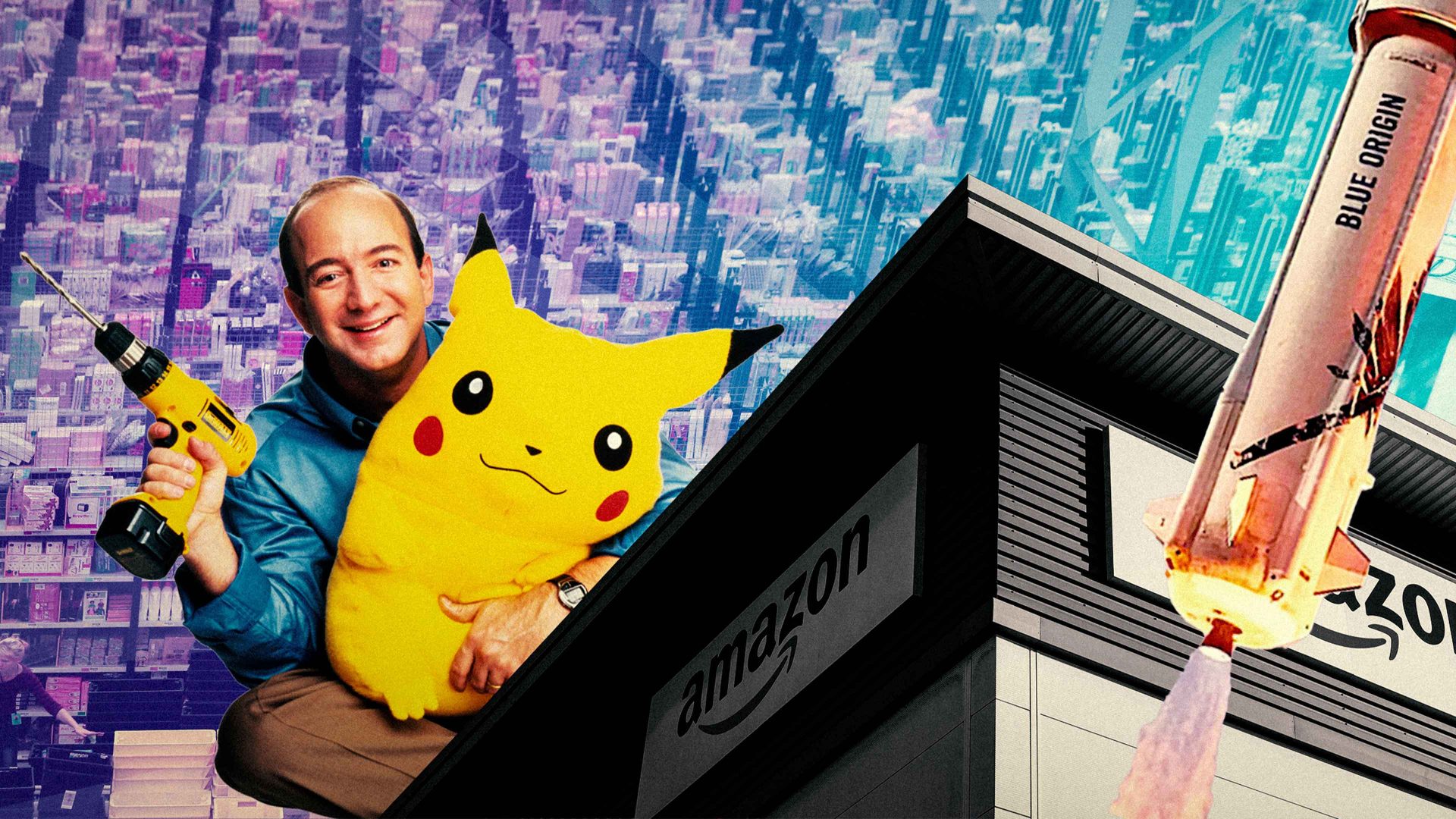
It is 2006. You are Jeff Bezos. Your bookselling business, founded in a garage after you quit your job at a hedge fund, has expanded into music and DVDs, as well as the increasingly lucrative cloud infrastructure market. You have a distinctive, honking laugh which you deploy with disarming frequency.
You are slender and balding and have a vibe that can best be described as “man who is really into spreadsheets”. You have been married to MacKenzie, a novelist, for 13 years. If the world thinks of you at all, it’s as one of the new wave of post-internet business geniuses. You are worth some $6bn.
It is 2026. You are still Jeff Bezos. You have stepped down from Amazon, a company that is now basically a piece of global infrastructure which supports about half the world’s internet, and have pivoted into AI and commercial space travel. You own the Washington Post. You are now insanely jacked, like a condom full of walnuts, and your vibe is “Pitbull’s more serious and incredibly sinister cousin”.
No one has heard you laugh for years. Following an extramarital affair, you are now married to Lauren, a walking counterpoint to the concept of cosmetic surgery as art. You own a megayacht featuring Lauren as a figurehead. Thanks to leaked messages between the two of you, a troubling number of people know what your penis looks like. You hired the entire city of Venice for your wedding, bringing hundreds of private jets and yachts to a city increasingly ravaged by climate change.
You have sent Katy Perry into suborbital flight. You have laid off a third of the staff of the Washington Post. You have sponsored the Met Gala, the pinnacle of global celebrity networking, and nowadays rub shoulders with Kardashians. When the world thinks of you it shudders. You are an avatar of all that is wrong with modern capitalism. You are worth some $270bn.
Jeff – what the fuck has happened to you?
Suggested Reading

What would Rousseau think of Bezos’s wedding?
There was a time not too long ago when the new titans of industry born of the digital revolution were content to sit in the shadows and build their businesses, quietly coding away in their hoodies or buttondowns as they studiously avoided eye contact with the rest of us. Now, though, they are no longer content with being violently rich – they want to be seen.
Jeff in particular has done something of a 180 in terms of his relationship with the outside world, seemingly in part motivated by his second wife. Mrs Sánchez-Bezos, a truly remarkable human being, was recently profiled in the New York Times. The piece suggested that the plutocrat class was ready to “stop apologising, and start enjoying themselves,” while going on to list in exhaustive detail the many, many privileges enjoyed by the happy pair in their multiple mansions.
The couple’s Met Gala sponsorship – acquired for the reported price of “at least” $10m – feels like an apotheosis of sorts. Bezos is evolving into his final form, a sort of appalling Pokémon made of silicon chips and vested share options wrapped in lab-grown muscle, rubbing shoulders with the gilded celebrity class – as is his right.
Following the couple’s star-studded Venetian nuptials, Jeff and Lauren are now firmly established on a par with the Kardashian class, accepting of their status as special people with a special right to wealth and happiness. Jeff Bezos isn’t ashamed any more.
And why should he be? While Trump 2.0 has prompted comparisons to the 1930s for obvious and increasingly terrifying reasons, there are arguments to suggest that the 2020s are far more similar to the 1980s. Cocaine is once again everywhere, greed is once again good, and wealth is once again to be celebrated.
The Leader of the Free World [sic] is a man for whom gaudy, ostentatious displays of wealth are second nature; why shouldn’t those benefiting from his deregulatory largesse follow suit? After all, if you have it, it’s a shame not to flaunt it.
There’s also perhaps a sense of safety in numbers. While back in 2006 Jeff was part of a select global cabal of billionaires (a mere 793), in 2026 the ranks of people with 10-figure bank balances has swelled to an astonishing 3,428 billionaires. Once there are enough of you to constitute a village, you become emboldened to strut a little more and hold your head a little higher.
It’s hard not to feel that, in tech at least, there’s some very specific revenge being enacted. While it’s impossible to know the exact childhood trajectories of messrs Bezos, Zuckerberg, Musk et al, it’s not hard to imagine them not enjoying entirely happy adolescences. Musk’s biographers in particular recount Elon being mercilessly bullied at school. When you’ve broken free of the playground taunts to basically win at capitalism, perhaps it’s understandable that you might want to show off a bit.
Suggested Reading


Come on, Jeff. Don’t let the Washington Post die in darkness
There is also a very clear sense of entitlement at play, and a growing belief among the more ostentatious, founder-cult tech leaders that we serfs simply haven’t been quite grateful enough for the boons bestowed on us by the genius class at the top of the pyramid.
In September 2024, Mark Zuckerberg said that he was “done apologising”, suggesting he had always operated “in good faith” and that criticism of his company was senseless carping from “people who want someone to blame”.
Elon Musk never tires of reminding people that we only have a successful electric car market because of him, and that he is the only person seriously trying to save humanity through a multiplanetary, interstellar future. The fact that this might be necessary to escape an Earth beset by problems caused by people who, if you squint, might be considered quite similar to Elon Musk does not at the time of writing seem to have occurred to him.
Oddly, this is a perspective that’s been propped up by sections of the US media. Amid the furore over the Bezos Met Gala sponsorship (although exactly what moral high ground a fashion parade for the Hollywood class has to lose is, perhaps, questionable), the Wall Street Journal published an unhinged piece of commentary headlined “Billionaires Rock”.
Sample quotes include “our greatest billionaires ought to have statues placed in public squares. Their stories ought to be taught to children as parables of inspiration.” Critics of people like Zuckerberg should shut up, said the WSJ, and “volunteer to clean his sneakers and iron his hoodies.”
Suggested Reading
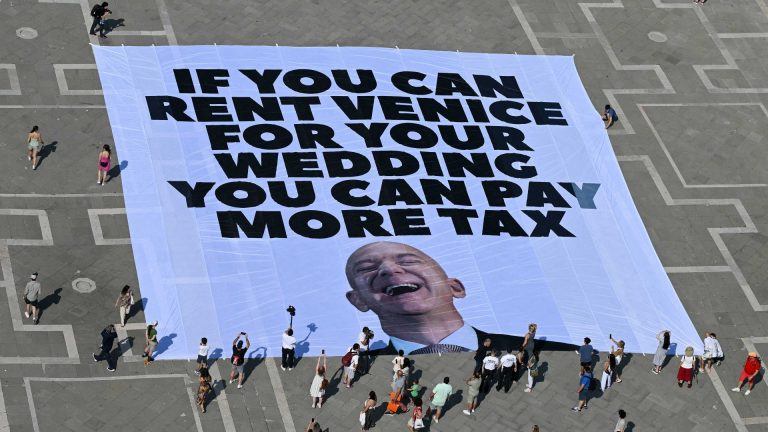

Venice cannot be bought, Mr. Bezos
Meanwhile, in the real world, governments are strapped for cash, public services are crumbling, the labour market is increasingly uncertain and swathes of the planet are becoming increasingly unliveable. Everything is technology and none of it is fun, adverts are inescapable, the web is degrading, it’s increasingly impossible to tell what is real and social media is turning everyone miserable or insane, or both – and that’s not to mention sodding AI. Without being churlish or too ungrateful, this feels like quite a big price to pay for next-day delivery and an infinite scroll.
It’s not clear how long this can hold. “Billionaires should not exist” is a position gaining traction among younger generations, and the most vital political presence of the modern era, NYC mayor Zohran Mamdani, owes his international appeal to a policy platform that openly campaigns on progressive taxation of income and assets.
While the international rule of law – and incredibly well-equipped personal security details and secure bunkers – lessen the likelihood of the French-style revolution, it is not inconceivable that we might see a swing towards a more punitive policy approach to plutocrats in the inevitable, longed-for post-Trump era.
Until then, though, Jeff Bezos will seemingly continue accruing additional wealth for the rest of his life. The terrifying prospect, of course, is that some of those $270bn will be devoted to pursuing life-prolonging techniques that will see him and the rest of his tech oligarch cohort last well into the 22nd century.
The future is a betuxedo’d muscleman with an ovoid head posing stonily on a red carpet, for ever. On reflection, given that AI is set to take our jobs anyway, perhaps we should all retrain as carpenters and get into the guillotine business – before it’s too late.
Matt Muir is writer of the webcurios.co.uk newsletter on tech and the internet