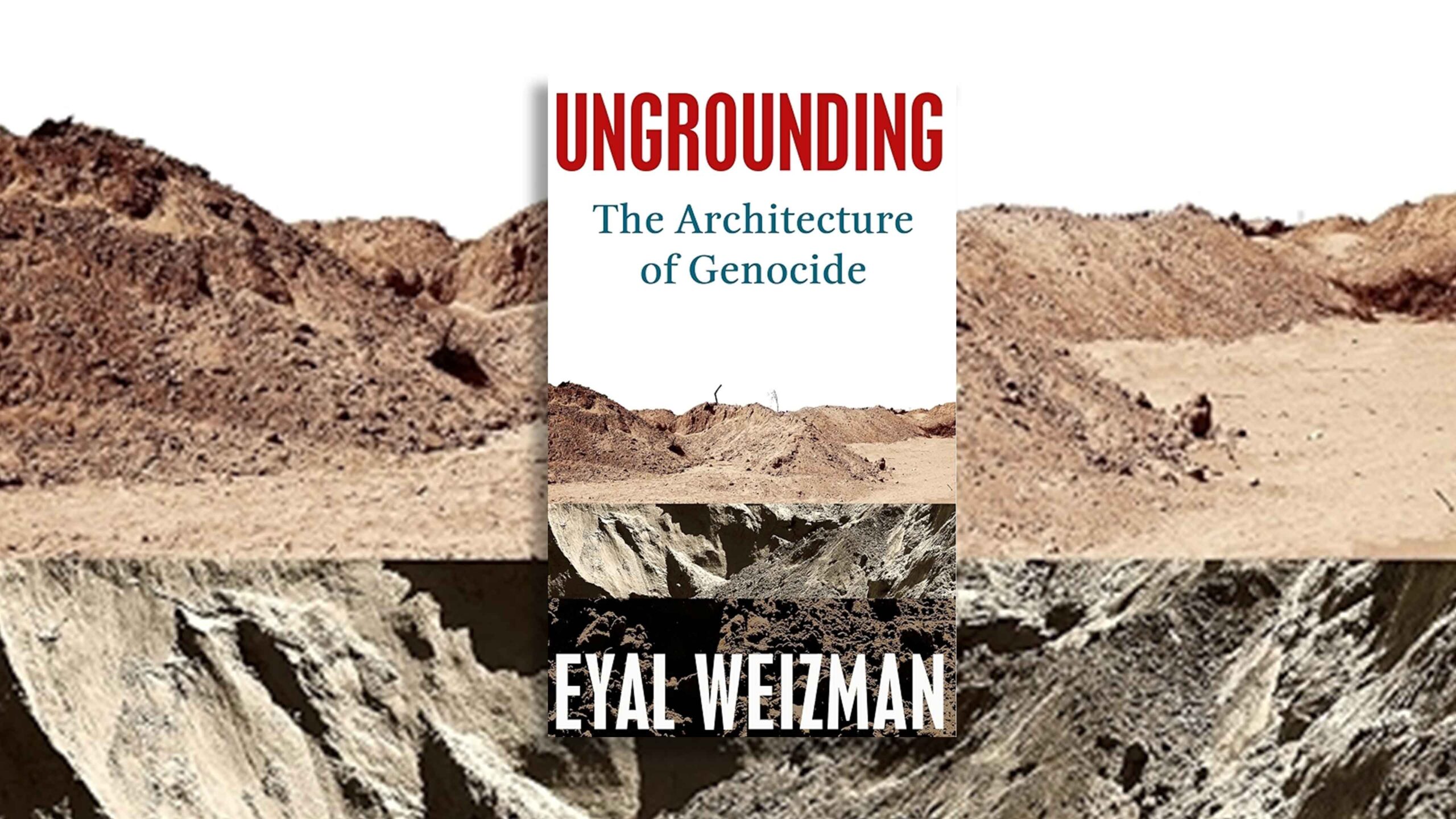
Before October 7, 2023, the border between Israel and Gaza seemed impenetrable. Israel’s security fences included a deep underground barrier with sensors detecting subterranean activity. In the skies, drones and military planes hovered. Above those, loomed Israel’s Iron Dome missile interceptor system.
“The [Israeli] army believed it had solved the Gaza problem,” writes Eyal Weizman in Ungrounding: The Architecture of Genocide. Then on October 7, Hamas attacked the Gaza Envelope.
Later, Hamas tried to defend the slaughter of 1200 people, claiming the focus of its military operation was destroying the Israeli army’s Gaza Division, while avoiding harm to civilians. But the video broadcasts from the body cameras of Hamas militants showed Palestinian fighters shooting unarmed civilians and torching homes with families inside.
Among these victims were people close to Weizman’s family. He was born in Haifa, northern Israel, in 1970. In the early 1990s, Weizman departed for London to study architecture, where he has remained ever since. In 2019, Weizman was elected a Life Fellow of the British Academy. A year later, he received an MBE for services to architecture.
Weizman’s work examines the link between history, politics, architecture, systematic violence, and colonization. He has published several books on this topic, including Hollow Land (2007), which provided a detailed history of Israeli-built architectural structures, since 1967, inside the Palestinian Occupied Territories.
Ungrounding also deals with this history. But it specifically focuses on Gaza. It also goes back a little bit further, to the last years of British Mandate-era Palestine (1920-1948).
Suggested Reading

How America changed its mind on Israel
During the Arab-Israeli war (1948-49), Yosef Weitz, director of the Jewish National Fund’s Lands Division, told a group of soldiers from The Haganah (a Zionist military organization) that occupying territory by itself in Palestine would not be enough to complete the Zionist vision for a Jewish homeland. The occupation of the soil would also be necessary,
Weitz explained: “After the Negev [is] conquered by sword, we will later need to conquer it with a pickaxe and the plough.”
Weizman’s book contains many maps too. They draw attention to the soil and topography of Gaza. Post-1948, Palestinians in Gaza were expelled from areas with fertile soil and pushed towards refugee camps on the coastal dunes, where the land was arid. When the Gaza Strip was occupied by Israel in 1967, the security fences were built over a plough line.
Following the US-brokered 1979 Israel–Egypt Peace Accord, Israel’s demand to leave Gaza under Israeli occupation was granted. “A hard border between Palestine and Egypt was erected for the first time,” Weizman explains. “The first cross-border tunnels were dug as soon as a fence was erected.”
It took several decades, however, for a sophisticated network of Palestinian tunnels to develop. They evolved with the restrictions imposed above ground.
In 2005 Israel dismantled its Jewish settlements and military bases in Gaza. But the UN and other international bodies still considered Gaza an occupied territory.

“The means of occupation changed,” Weizman points out. “Control previously enacted on the ground was relocated to the perimeter, and to the airspace above.” The following year, Hamas won the January 2006 Palestinian parliamentary election, seizing control of Gaza.
A year later, Israel imposed a blockade on Gaza, restricting food, diesel, electricity and humanitarian aid. Hamas responded by building more tunnels, which helped goods and weapons from Egypt flow into Gaza. Weizman refers to Israel’s two-decade blockade on Gaza as “a slower way of continuous killing.”
After October 2023, the pace of killing in Gaza increased exponentially. The final section of Ungrounding provides a detailed account of this.
The book’s title refers to the systematic, structural damage Israel has inflicted on Gaza from then until now. “Ungrounding is not a byproduct of military confrontation but rather its aim,” the author writes.
The evidence Weizman presents here has been accumulated via Forensic Architecture, a research agency he founded 16 years ago. Based at Goldsmiths University, London, it uses cutting-edge techniques in spatial analysis and digital modelling to reconstruct incidents of state violence.
Since October 2023, Forensic Architecture has worked on tens of thousands of testimonies, videos and audio files from Gaza, which are categorised and archived from London, often in real time. That list includes details of an Israeli soldier who killed a deaf and mute 73-year-old Palestinian.
We also read gruesome details about Israeli snipers shooting Palestinians waiting outside a food ration station in Gaza. Once an incident is archived, Forensic Architecture plot it on a constantly evolving digital map they call “A Cartography of Genocide”.
Ungrounding finishes with a reference to Axis Rule in Occupied Europe (1944), published by Raphael Lemkin. The book by the Polish Jewish lawyer first coined the term genocide, which was recognised as a crime under international law in 1946 by the UN, and codified as an independent crime in the UN-ratified treaty, The Genocide Convention (1948).
Suggested Reading
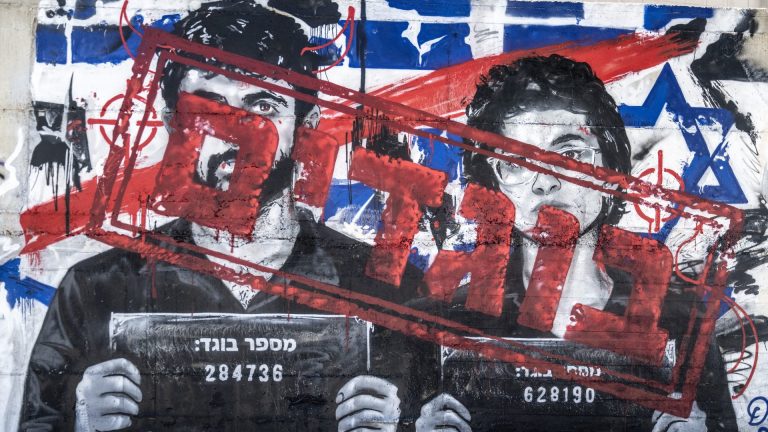

Why Netanyahu hates the most powerful film of the year
In December 2023, South Africa’s government submitted a petition to the International Court of Justice (ICJ) in The Hague, charging Israel with breaching the Genocide Convention. At the end of October 2024, South Africa’s legal team submitted a report to the ICJ detailing their case, which is still ongoing. Their evidence included an 827-page report, produced by Forensic Architecture.
They also work closely with Al-Haq, a human rights organisation based in the West Bank. Six years ago, with no credible evidence, the Israeli Ministry of Defense declared Al-Haq a terrorist organisation. In September 2025, Al-Haq was put under sanctions by the Trump administration.
Discrediting Palestinian testimonies is nothing new. It includes the destruction of evidence and the intimidation, arrest or killing of witnesses, journalists and human rights activists. Weizman believes it follows a pattern that is carefully orchestrated by Israel and its allies.
“These acts make clear that negation is not merely a game of language,” he concludes: “But a violent physical practice that unfolds in the material world, similar to the way that ungrounding is an act of denial directed against the landscape, a claim that nothing had previously existed.”
Ungrounding: The Architecture of Genocide by Eyal Weizman is published by Fern Press
 Most popular


The reckoning I thought Russell Brand would never face

The Spectator’s brazen hypocrisy over Russell Brand

Why does everyone hate Laura Kuenssberg?

Slavoj Žižek: Beating Trump isn’t the wild triumph you all seem to think