
Bernard Beatty, one of my professors at university, once told me that my fascination with William Shakespeare’s Coriolanus was because, though I swanned around fancying myself a socialist, I couldn’t help getting a bit of a stiffy when it came to a fascist. He didn’t use exactly those words, though as a man who wrote the book on Byron he might have.
I often think of this observation. Coriolanus is a violent man who protects society, but whose violence puts him beyond the pale.
A successful Roman general, he is persuaded to go into politics, but ends up insulting the people so much that not only does he fail to win their approval, but he is exiled from the city and joins Rome’s enemies, who appreciate his prowess at murdering. Returning at the head of a Volscian army, he’s finally persuaded to relent and save Rome, which he does knowing it’ll almost certainly get him killed.
Coriolanus turns up again and again in our culture. He’s the gunslinger, like Ethan from The Searchers, who makes the west safe for white settlers but who is left to the desert, the door of the homestead closing on him in one of the most iconic shots in cinema.
Clint Eastwood, John Wayne’s cool younger brother, gave his own version as “Dirty” Harry Callahan, who is basically Coriolanus with elbow patches and a .44 Magnum. He doesn’t like the libtards of summer-of-love San Francisco but he’ll blow away anyone who looks like they’ll put a dent in their afternoon. We want our Mel Gibsons: we just don’t want our Mel Gibson.
Suggested Reading

The rules of rebooting James Bond
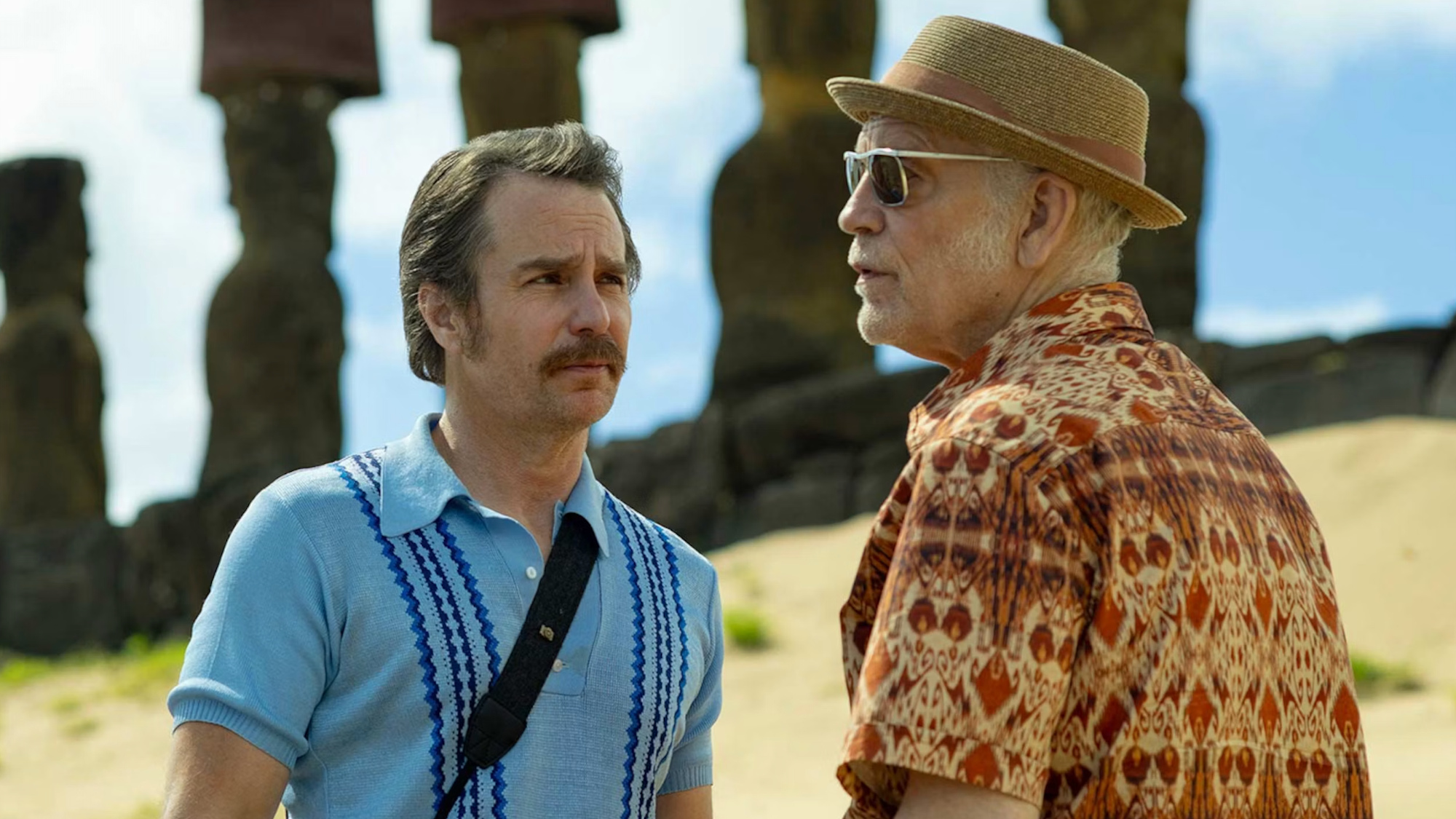
Martin McDonagh’s new film Wild Horse Nine features two lovable Corialanuses. John Malkovich plays Chris, a CIA hitman who along with colleague Lee (Sam Rockwell) head to Rapa Nui (or Easter Island) for some downtime before the coup that would lead to the death of Chile’s democratically elected president, Salvador Allende, and the country fall into the hands of Augusto Pinochet, one of history’s cunts.
The film places us in familiar McDonagh country: a world of cool violence, male friendship and off-the-beaten-track tourist destinations. The tourist outing gives McDonagh a structure as his off-the-clock assassins take in the sights and rub shoulders with tourists from around the world.
Two of these are a pair of young students, Monica (Mariana di Girolamo) and Alicia (Ailín Salas), who the men bump into at the airport. They are lefties who initially despise the gringos and correctly suspect them of being CIA.
Things are not entirely as they seem though. Chris is dying and becoming increasingly indiscreet, something that his section chief – the always great Steve Buscemi – wants stopped, or more accurately wants Lee to stop.
In the past, McDonagh has used violence with black humour and the consequenceless playfulness of an adolescent drawing gory battles in an exercise book between lessons. It’s the Tarantino school of hitman cool, but morphed into a long-coated sixth-form melancholia.
The violence heightens everything and then he can be doubly cool by undercutting it like it’s no big deal. In Bruges is a wonderful film, but I wonder how much better it would be if Colin Farrell and Brendan Gleeson had been businessmen attending a conference and Ralph Fiennes their supervisor.
In Wild Horse Nine he further sticks his thumb on the sympathy scales by giving Chris a fatal disease and – like Farrell’s character in In Bruges – suicidal tendencies. Chris can now pronounce with end-of-life wisdom.
It should be noted that Pinochet himself was portrayed as a feeble, sickly man by best bud Margaret Thatcher when a civil rights lawyer had the temerity to try and hold him accountable for the 40,000 people imprisoned, tortured, disappeared or murdered during his regime.
All of this is filigreed throughout with one-liners so good that they come with applause breaks. “My cancer has a lisp,” Chris says.
Sometimes the lines are too good. “You only need to taste an American cheese to understand why we lost Vietnam” is a great line, but it’s an Englishman’s line and you can tell. Likewise, Chris blows up about the political correctness that frowns on his referring to the Moai statues as “the Big Heads,” the only problem being the film is set in 1973, in which the political correctness of the day was racism, sexism and homophobia.
Lee and Chris are by far the deepest, most complicated, most charming characters in the film. The girls are cyphers, and Chris in particular gets an opportunity to expiate his sins with his apparently no-nonsense rundown of how the world works.
This was a time when conspiracy theories had the decency to be connected to actual conspiracies and we learn that Chris was involved in quite a few, including the JFK assassination and has foreknowledge of the “downfall” of Allende: “Enjoy him while he lasts, girls,” is his less than covert observation.
Many might take exception to the use of the term “fascist” when describing Chris and Lee but I’ve always been of the Rick from The Young Ones school of political philosophy, slinging the term round like it’s going out of fashion, which it most definitely isn’t. Chris has killed his way around what was then called the third world, favouring white supremacy and American hegemony over self-determination and democracy.
His number of kills – 68 – ironises the year of peak western radicalism and suggests that his own brand of nihilism (itself a sort of disappointed romanticism) was the way to go. He is the unacknowledged legislator of the world, the invisible hand of violence moving the levers of history.
In Latin America and most anywhere, this means siding with fascists and – if you’re siding with fascists, facilitating them, working with them – then not calling them fascist is a “distinction without a difference,” as I screamed in the face of Great Aunt Ethel who used to clean Oswald Mosley’s house on Tuesdays and Fridays.
I love McDonagh’s films. They’re entertaining, clever, glib and funny. Like him, I also lay claim to an Irish heritage, while being entirely English.
I love hitmen and psychopaths and labour under the delusion that being suicidal makes you de facto interesting. I am a fan of the great line, beautifully delivered.
But McDonagh’s fantasy is a heady brew and Wild Horse Nine breaks down when it begins to take its viewpoint too seriously. Chris becomes an oracle seeing all the way to 2026 and giving us a quick how-to on fighting fascists. The solution is mass-murderous and I don’t think we should be taken in.
Suggested Reading
The gentrification of horror: Are scary movies losing their bite?
Which brings us back to Coriolanus’s weakness: he’s antithetical to democracy. The people who will save democracies won’t be the hitmen and strongman leaders – any polity that drops its opposition out of helicopters is to be despised – but the civil rights leaders, the resistance movements, the journalists and people willing to brave the secret police. We rarely see these people on the big screen.
Movies and television shows repeat the old lie that we need violent men to clean up the wilderness and bring law to the lawless – a thankless task – when in reality they’re the problem: committing genocide and destroying basic human rights. Are ICE making the streets of America safe? Is the IDF bringing peace to the frontier? Are the French police upholding the values of the French republic?
It’s easy to have a stiffy for a hitman as a persona rather than a person, a hit as a deft movement rather than an actual action. (See Ted Hughes’ “Crow’s Account of the Battle” where shooting someone through the midriff is “too like striking a match/ too like potting a snooker ball.”) In the end, Coriolanus really needs to do one.
 Most popular

Emily Maitlis’s diary: The Democrat who’d rather see Trump win if it means El-Sayed losing

It might not look like it, but a motoring miracle has now happened

What happens to Trump if he loses the midterms?

How Abdul El-Sayed became the man who can break Trump