
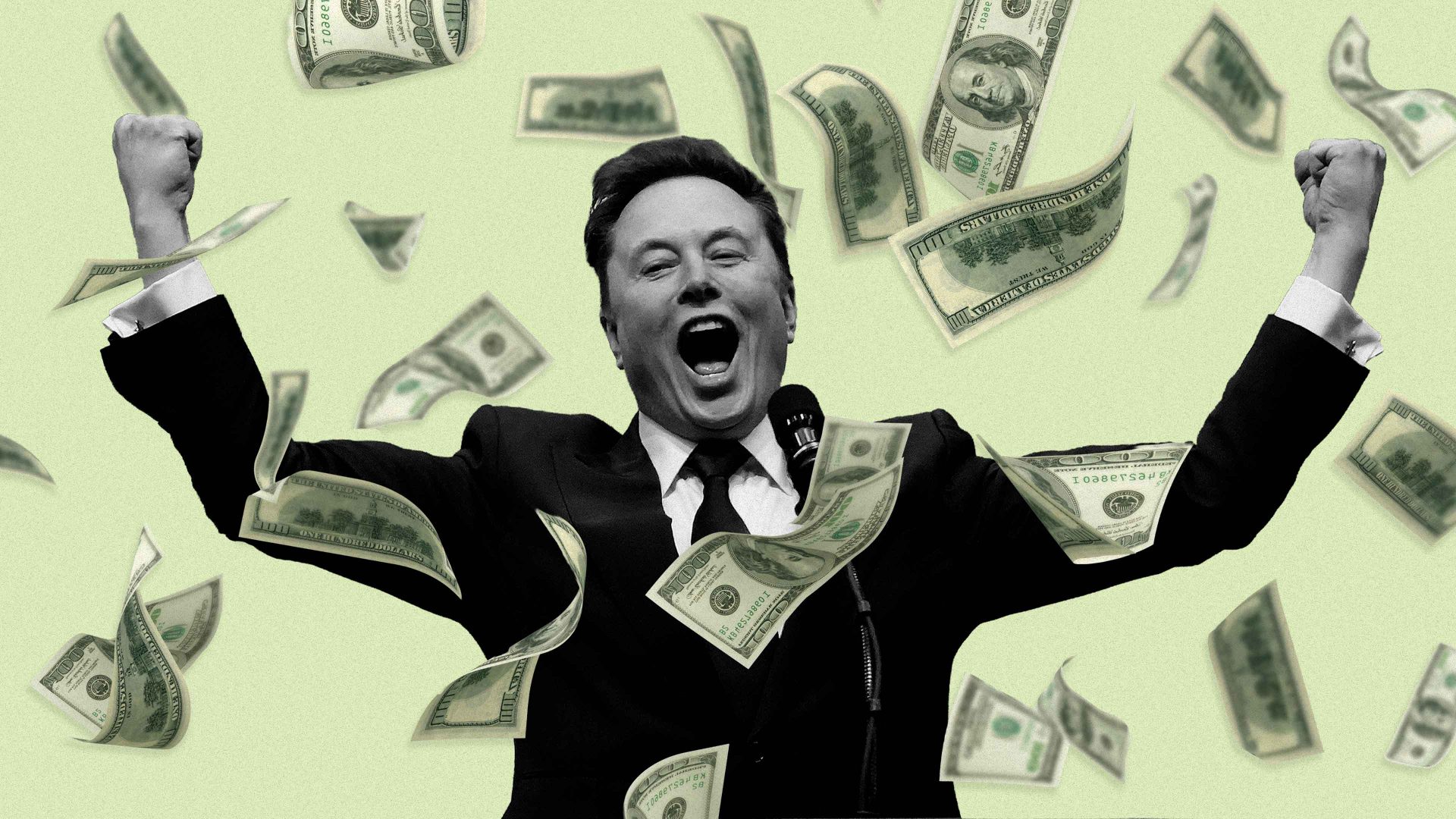
Elon Musk became a trillionaire this week. The man himself barely seemed to notice – he appeared to spend more of his time, online at least, fomenting unrest in the UK and encouraging violence in Belfast that escalated into pogroms against terrified minority families burned out of their homes.
Musk himself might be superficially unconcerned about the milestone he’s just reached and crossed, but the rest of us shouldn’t just let it slide by. He has just become the first person in human history to attain a net worth of a trillion dollars, and it’s worth us stopping to reflect on just what, exactly, that means.
The human brain isn’t good at dealing with numbers on the scale of millions and billions, let alone trillions. It’s too far out of the range of what we deal with in our day-to-day lives. Let’s frame it this way: imagine you earn $1 every single second. That’s $3,600 an hour, and $86,400 – roughly double the median UK annual earnings – every single day.
Earning money at this rate, you’d be a millionaire in less than 12 days. By contrast, it would take around 31 years to become a billionaire. For a trillion dollars, you would have had to start earning more than 31,000 years ago. That’s at least 10,000 years before the earliest known small-scale agriculture, and 20,000 years before the first evidence of cities.
Suggested Reading
The insane assumption behind the value of Musk’s loss-making SpaceX
Elon Musk is unimaginably wealthy. So understandably, when we look at what that kind of money could do, the answers seem terrifying. A trillion dollars is more than the GDP of most of the world’s nations. On paper, Musk could single-handedly buy not just almost any company in the world, but also many of its countries.
No single person should have that kind of power. And of all the eight billion people on the planet to have it, Elon Musk would surely rank somewhere near the bottom of the list.
The silver lining, if there is one, is that Musk doesn’t quite have that kind of power either. He might have a trillion dollars on paper, but almost the entirety of that wealth is held in the form of SpaceX and Tesla shares – and if he tried to sell up and take the money in cash, his wealth would collapse almost instantly.
When Musk tried to buy Twitter for $44 billion, he was worth around $300 billion – but he tried to pull out of that deal because raising $44 billion was much more difficult for him than it might look. He didn’t have anything like $44 billion sitting around in cash.
He couldn’t sell that many of his Tesla shares, because a huge sell-off might panic his investors. What he eventually had to do was leverage loans against his shareholdings, while persuading other companies and funds to invest alongside him. He couldn’t just go out there and do it on his own.
Musk is in a unique position among the ultra-ultra-ultra-rich in that none of his companies generate very much cash. Amazon is a massively profitable company that generates hundreds of billions of dollars in global sales. Apple is the same. Google and Facebook sell billions of dollars of adverts, with huge profit margins, every year.
Most of Musk’s businesses burn cash, rather than generating it. SpaceX has some truly impressive technological capabilities, especially when it comes to rocketry – but it doesn’t have a huge mass-market consumer business. Rockets require huge capital investment, and so SpaceX has never turned a serious profit.
Suggested Reading

Ebola, USAID and how Musk’s spending cuts will kill millions
Today, SpaceX is mostly an artificial intelligence company, with a space company attached. Its owner is burning billions of dollars a year in trying to develop his AI brand Grok – and if you believe his hype, data centres in space to power it – and has staked SpaceX’s future on its success. For the foreseeable future, SpaceX will burn cash rather than generate it.
Tesla, similarly, is pivoting away from being a car company – it hasn’t launched a major new model since the catastrophic Cybertruck – to a humanoid robotics company. It has no robot to sell, it has fewer than 100 robotaxis in service in America, and it has no obvious product roadmap for either.
Tesla and SpaceX are both companies with ludicrously grandiose plans for the future: a colony on Mars, thousands of data centres in space, a humanoid robot in every house. Their huge valuations are based on people who believe Musk will deliver on these promises, rather than any kind of sales or profits that they make today.
If people stop believing that he can actually deliver on those promises, or if they stop believing in Musk himself, those valuations could disappear overnight. On their fundamentals – on their actual sales and profits – Tesla and SpaceX are worth a tenth, or less, of their current market value. Musk is a modern-day Tinkerbell: if enough people stop believing in him, he simply ceases to exist in his current form.
His trillion dollars isn’t best thought of as a huge pile of cash upon which he’s sitting as a high score in an arcade game. He’s at the top of the leaderboard, and you can be sure he will be loving that lofty perch – wealth is all about keeping score, and Musk is in first place. But just like an arcade game, if you make one move that’s bad enough, you’re back to zero.
Other billionaires have diversified portfolios, which spread their wealth across a huge array of global assets. They have the security that their businesses generate huge amounts of cash, with an obvious value that is less reliant on their personal brand or grandiose claims.
Musk has climbed very high up a Jenga tower that has made profoundly fragile. On some level, he must be aware of that – his constant furious online rants betray a deep insecurity. Perhaps that comes from the knowledge his position is not nearly so secure as it looks from the outside.
There are limits to this. Musk will never be a poor man, or even a merely rich one. However catastrophically wrong things go for him, he will still be wealthy beyond the imaginations of almost all of us. But Musk has made some extraordinary promises about what his companies will deliver, and his track record on actually delivering those contains many times more misses than it does hits.
Suggested Reading

Elon Musk’s next plan: to become a space invader
Musk’s online supporters – of whom there are many – might brush all of this off as ‘copium’. The world’s richest man has been radicalised by the social network he owns, and is a vocal champion of the global far right. He has personally devastated the world’s aid infrastructure in such a way that will cause hundreds of thousands of deaths. He is actively encouraging violent unrest in Europe. He is a deeply dangerous man.
He is, though, still just a man, and one whose wealth and power are less insurmountable than they look from the outside. If the wind blows the wrong way, the markets change their mind, or political currents move against him, all of it could fall away, and fast.
Somewhere inside Elon Musk’s head, amid the raging ego and mania, there is a voice that still knows that. It is worthwhile for the rest of us to be aware of that, too.
 Most popular

Emily Maitlis’s diary: As I was saying to George Clooney just the other day…

A new film about Elon Musk reveals him as so awful it’s almost tragic. Almost

The strange case of the Lib Dem writer who fell for Farage
The right wing media hounded Jason Arday and ignored James Orr. It’s obvious why