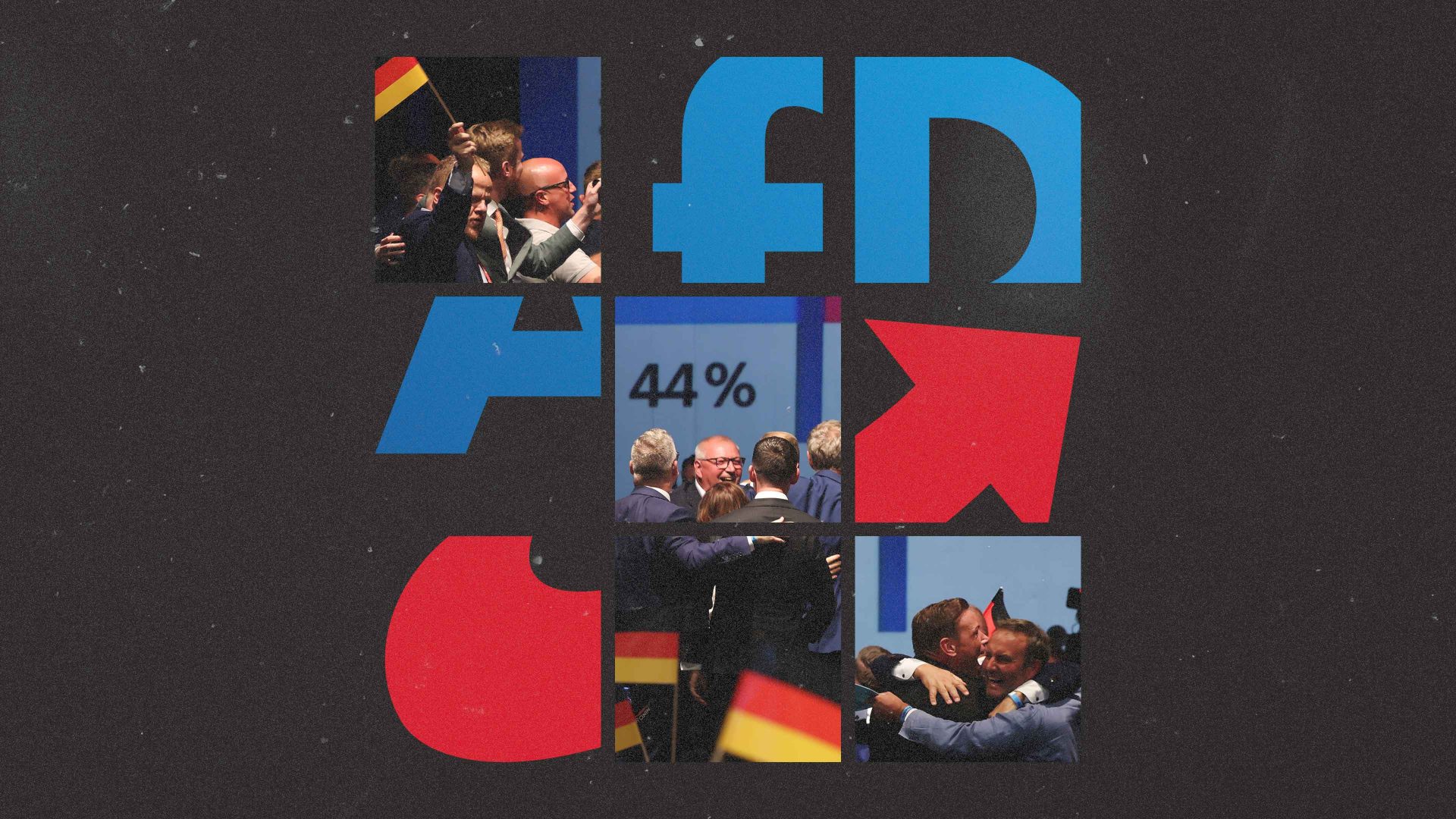
September 6, 2026 is a date that could mark a turning point in German history, of a similar order to November 9, 1989, the day of the fall of the Berlin Wall. In an optimistic scenario, the historic AfD victory in the Saxony-Anhalt regional elections could be the shock the established parties need, in order to grasp that this is now about nothing less than preserving the foundations of liberal democracy.
What is more likely, however, is that Sunday September 6 2026 goes down as a dark day in German history. It will be seen as the overture to the Alternative für Deutschland taking political power at a national level in a few years.
Just over a week after this electoral landslide, there is little to suggest that the optimistic scenario is the realistic one. The 43.8% share of vote for the AfD and the helpless wittering in response signals far greater challenges ahead for Berlin’s democratic political forces.
Even several days after the disastrous result, chancellor Friedrich Merz and the leading members of his coalition government were still speechless. And when words were spoken, they sounded empty and hollow, devoid of meaning: “We need to communicate better”, “we have to reach people on an emotional level,” blathered Merz in Bundestag – rather than actually doing just that. In response, the AfD leader Alice Weidel, drunk on victory, declared his time was over. Germany’s conservatives would never win another election again, she shouted into the chamber – and the momentary silence that followed, showed that this was not an empty threat.
Something has undeniably shifted in Germany. Saxony-Anhalt may be one of the smallest of Germany’s Länder (population 2.1 million), but the result is already affecting the whole country. The alliance of Christian Democrats (CDU) and the Christian Social Union (CSU) was once the undisputed big-tent conservative party. Now, it is losing voters in droves. In last year’s national elections, 28% voted for that alliance, and that counted as one of the parties’ worst ever results.
Now, just eighteen months later, the first surveys show them at under 20% on a national level – and the AfD at near 30%. There’s only one reason why Friedrich Merz hasn’t already resigned: the next set of regional elections this coming weekend in Mecklenburg-Western Pomerania, for which the CDU needs to put on a display of unity.
The AfD is in the lead there too, while CDU polling has collapsed to just 7% – dangerously close to the 5% minimum threshold for parliamentary representation. If the end result is 7%, it would be the CDU’s worst performance at a regional ballot since the Federal Republic was founded; and if they fall below 5%, that would be a political earthquake on a par with September 6. In either case, Friedrich Merz’s resignation seems inevitable in the near future.
In the speed of its collapse, Germany’s mainstream centre-right party is outdoing Britain’s Tories. And even though the battle of traditional conservatism against a resurgent far right is a pan-European phenomenon, the rise of the AfD is particularly shocking – not just because this is happening in Germany, the country that had most to learn from its dark history.
What makes the AfD uniquely dangerous is its unabashed hostility to democracy and its institutions, the explicitly-stated aggressive will to remove them. There is a reason that domestic intelligence services have officially declared Saxony-Anhalt’s AfD to be a far-right extremist organisation: this party wants a national revolution that would completely change the Federal Republic. It wants a different country.
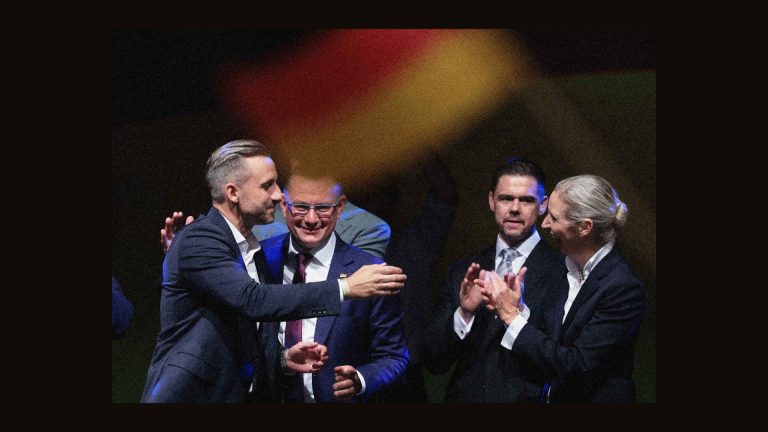
Behind the tacked-on grin of its ever-smiling lead candidate in Sachsen Anhalt, Ulrich Siegmund, lurks an unappetising troop of tightly-organised right-wing extremists and neo-Nazis whose flirtation with Third-Reich imagery is a deliberate repudiation of atonement. They want nothing less than to wipe away the deep shame Germany feels about its own history – the very shame on which democracy was built after the Second World War. The famous “Never again.”
Of course there haven’t been torchlight parades; of course the AfD is not the new National Socialist Party. The AfD is different – and represents a threat of a different kind. Yet obvious historical parallels should not be overlooked, especially not when leading figures in the party are actively and deliberately toying with them, or have themselves been active in organisations so radical as to have been banned.
Some in Saxony-Anhalt’s AfD were in the youth organisation Heimattreue Deutsche Jugend, HdJ for short, which is just one small letter away from the Hitler Youth – Hitlerjugend, HJ – and which was eventually forced to disband. Others had their photo taken last summer with historical posters for Kommando Werwolf, a 1930s terror organisation, in the background. And at summer festivals and on the AfD YouTube channel, you could hear Nazi marching music or propaganda songs.
This dis-inhibition has been accompanied by political revenge fantasies, or, indeed, with actual violence. During campaigning, an AfD politician appears to have attacked a 14-year-old boy with a baseball bat (and garnered plaudits from Siegmund supporters). At rallies, there was talk of “putting Merkel in front of a firing squad” and mocking amusement at the fact that there hasn’t yet been an assassination attempt against Friedrich Merz.
All a joke, of course. In neighbouring Thuringia, meanwhile, Björn Höcke, referred to people serving prison time for being members of an armed neo-Nazi terrorist group, the “Saxon Separatists”, as mere victims of miscarriages of justice.
Suggested Reading

The stolen Nazi artworks, the AfD and antisemitic stereotypes
Things have gone so far that Götz Aly, a historian and one of Germany’s leading authorities on National Socialism who long argued rigorously against hasty comparisons between the AfD and the NSDAP, has now changed his mind. In an interview with the Frankfurter Allgemeine Zeitung (FAZ), he spoke of how he has observed the AfD deliberately “awakening fantasies of violence and murder” – a technique that, he explained, Hitler and Goebbels had mastered. He’d always been against banning the party, he said, but would now argue in favour of doing so.
This, though, is the nub of the issue: following the Saxony-Anhalt landslide, it has become more difficult to ban the AfD than ever before. Taking a party for which more than a third of the electorate are voting or intending to vote and dragging it through an extended institutional process would feed right into the narrative of “The establishment is out to silence us!” Indeed, this is precisely the reason why the established parties and, at their helm, Friedrich Merz, have thus far avoided going down that route – even if, prior to the recent landslide result, it would have been a much easier path to take.
The preferred strategy was to erect a cordon sanitaire around the AfD – referred to in German as the Brandmauer (firewall) – a voluntary commitment not to cooperate in any way with a party regarded as an enemy of the German constitution and democracy, so limiting its electoral potential.
That was always doomed to fail: the metaphor itself explains why. After erecting their firewall, the established parties thought they were safe behind it – and saw little reason to go and actually fight the fire, to attack the AfD in detail by identifying its weak points and showing precisely how it is an anti-constitutional danger to democracy.
What is more, the rhetorical imagery made the AfD bigger than it actually was. After all, you wouldn’t erect a firewall against something that doesn’t represent a danger – and the AfD had a field day presenting itself as the “mad, bad, and dangerous-to-know” mavericks, as the only party you could vote for if you wanted to change “the System”. Yes, in the end, it wasn’t just – as Ulrich Siegmund never tired of smirking – Friedrich Merz’s haplessness that helped the AfD to such a stonking victory: it was the established parties’ strategy and choice of metaphor, too.
Since the Saxony-Anhalt result, the firewall looks as if it has been blown down. How, after all, can you erect a barrier against a party with nearly a half of the vote behind it? This is a defining moment for the CDU. Does it decide to drop its resistance to cooperating with the AfD, an idea floated by some in its ranks? Or does it now push to have the party banned, and accept the huge risks that would bring?
Option number one would be nothing short of suicidal. Any form of cooperation – be it a coalition, or whatever form of toleration – with a party whose stated aim is to destroy the CDU/CSU could only be read as a gesture of abject submission – and would mark the end of modern German conservatism as an intellectual force.
The AfD is out to do nothing less than eradicate every post-war convention at the heart of the CDU/CSU: Konrad Adenauer’s policy of Westbindung, with its commitment to transatlanticism, Nato, and to Europe; the principles of liberal democracy; a philosophy broadly based on a Christian view of the world. The AfD agitates for Putin and is against supporting Ukraine, it sees Germany’s domestic security services as a “sleazy bunch of undercover agents”, and its manifesto includes racist policies of “remigration” in which even non-white citizens with German passports will be deported en masse. This would, as Friedrich Merz quite rightly described it last week, be “ethnic cleansing”.
Those in Merz’s party who think cooperation is a viable option are conjuring up an image of the AfD that does not exist: they see it as a group that still has moderate elements, which, in the end, can be tamed or kept in check. That is exactly what the conservative bourgeois elites in Germany said about another party, back in the 1930s.
The only logical option remaining is number two: trying to get the AfD banned by the Constitutional Court. It’s the nuclear option – the legal weapon of last resort in Germany, to be used in extremis when the constitution is under threat. As such, the threshold of proof is high and there is a risk that the attempt will fail and play into the party’s hands. Yet there is little other choice. Continually refusing to cooperate with a party of the AfD’s size is becoming both impossible on practical grounds and democratically untenable: after all, the party is listed on ballot papers.
Otherwise, if the AfD gets its way, there may well be no more elections. Just a few weeks ago, a Social Democrat (SPD) member of the Saxony-Anhalt regional assembly said in chamber that the AfD would never get the absolute majority it would need “to get rid of all this here!” An AfD opponent interrupted him with a chilling reminder: “You have to keep winning! We only have to win once.” Just think about what those words mean.
It is no exaggeration to state that the AfD is convinced of German exceptionalism, and firmly believes that things work differently in Germany to the way they do in Italy or France. Why? Because they always have. “When the moment comes, we Germans don’t do things by halves,” wrote Björn Höcke a few years back in a book about his political convictions. For him, there is “deutsche Unbedingtheit”, a specifically German form of uncompromising-ness, of absoluteness, of going all out, which “will ensure that we tackle the issue thoroughly and categorically.”
Suggested Reading
Germany’s pro-Putin, loony-right are about to do the unthinkable
Höcke and his supporters are not simply about using populism to get into government and then making things a bit more right wing. For them, Giorgia Meloni is not a role model, but an insult. They want nothing less than a completely different country, a fundamentally transformed republic – and they have no qualms about saying it.
Of course, a miracle could happen. After all, despite the electoral landslide, Ulrich Siegmund does not command an absolute majority and is currently having trouble forming a government. And across Germany last week, tens of thousands took to the streets in protest against the AfD. Who knows? Perhaps the CDU will get rid of Merz and find a German Andy Burnham to finally turn things around. Yet it would be foolish to bet on it. A German Burnham is not in sight and the AfD can easily frame a failure to form an administration in Saxony-Anhalt as propaganda-ready proof that “the Establishment” is out to get them. Whether that is true or not is of no more interest to a German AfD voter than Reform’s dodgy crypto-billionaire donors are of interest to the hardcore Farage Fans in Britain. That’s post-truth politics for you.
A few weeks back, a book was published in Germany, Deutschland 2033. It was an immediate bestseller, and it couldn’t have been timelier. In this work, AfD expert and FAZ staff writer Justus Bender peers into a fictional future in which the AfD gains power on a national level.
Unlike in the 1930s, there are no burning buildings, street battles, or violent putsches, but rather step-by-step, almost imperceptible attacks on liberal democracy by legalistic means. It’s not about Nuremberg Rallies, but about how ruthless authorities and politicised courts can undermine the republic – how, eventually, it dies a silent death and “Chancellor of the Masses” Alice Weidel is left reigning coldly over an exhausted nation.
It’s a dystopia, of course, where the author consciously takes things to extremes in an attempt to shake Germany’s democratic moderates awake before it is too late. Unfortunately, though, Bender has already written a dystopia which proved a little too close to reality: back in 2017, he predicted that Olaf Scholz would become Chancellor in 2021, that his coalition would collapse shortly after, and that, soon afterwards, the AfD would rise to become Germany’s largest party.
All that seemed rather far-fetched at the time, though – highly amusing even. That laughter rings hollow now.
 Most popular


Emily Maitlis’s diary: As I was saying to George Clooney just the other day…


History says Polanski is going to win the St Pancras by-election


The uncomfortable truth about Ariana Grande


BORN IN THE FIRES OF 9/11