It was a case of déjà vu all over again. From the moment Germany’s ARD channel announced the first exit poll on Sunday evening, the texts I received began expressing consternation, despair and attempts at gallows humour. The results of the elections in Saxony Anhalt were worse than the most pessimistic expectations of anyone I had spoken to, either on the ground in the eastern state or among political players in Berlin.
It brought back memories of the Brexit referendum night of June 2016 and the return of Donald Trump in November 2024. Each event followed a familiar pattern. In the days running up to the vote, people exchanged messages suggesting that support for the extremists was waning and that it would turn out alright. Then, when the first results came in, people clung to the hope that, somehow, when postal votes were counted things wouldn’t look so terrible. They were wrong. With each hour, it got even worse.
The consequences this time around are likely to be just as dramatic for the whole of Germany, for Europe and for the future of liberal democracy around the world.
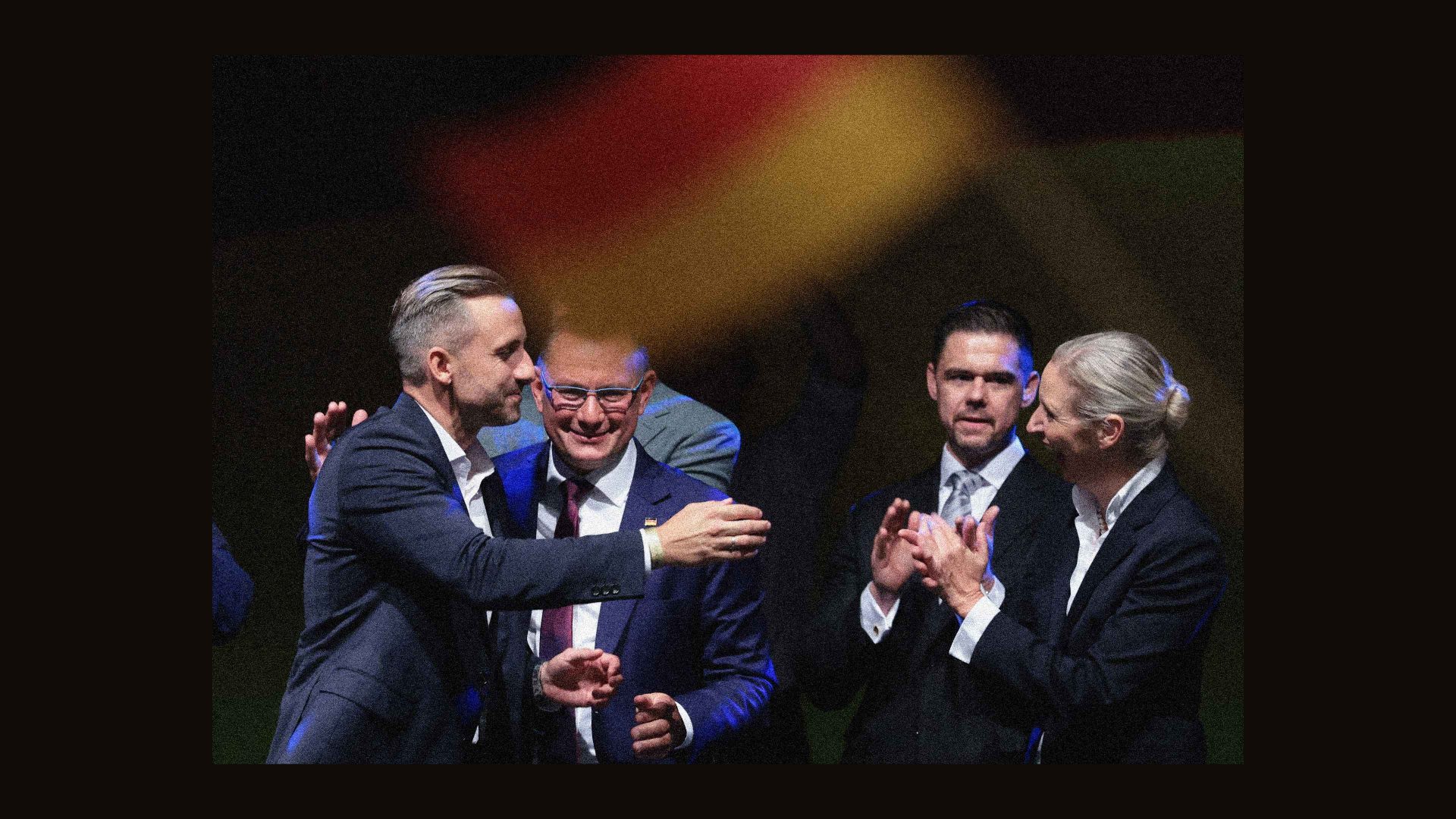
Such were the celebrations of the Alternative für Deutschland (AfD) activists as the results came, they could be heard inside the adjacent TV studios as they were broadcasting. The jubilation in the Kremlin and in the White House will have been just as loud. Elon Musk was quick to congratulate the AfD’s national leader, Alice Weidel. Donald Trump confined himself to posting the results. One of Vladimir Putin’s most important officials, Kirill Dmitriev, took a screengrab of Trump’s post and praised a “historic win for the pragmatic AfD” – evidence if it was still needed of the two administrations working in lockstep.
The victory was seismic. Much of it was down to the campaign fought by the AfD’s local leader, and likely next premier of Saxony Anhalt, Ulrich Siegmund. The 35-year-old former perfume salesman fought a nearly flawless campaign, mixing standard dog-whistle messaging around migrants, woke and economic injustice mixed with nostalgia for the Communist former GDR and relentlessly photogenic and telegenic posts to his hundreds of thousands of followers on TikTok and other platforms.
Not only did the AfD more than double its vote share in the region to 44% (a total no other party can match anywhere), but the Christian Democratic party of the chancellor Friedrich Merz saw its support more than halve to a desultory 17%. The Social Democrats, in a coalition with the CDU nationally, received a paltry 9%, which by the standards of their recent performances they tried to dress up as a success. The Greens and Die Linke, the Left, ended with a similar total.
Siegmund’s campaign will provide a textbook “how to” guide for electioneering, juxtaposed with the stultifyingly old-fashioned approach of much of the mainstream, which still struggles to deploy social media. Across the state, the best the centrists could muster were stalls giving away free Wurst and beer, alongside posters attached to lampposts with anodyne slogans such as “Experience Not Experiment”.
Voters, in their droves, with an extraordinary turnout of 76%, repudiated the national government in Berlin. Up to 200,000 voters who had sat on their hands in previous elections were mobilised by the AfD.
Germany’s far-right has long been knocking at the door, its panache and confidence increasing all the time. Ever since it was founded in 2013, originally as a small anti-EU outfit, it has been mocked by metropolitan society and shunned by mainstream politics.
The Brandmauer, “firewall”, to which all parties from centre-left to centre-right signed up, stipulated that the AfD would not be included in any national or regional coalition. That exclusion order started to fracture in recent times, with many arguing that it only added to the party’s sense of grievance and establishment stitch-up.
Now the firewall is surely over – a point made by Sven Schulze, the shell-shocked local leader of the Christian Democrats. Schulze will have to continue in an interim capacity over the next few weeks.
As ever in post-election German politics, the arithmetic is complicated, with parties jockeying for position to see who can form a government. The difference this time are the players. The mainstream parties will have to wait their turn. The AfD has fallen just three short of the 42 seats it is required for an overall majority in a parliament of 83. Over the next few weeks, it will see if it can woo any maverick CDU politicians onto its side, or if it is lent support by the far-left BSW grouping, which just got over the 5% hurdle required for representation.
Even though Siegmund has vowed not to “do deals”, chances are the AfD will eventually get there over the next few weeks, presenting the first far-right government anywhere in Germany since the Nazi era.
What of the fate of the other parties? Schulze had reasons to be furious. A former regional economics minister, he was given the job of running the state and taking on the AfD only seven months ago, after his predecessor retired at precisely the wrong time.
Suggested Reading

Is AfD tearing Germany apart?
Schulze’s personal rating was relatively high; yet he is likely to carry the can rather than Merz, the man responsible for the CDU’s collapse.
In the short-term Merz is likely to do everything he can to hang on. But, with two more regional elections taking place over the next fortnight, in Mecklenburg Vorpommern, a state also in the east, and in the city-region of Berlin itself, it is surely only a matter of time. With the wind in its sails, the AfD may well exceed expectations in both votes on September 20, although it is unlikely to be able to govern in either.
What matters, however, is the next federal elections in 2029, and nobody should now rule anything out. As the CDU party chair, Thorsten Frei, admitted: “this is a watershed”.
The AfD has established itself as a major player, perhaps the major player in German politics. In its desperation to cling to power, the CDU may seek to commandeer some of its lines, just as the UK Conservatives have done with Reform UK and Les Républicains in France have done with Marine Le Pen’s National Rally. That will make the coalition even more fragile.
There is a more optimistic scenario – though optimism is hard to find. Might the two ruling parties conclude from their cataclysmic performances that they have to finally address the yearning for deep-seated and rapid reforms? That would be the sensible conclusion, but most commentators in Berlin are not holding their breath.
Saxony-Anhalt may be small, a mere 2.2 million voters, a 40th of the overall population. Yet in all areas of policy, the disaster for liberal democracy will be felt. The most important repercussion is for Ukraine and the future of the West. A majority of voters on Sunday opted for parties – not just the AfD, but also for BSW – which are avowedly pro-Kremlin, and Die Linke, which argues for “peace engagement” with Russia.
The one area where Merz could be seen to have ruled courageously is the overhaul of Germany’s defence, and the commitment to meet the Nato target of 3.5% in military spending in short order. He has been unabashed in confronting the Kremlin, and only days before the election, he openly accused Moscow of a series of drone attacks. He will now come under increasing pressure to shift away from his hawkish approach.
Suggested Reading
Can the AfD survive another scandal?
Putin and Trump will be salivating at the prospect; their job has barely begun. Russian bots have been fuelling disinformation for many years, particularly in Germany. The US National Security Strategy, published last November, promises to support all “patriotic” groupings across Europe to help prevent “civilisational erasure”.
This work will intensify in the run-up to France’s presidential elections next April and May; a Le Pen victory is less a possibility, more a probability. European cohesion, within the EU and Nato, would be extremely hard to sustain.
Germany has more time, but nothing now should be ruled out. That Merz’s government, only 18 months into its life, has been a disappointment, is beyond doubt. What is new, and different, about politics is the tone of criticism. Gone are the days when consensus, compromise and coalitions were seen as a virtue, the bedrock of the post-war German settlement; langsam aber sicher, slow but steady.
In its place has come Anglo-Saxon confrontation, projected by social media. With the lowest personal ratings of any chancellor, Merz is the object of contempt and bile. Unlike Angela Merkel, who he spent years trying to oust, he saw little need to create alliances within his party or beyond it. The list of enemies circling around is long and growing, and despite official statements to the contrary, it seems inconceivable that he’ll be allowed to lead the CDU into 2029.
Such is the pace of contemporary politics (think Britain and its seven prime ministers in a decade), it’s more likely to be a matter of months, even weeks, before he’s ousted. Yet the man most likely to succeed him, Hendrik Wüst, leader of North Rhine Westphalia, the most populated region, shows little immediate sign of wanting to take on the mantle in these poisonous times.
The other curiosity about present-day German politics is the extent of the dissatisfaction, particularly but not exclusively in the east. So why did it happen?
Suggested Reading
Blue Labour’s AfD blunder could see them swept away by Burnham
“They say it’s all terrible now, it’s all gone down the drain.” I’m sitting with Maik Reichel, director of the regional office of civic education, the Landeszentrale für politische Bildung. This official body, which is represented at national level and in all 16 Länder, is a very German thing.
It’s designed to help encourage people to embrace liberal democracy. Even in these difficult times, he has kept plugging away, curating meetings with disgruntled voters in sports clubs or in the backroom of pubs. “I say to people: ‘was your rubbish cleared this week? Did you make it to your doctor’s appointment OK? Did you go shopping and find what you needed?’ They say ‘yes, yes, but it’s not about that’.”
When I sat down with Reichel a few days before the election in his office in the centre of Magdeburg, capital of Saxony-Anhalt, he tried to sound calm. He insisted that the regional government hadn’t done a bad job; it’s just that people prefer binary fury online to listening to rational argument.
He, like everyone I spoke to, didn’t play down the dangers. “The atmosphere has radically changed,” he said. “The level of distrust and abuse is unlike anything before. There’s so much hatred. People can’t deal with disagreement. That’s a real problem.”
Much of the work Reichel’s organisation does is in schools, curating debates and taking students to concentration camps and to the installations marking East Germany’s fortified border to the West. If the AfD ends up forming the government, it will either be abolished or given an altogether different mandate, and he’ll be off.
Regional governments have jurisdiction over culture, much of education, policing and internal security. Siegmund has made no secret of how he’d like to change Saxony-Anhalt. It was all in the manifesto – such as de-funding or closing arts organisations that promote “modern” culture over “German” culture; an emphasis on “patriotic” history rather than Nazi history in schools; the reintroduction of school exchanges with Russia.
The most popular aspect of the programme is remigration. He wouldn’t have jurisdiction to achieve that aim, but it is no exaggeration to say that many non-whites living in Saxony-Anhalt are petrified of what comes next, as is the gay community, as is anyone who does not conform to the new, or should I say old, view of the Good German. One local politician suggested to me that the AfD “has lots of support in the police and the ‘blue lights fraternity.”
Should people who feel vulnerable stay and resist? Or should they flee to quieter pastures elsewhere in Germany? And how long would those areas remain safe havens?
As politicians across Germany assess the damage, some argue that, in Saxony-Anhalt and perhaps beyond, it’s time to let the AfD show what they can do. That’s based in the vague hope that it will struggle to deal with the nitty gritty of the cost-of-living, of funding public services, just as the CDU, the SPD and the Greens have done.
History, not just of the Weimar variety but also of the more recent Trumpian one, suggests this is a risky strategy, that extremist parties ride roughshod over constitutional norms, and checks and balances that were once thought of as sacrosanct fade away. With these precedents in mind, most politicians in the mainstream parties continue to insist that they should try to cobble together anti-extremist coalitions, no matter how fractious and unwieldy, and to prop up the firewall for as long as possible.
A third option is to get rid of Merz and find new, more courageous leaders on the centre-right and centre-left who can take on the AfD. So far, however, they are thin on the ground.
John Kampfner is author of Braver New World