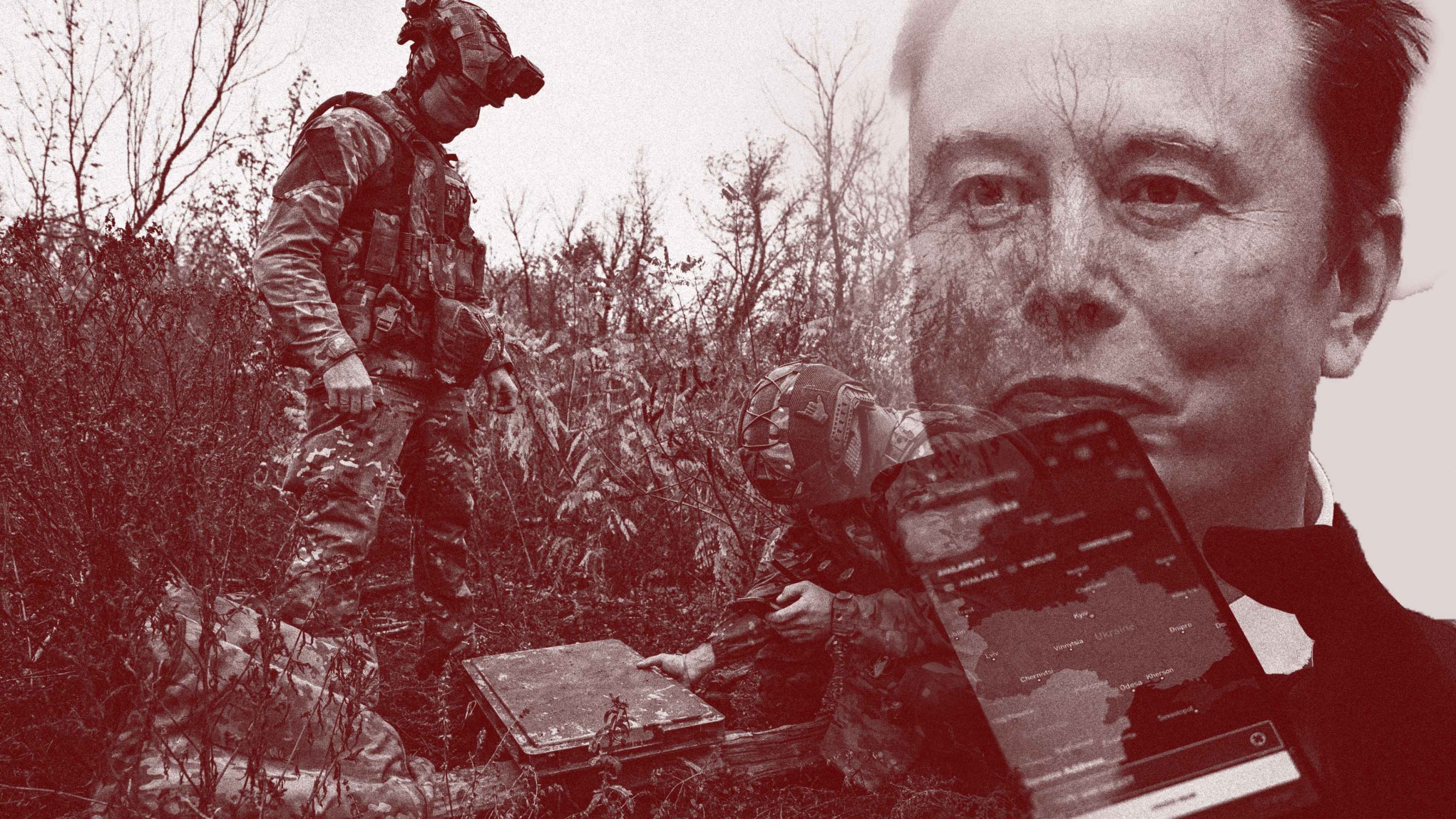
When Elon Musk confirmed on October 25 that he had personally ordered the throttling of Ukraine’s Starlink internet service, it felt like a line had been crossed. Here was an individual tech billionaire admitting to intervening in a conflict in which a sovereign nation the other side of the world fights for its existence, in a wider conflict of autocracy against the right of self-determination of democratic states.
The world’s richest man says he slowed down Starlink, which allows Ukraine to co-ordinate its military units in remote battlefields, because it was being used for offensive drone strikes on Russia. He still denies slowing its military-grade, higher-capability counterpart Starshield, which gives Volodymyr Zelensky the ability to intercept Vladimir Putin’s jet-powered drones targeting Ukrainian cities and to launch its own attacks on Russian targets.
But slowed down Starshield was, and Ukraine – which insists the far right populist’s claims about its use of Starlink are false and impossible – says civilian deaths followed as a result.
These restrictions highlighted a vulnerability, not just for Ukraine’s military, but for the wider security of British and European society. As militaries, in search of high-speed targeting and decision-making, increasingly rely on technologies owned by commercial entities, owning hardware does not necessarily mean you can operate it as you want.
As the Starlink/Starshield restrictions demonstrate, private actors can now exercise control over the availability of military capabilities. But it’s not just military capabilities – it’s also electricity grids, ports, railway signalling, nuclear power plant operating systems, hospitals, navigation systems, financial payments and emergency communications.
Nation states are forming a complex matrix of alliances across trade, security, energy, and cultural communality. Rather than rigid alliance blocs, states are situated in a complex matrix of overlapping agreements. Partners in one arena are direct adversaries in another.
Suggested Reading


Slavoj Žižek on Trump, Musk and the antichrist
Now, woven into these alliances are powerful multinational companies, for years seen as rootless concentrations of stateless capital, but now increasingly being pulled back into geopolitics. This has been accelerated by, perhaps for the first time in modern history, the development of cutting-edge technology that can give a battlefield advantage, by commercial companies for commercial markets, not primarily for military purposes.
Additionally, as the majority of these companies are American, many states are now reliant on foreign-owned commercial companies for military capability and critical national infrastructure.
These new technologies are embedded across this matrix, allowing globalisation to occur, through numbers and vectors on screens that control the velocity of the movements of capital, goods and information. But the new tech still relies upon water, energy, minerals, cables, labour, land, climatic stability and the ability for goods to cross borders and through choke points. The virtual and the physical – cyberspace and geopolitical space – are aspects of a single matrix, and every node of which is now a point of conflict.
Russian hybrid operations, the attempted Iranian attack on RAF Fairford, US tariffs, and Chinese economic espionage and attempts to burst the AI bubble all demonstrate that conflict is not limited to battlefield frontlines.
Commercial companies’ research departments, sub-sea cables, data centres, logistics warehouses, financial and navigation systems and the political will of populations attacked through disinformation and misinformation operations are all part of the battlefield. But this battlespace also includes the minds of multi-national tech company CEOs like Musk, or Palantir’s Alex Karp.
They are nodes in the matrix to be contested. To be at the whim of such a mind, or the vagaries of the markets and shareholders many of these companies answer to, is not a good idea in terms of national resiliency, and a lot of national resiliency now depends on space-based assets.
We have launched more satellites and invested more capital in the space industry in the last five years than during the rest of history. We rely on in-orbit technology to provide GPS, signals to beam down our entertainment, and time signals from atomic clocks contained in satellites, which allow our banking and logistics networks to function.
Much of this in-orbit technology is American. There are some options that the UK and Europe have to reduce dependency on US systems, but none of them are fully operational.
Shares in the Anglo-French Eutelsat (the UK owns which ownsho own the OneWeb LEO constellation, jumped with the Starlink/Starshield interruption. But OneWeb has just over 600 satellites in low Earth orbit (Starlink/Starshield has over 10,000). It has plans for a further 900.
However, it is not just an issue of satellites. To replace or reduce the use of Musk’s tech in Ukraine, thousands of ground terminals with frontline units would have to be replaced too, as they are not inter-operable (Eutelsat terminals were originally bulky. They are improving, but may still be too big for small drones). OneWeb has also had capacity and performance constraints.
Then there is the planned IRIS², the EU’s existing communications project. In August, its planned constellation was expanded to 348 satellites. First launches are planned for 2029, with initial services from 2030.
For its established military satellite communications programme, the UK has Skynet 6 providing hardened strategic communications. It will be upgraded in 2027 with new satellites built by Airbus. It supplies secure communications for the military, but it comprises a small number of geostationary satellites which are not a substitute for supporting distributed ground terminals in combat.


Outside of Europe, Canada has Telesat, its emerging LEO network, with commercial services anticipated from late 2027. In August, Canada awarded Telesat an approximately C$2.3 billion military communications contract.
Govsatcom, the EU’s satellite-sharing network, may provide a way forward. It was set up in January to share existing satellites between EU member states.
Ukraine is not a fully-fledged member, but the European Commission is in talks with Kyiv to join. This could provide an alternative to the battlefield communications provided by Starlink. A similar sharing network of European and Canadian secure networks could provide a replacement for Starshield if integration and acceleration of existing planes could be achieved.
There would be challenges, including launch capability (which would be reliant on US capability), scaling of industrial capability to build satellites and terminals (UK and Europe have lots of smaller companies while SpaceX does everything and at scale with commercial as well as government funding) and cost at a time of competing priorities. There would also still be command and control challenges with all stakeholders having to agree when services are turned off and on.
The alternative to action though is surely worse: replacing connectivity with more automation of drones and therefore risking more collateral damage and lower effectiveness, or relying on the unpredictable whims of those driven by their own fragile egos and petty politics rather than the care for the lives of others.
Andy Owen is a former UK military intelligence officer
 Most popular


What happens to Trump if he loses the midterms?

It might not look like it, but a motoring miracle has now happened


It’s time for Burnham to kill off old Labour


18 things that will absolutely, definitely happen if Trump gets whopped in the midterms