PICK OF THE WEEK
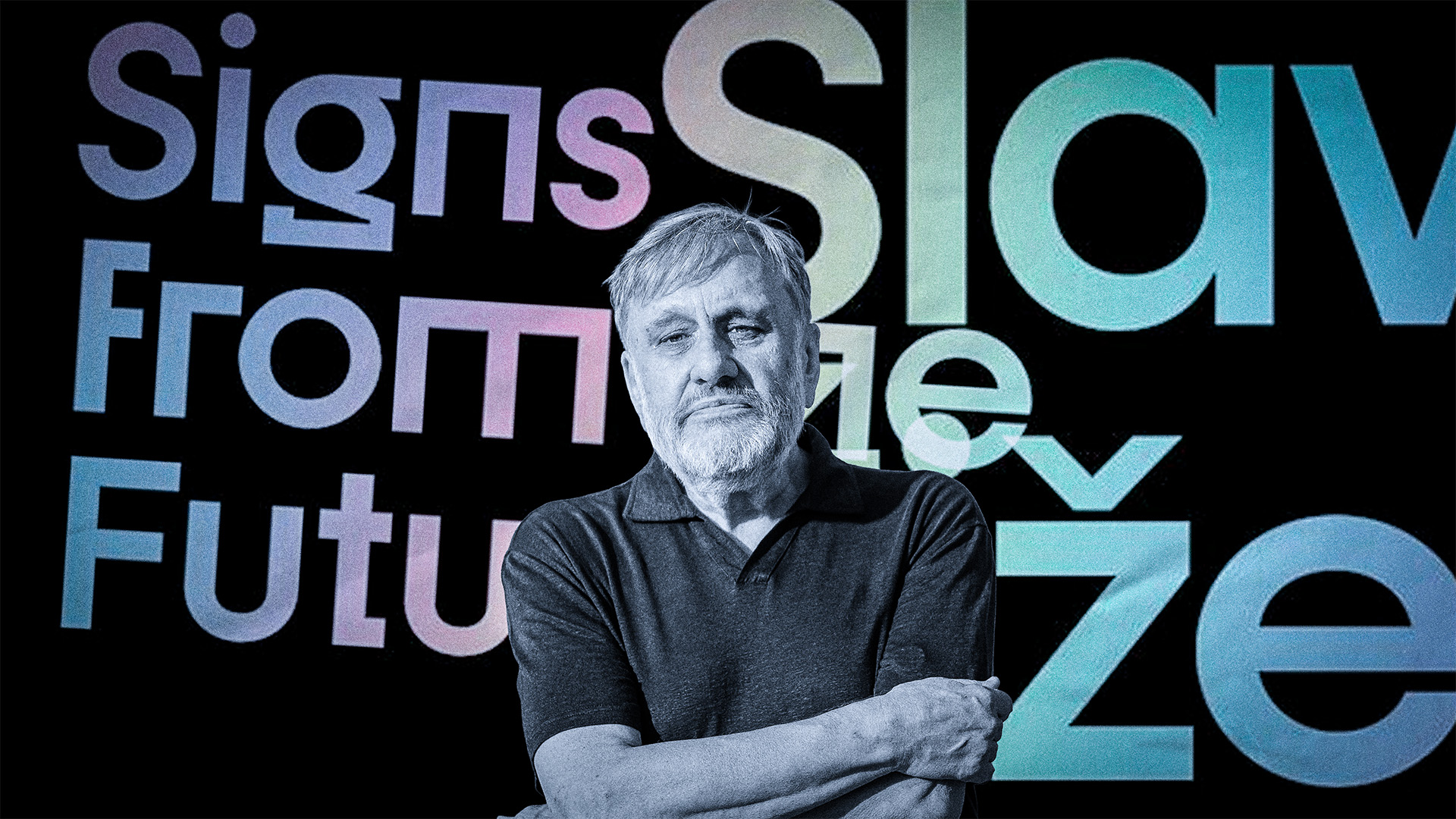
Signs from the Future by Slavoj Žižek (Bloomsbury Academic)
“To know what to do today, we must learn to read signs from the future”: thus does the great Slovenian philosopher, critic and theorist frame his latest collection of essays on everything from Peter Thiel’s lectures about the antichrist, via digital sexuality, to Christopher Nolan’s adaptation of The Odyssey.
Those who follow the intellectual fashions of Silicon Valley will be familiar with the idea of “retro-causality”: the radically counter-intuitive claim that the present is determined by the future. Žižek’s proposition is much more subtle and rooted in the complexities of quantum mechanics that he explored to such compelling effect in last year’s Quantum History: A New Materialist Philosophy.
Thus, the best way to apprehend “the chaos of the contemporary moment” is to deploy the concept of quantum superposition, most closely associated with the English theoretical physicist Paul Dirac: whereby a physical system can exist in a combination of multiple states.
To understand the maelstrom of the present, Žižek argues, we must look ahead to “the future of the ecological suicide of humanity, the future of a new global war, the future of humans subordinated to the glitches of Artificial Intelligence, the future where civilization as we know it will have disappeared, the future in which sex will be replaced by the meaningless search for pleasure”.
To which end, he cites Gramsci’s famous dictum: “The crisis consists precisely in the fact that the old is dying and the new cannot be born; in this interregnum a great variety of morbid phenomena appears.” It is the “morbid phenomena” to which we should pay closest attention.
One such phenomenon is Thiel’s lecture series, most recently delivered in Nashville, that reflects a form of plutocratic effrontery which will long outlast Donald Trump: “[the] basic paradox of fighting against antichrist from a position which ultimately is that of antichrist. Is this not the truth of nationalist-populist Christians? Are they not the ultimate figure of antichrist today?”
That is spot on, as is Žižek’s observation that the 45th and 47th president “reverses the old Hegelo-Marxian formula ‘first as tragedy, then as comedy’: he begins with an idea that sounds like a (bad) joke, so that if the backlash is too strong, he can excuse himself (in classic sexual harasser fashion) that he was ‘only joking’.”
As ever, his eclecticism is dazzling. The essay “No Desire, Just Drive” opens with an analysis of the cover of King Crimson’s 1969 prog rock album In the Court of the Crimson King, moves on to Elon Musk’s brain-computer interface company Neuralink, and then offers the most interesting commentary I have read on Vince Gilligan’s sci-fi series Pluribus.
In a world of drearily cantonised academia, the 77-year-old Slovenian is as fascinated by Emerald Fennell’s adaptation of Wuthering Heights as he is by Rowan Williams’ most recent book, Solidarity; by the French revolutionary and “Archangel of Death”, Louis de Saint Just; and by Zohran Mamdani, who, he believes, has a vision with the “potential to mobilize millions.”
When I interviewed him for the How:To Academy on Tuesday, he told me with delight that the New York City mayor is a fan and had sent him a baseball cap. Žižek has already published (at least) 50 books. On the basis of this thrilling collection, I would say he’s just getting started.
Suggested Reading

There’s no reckoning for Zuckerberg in The Social Reckoning
STREAMING
The Diplomat (Netflix)
The fourth season of Debora Cahn’s superior political thriller – pulsing, as ever, with geopolitical and diplomatic crises – is cleverly structured around three strained personal relationships. Lead character Kate Wyler (Keri Russell), US ambassador to the court of St James’s, is still struggling with her side-hustle as second lady – after the shock appointment in season three of her husband Hal (Rufus Sewell) as vice-president.
Meanwhile, President Grace Penn (Alison Janney) and her husband Todd (Bradley Whitford) have hit a marital rough patch: he admits to Kate that plenty of people have “mixed feelings about my wife” – and he is one of them. Can a role be found for the first gentleman that bolsters his self-esteem and, crucially, makes him less jealous of Hal?
Kate, too, has spotted the sparks flying between POTUS and the VP. “There’s an energy between the two of you,” she tells her husband. “You’ve got to know what you’re doing.” At a G7 summit in the Tuscan city of Lucca, Todd lays down the law to Hal: “How about we say the bedroom is the one place I’m allowed to go and you’re not?”
Best of all is the office romance between Kate’s deputy chief of mission, Stuart Hayford (Ato Essandoh), and Eidra Park (Ali Ahn), head of the CIA’s London station. They are as crazy about one another as they are professionally buttoned-up – leading to very funny scheduled meetings on a bench by the river to discuss their relationship as if preparing an exfiltration operation (“I am concerned that you think all our problems are structural,” says Eidra).
At the heart of this season’s plot is President Penn’s unilateral decision – at Hal’s private urging – to remove the doomsday Poseidon weapon from the disabled Russian submarine Sarov lying off England’s northeast coast. Needless to say, this does not go down well with Prime Minister Nicol Trowbridge (Rory Kinnear) whose already tenuous grip on reality is loosening fast: he hallucinates his dead political mentor Meg Roylin (Celia Imrie) and Pavarotti singing “Vesti la giubba” from Leoncavallo’s Pagliacci.
Consistently entertaining since its premiere in 2023, The Diplomat has never shied away from big plot developments that must not be spoiled – and there are plenty of them in the latest tranche of eight episodes (all now streaming). But it’s worth singling out the pleasingly central role played by the 67-year-old Whitford.
Still best known for his role as Josh Lyman in The West Wing, he has latterly become one of the best character actors around – notably in Jordan Peele’s Get Out (2017), as the conflicted Commander Joseph Lawrence in The Handmaid’s Tale (seasons 2-6) and as secretary of state James Blaine in Death by Lightning (2025).
Amidst all the scenes in motorcades, castles and diplomatic receptions, Whitford invests his character with an authentic blend of wit, cynicism, and fear that his marriage is slipping away from him on the world stage.
All of which helps to elevate what might otherwise be a by-the-numbers political drama into a high-quality ensemble piece with plenty of road left to run. Roll on season five.
1381 and All That…
Tipped to receive an Oscar nomination for his performance as Sam Altman in Luca Guadagnino’s Artificial (to be released on January 22), Andrew Garfield excels as a very different kind of disruptor in The Uprising (general release): not a Silicon Valley pseudo-messiah, but a 14th-century Essex farmer, psychologically broken by the loss of his family in the Black Death and ground down by the exactions of landowner Lord Beauchamp (Gerald Tyler).
When the king’s council imposes a poll tax, this husk of a man suddenly erupts in rage: “Enough! We’ve given you enough!” Known only as “Ploughman” – a nod to William Langland’s roughly contemporaneous allegorical poem Piers Plowman – he joins forces with rebel leaders Wat Tyler (Cosmo Jarvis) and the heretic preacher John Ball (Jamie Bell, excellent).
When Ploughman first encounters Ball, he is delivering the sermon attributed to him by the Benedictine chronicler Thomas Walsingham: “When Adam delved and Eve span, Who was then a gentleman?”. These egalitarian words have echoed through centuries of English radicalism from the Diggers of the civil war era to the Chartists, early communists and socialists of today.
The 14-year-old Richard II (Woody Norman) is paralysed by uncertainty and, initially at least, the hostage of his splendidly wicked counsellors Sir Robert Hales (Tom Hollander) and the Archbishop of Canterbury, Simon Sudbury (Stephen Dillane). To the disgust of the king’s mother, Joan of Kent (Katherine Waterston), they hail him as “our salvation” – while manipulating him and lining their pockets.
Remarkably, Paul Greengrass’s 13th feature as director is the first major movie about the 1381 Peasants’ Revolt – a reflection, perhaps, of the rebellion’s historical complexity and resistance to pat narrative structures.
Broadly speaking, Greengrass is faithful to the spirit, if not the detail, of the uprising and, in particular, the nostalgia embedded in the rebels’ demands. In most cases, they remained loyal to the king and invoked the Domesday Book of 1086 (optimistically) as a record of ancient liberties that had been torn from them in the intervening centuries. The only misfire is the movie’s wildly anachronistic attempt to graft the aftermath of the rebellion onto the Robin Hood legend.
Greengrass has also been quite explicit about the connective tissue between the uprising and contemporary populism. As the rebellion sours, the mob turns on Flemish immigrants in London: “the foreigners are taking our jobs!” It is no accident that Hales refers to the peasants as “deplorables”.
Finding his voice, Richard postures as the tribune of the people against the rapacious elite – and deceives them into laying down their arms: “It was no miracle. You marched for a dream!” Remind you of anyone?
By coincidence, The Uprising has hit the multiplexes just a few weeks after the publication of AK Blakemore’s Doom Painting (Granta) – a terrific fever dream of a novel that tells the tale of the revolt over 16 days, hour by hour; imagines a love affair between Tyler and his fellow rebel leader Jack Straw; plays gleefully with language (“squeezed boggle-eyed in the velvet snare of London”); and leaps unashamedly from century to century in reference and perspective.
There have been other novels about the Peasants’ Revolt – William Morris’s A Dream of John Ball (1888) and Melvyn Bragg’s Now is the Time (2015) – but Blakemore’s is in a category of its own and seals her status as a thrilling pioneer in the field of historical fiction.
 Most popular

My truly deranged encounter with Trump apologist Kellyanne Conway

Is this the real reason Trump keeps falling asleep in public?


Why are all AI posters so bad?

23 stupid reasons why Britain should never rejoin the European Union