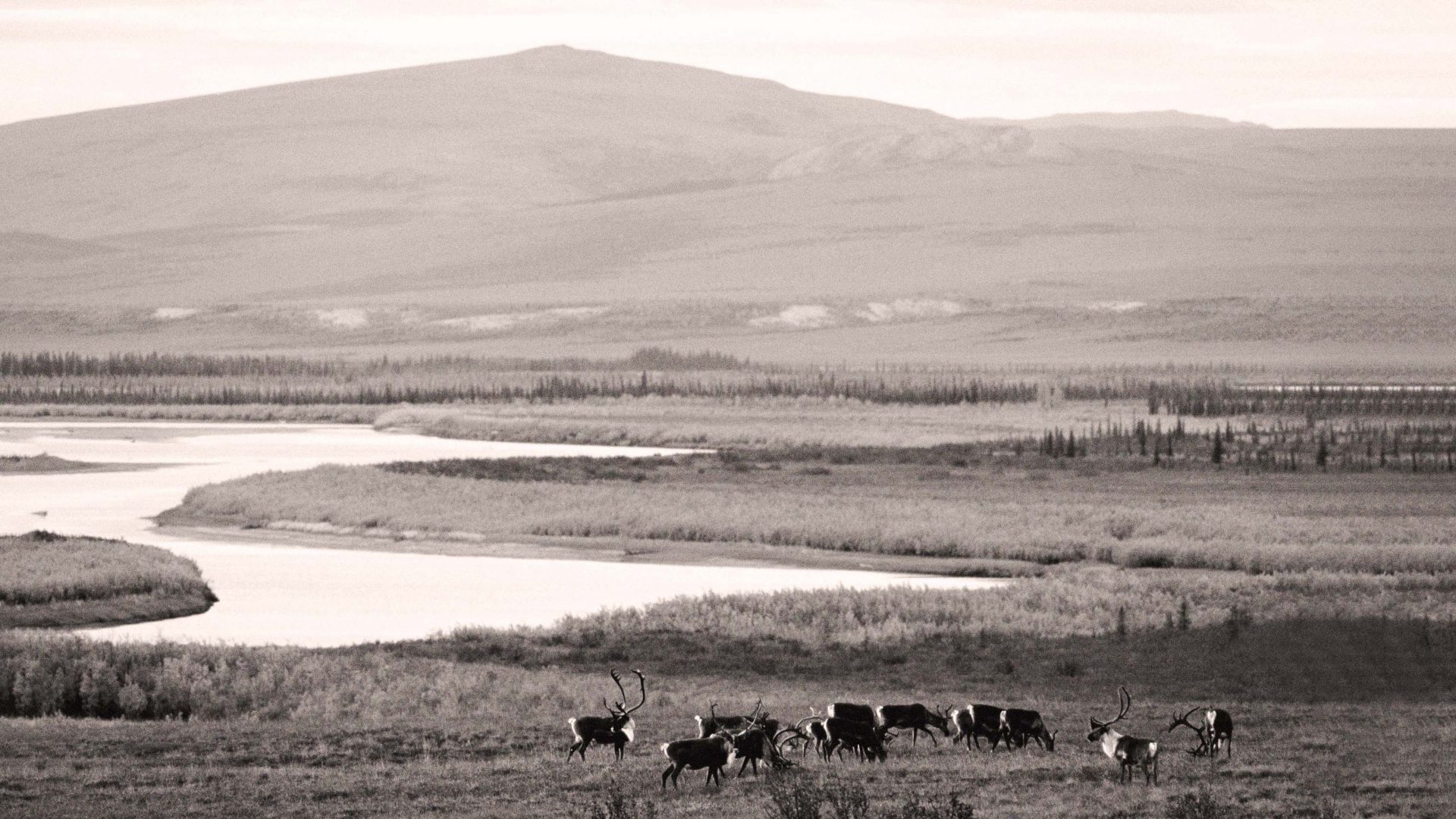
Donald Trump wants to build a new road across the wilds of Alaska. If he gets his way, a 210-mile route called the Ambler Road will cut through a remote National Park in America’s far north-west. It will traverse hundreds of streams and cross a route that for generations has been used for migration by one of North America’s largest caribou herds.
The aim is to open up mining areas that are rich with copper, silver, gold, and lead. There are also deposits of cobalt, gallium and palladium, which are vital for the production of semiconductor chips and fibre-optic cables. Some estimates say the deposits could be worth $7bn.
While the Pentagon and the mining industry have been trying to reach these deposits since the 1940s, there’s been staunch opposition from environmentalists and many – but not all – indigenous groups. That includes people such as 25-year-old Jazmyn Vent.
“These areas are deeply connected to my culture, my identity and my way of life,” she said. Vent is of Koyukon Athabascan and Iñupiaq heritage, and she grew up in Huslia, a village in central Alaska that cannot be accessed by road or rail. She heard about the proposed road from family members as a child.
“The lands and waters that would be affected by the Ambler Road – our people have relied on that for generations,” she said. “These things aren’t just resources to us. They’re a deep part of our survival and our traditions, and to our relationships with the land.”
During his first term, Trump gave initial approval for construction of the road. The plan was that it would pass through part of the protected Gates of the Arctic National Park, and run close to a National Wilderness Area. Since 1964 both areas have received the highest level of protection from the government. Trump’s action was met by a lawsuit from nine environmental groups.
When Joe Biden took office, he opposed the plan. When Trump got back in, he renewed his approval, saying that the road was “vitally important to America’s national defence and economic prosperity”.
“It’s an economic gold mine,” Trump told reporters in the Oval Office. “I signed this years ago, and Biden un-signed it for me.” The president has since lifted restrictions on a further 245 million acres of public lands. If only a fraction of those lands are exploited commercially, Trump will oversee the most substantial destruction of the American wilderness in living memory.
Suggested Reading
Sorry, but Trump’s White House UFC cage fight was actually really good
That the 79-year-old president has chosen to side with big industry rather than environmentalists was not a surprise. As a man who has repeatedly used the phrase “Drill, Baby Drill”, Trump has rejected the existence of climate change, mocked electric cars and denounced the efficiency of wind turbines, all while rolling back many of the renewable energy projects on which Biden spent billions.
In both his first and second administrations, he withdrew from the Paris Agreement on climate calling it a “rip off”. On his first day back in the White House – an electoral success helped by at least $75m in campaign donations from the oil and gas industry – it was one of several orders he signed in front of cheering supporters that reversed actions of the previous administration.
“The United States will not sabotage our own industries, Trump announced, “while China pollutes with impunity.”
Trump is not a hunter and naturalist in the style of Theodore Roosevelt, or a mountain biker such as George W Bush. He is also not a conservationist like Jimmy Carter, who not only gave protection to 13,238 sq miles of Alaska, but installed the first solar panels on the roof of the White House. Trump’s interest in the great outdoors is limited to the golf course.
America’s wild places are regulated and governed according to a strict set of sometimes overlapping rules and definitions. The 63 National Parks are well known and include places such as Yellowstone in Wyoming, the nation’s first, and famous for the Old Faithful geyser. The law creating it was signed by Ulysses S Grant in 1872, “for the benefit and enjoyment of the people”. In addition to the parks, there are 21 national preserves that include places such as the Big Cypress National Preserve in Florida.
Suggested Reading

I didn’t rate Starmer as PM – so why do I feel so sad?
There are also 806 wilderness areas, covering 174,826 square miles, which represents almost 5% of all US territory. Protected by a law of 1964, they enjoy the strictest level of protection and almost all development and commercial activity is banned.
The wording that sets out what a “wilderness” actually is runs to several paragraphs, but at its core is the following statement: a “wilderness, in contrast with those areas where man and his works dominate the landscape, is hereby recognised as an area where the earth and its community of life are untrammelled by man, where man himself is a visitor who does not remain”.
The language comes in large part from efforts of The Wilderness Society, a non-profit organisation established in 1935, whose founding members were eight conservationists and naturalists. The photographer Ansel Adams was a member of both the Wilderness Society and the Sierra Club, America’s first environmental group. It’s said he was given his first camera by his father in 1916 – an Eastman Kodak No 1 Brownie box camera – when the family made a visit to Yosemite.
There he started compiling a body of landscapes – iconic, black-and white, sharp – that for many became the defining images of the American west. Those images contained within them the implicit message that these were landscapes of defining civilisational importance: that this was the true America.
Adams’s images of empty US vistas were not without their critics. They depicted an America devoid of inhabitants, waiting to be settled by white Europeans. The Edenic idea of a wild land solely for exploitation by white people has left a troubling legacy in American life. Earlier this year in Arizona, in a case with stark symbolic resonance, a 1,000-year-old indigenous burial site in the Cabeza Prieta National Wildlife Refuge was partially bulldozed to make way for the construction of the US-Mexico border wall. An ancient symbolic ground etching was partly destroyed – senior tribal figures of the Tohono O’odham Nation called this an act of desecration.
What perhaps looked like wilderness to the first white Americans was in fact already inhabited. Though it may have been an incomplete picture, that notion of the “wild west” remains central to America’s conception of itself, and there is still a strong sense in US public life that it must be protected. Polls show overwhelming support for the continued funding of national parks. More than a century after the founding of the Sierra Club, there are thousands of national and local groups battling to preserve America’s natural environment.
Americans are raised with stories of events such as the Lewis and Clark Expedition, the first crossing by Europeans of the rugged and purportedly dangerous American west. In truth, the expedition was one of many that opened up the country to development and exploitation by settlers. It was also the beginning of the end for America’s indigenous peoples.
There has already been a rethinking of “celebrations” such as Columbus Day, when the Italian explorer became the first European to put foot on the continent in 1492. In some places, but not all, it is now called Indigenous Peoples’ Day. As this summer’s 250th anniversary of American Independence has approached, some scholars and activists have pointed out the human cost: that the subjugation of the land went hand in hand with the subjugation of America’s indigenous people.
Suggested Reading
What Starmer never understood about being PM
Trump may well want the Ambler Road, but he will have a fight on his hands. While Alaska’s Republican governor Mike Dunleavy, its two Republican senators, and sole member of the House of Representatives, who is also Republican, support the project, opponents are gathering momentum.
A group recently confronted governor Dunleavy on an airstrip near Coldfoot, where he had hosted Trump’s interior secretary Doug Burgum, to celebrate issuing permits for the road. One sign carried by protesters read “Don’t Sell out Alaska”. Another said: “Burgum’s Corporate Welfare is Bankrupting Alaska.”
Two firms, Canada’s Trilogy Metals Inc (in which the Trump administration invested $35.6m for a 10% stake) and South32, an Australian company, would work together to operate the project. The cost of building the road ranges from $760m to $2bn, and even though much of the funding would come from public sources, members of the public would not be able to make use of it.
Vent took part in the protest at Coldfoot. “There are not many places left… that you could go out into the wilderness and be completely remote,” she said.
“I think everybody should have that opportunity to go to the wilderness and be present with themselves, to go reset, and you know, take a step away from this western world that’s disconnected us from each other. Everybody is just on their phones all the time.”
The campaign to preserve America’s wilderness is an effort to preserve something essential in the atmosphere and character of the land that pre-dates the formation of the US itself – a near spiritual power that the vast expanses of terrain can exert upon the individual.
As for Americans who don’t venture into the wild, they are still comforted and reassured by the presence of the wilderness, and by the idea that there is still a future to be discovered, that America is still a land of possibility. If that sense is lost, it can never be regained.
“This place is so important to safeguard,” Vent told me. “There’s no backing down. I know this will be a lifelong fight.”