
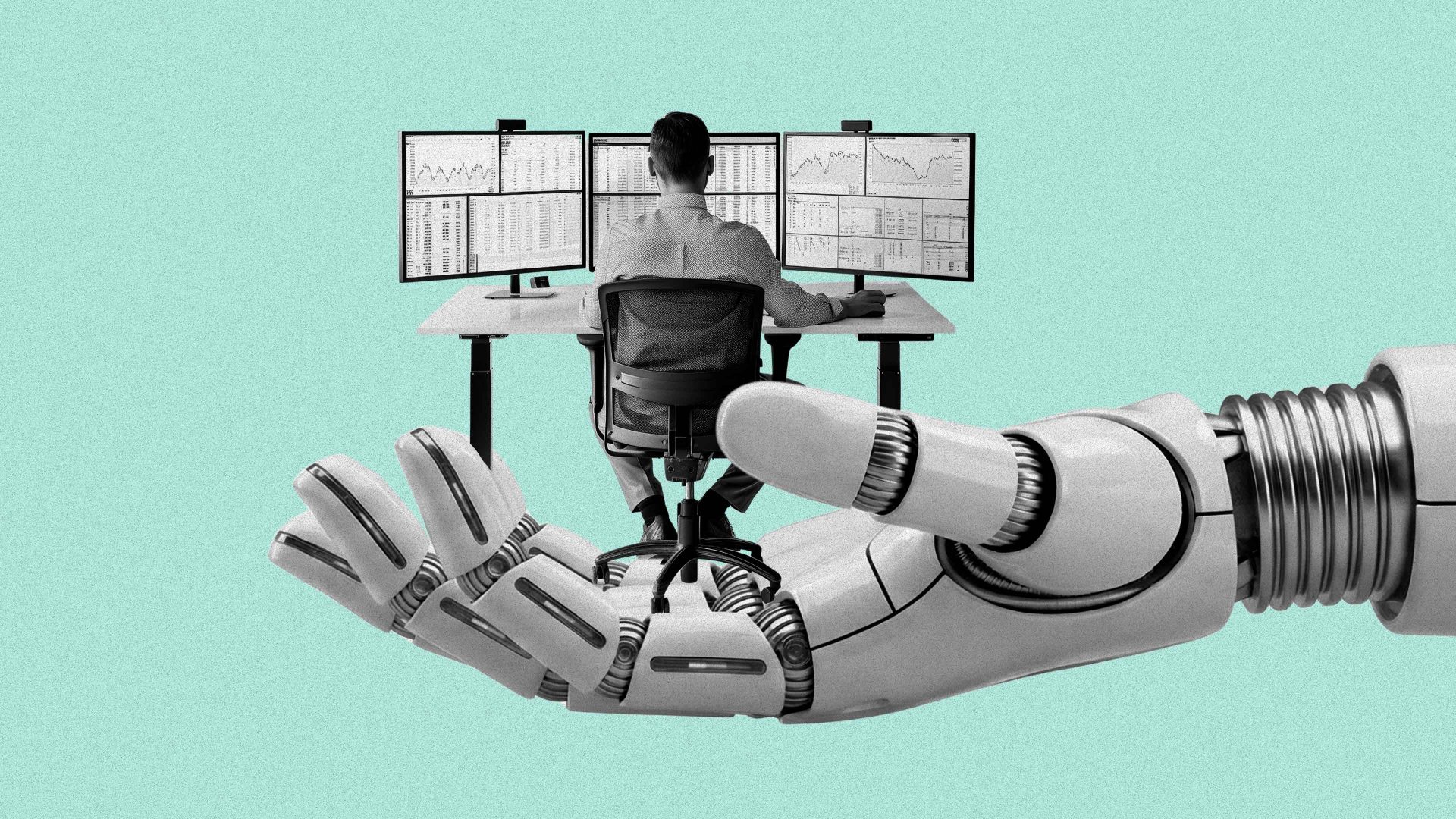
Ryan left his job as an economist about a year ago. Lots of people applied to replace him. Most of the applications were “weird slop,” he says. “Of the better few dozen, some had very similar phrasing, to the point where four of them had the same starting sentence of the third paragraph.”
These applicants were highly educated. They still feared that their ideas alone would not be enough to get them an interview. So they looked to AI, and turned themselves into the same amalgam of the sum of digitised human knowledge.
This is less of a problem when a human like Ryan is reading the applications. But what happens when AI is filtering them, tossing out the ones without the requisite keywords? Wouldn’t AI favour AI-authored writing? And what, exactly, has the recruitment software been programmed to look for and do?
These are the calculations that millions of jobseekers now make, as they wonder whether their application will ever be seen by a human. Some of them quickly discover that it won’t. Last year I was rejected for a fairly dull role in three minutes flat. Luckier applicants may be invited to book a slot with an AI bot. “Our AI-native digital worker is ready now to conduct bias-conscious interviews at scale,” boasts Eightfold, an “agentic talent intelligence company” that sells software to recruiters. “1m+ interviews in one hour. 22+ languages supported.”
Candidates try to game these, too. Some will run a question through an LLM and read off the answer. There’s a tell-tale pause before they reply.
Quietly, with little discussion outside HR departments and a few universities, British firms have decided to outsource huge parts of recruitment to AI. And the applicants, understandably, have done the same. Anyone who has spent hours sifting CVs and running interviews knows what a responsibility it is.
It can be boring, and many of us have interviewed a candidate whom we quickly knew wasn’t up to the job. But this work is immensely important to both the applicant and the recruiter – and indeed society as a whole. Why have we been so eager to hand it over?
Time and money are a big part of the answer. Hiring takes senior people away from other parts of their jobs, and as it has become exponentially easier to find and apply for vacancies – EasyApply on LinkedIn frequently attracts thousands of applications for a single post – the task of dealing with them is just too great.
Few people know that a law passed last year – the Data (Use and Access) Act – makes it even easier for employers to reject applications without a human seeing them. If they balk at that, some managers will manually “approve” AI scoring to eliminate candidates, so they can say the final decision is not fully automated.
But AI was originally sold to recruiters with a much more elevated justification than just saving money. It would eliminate bias. No longer would managers hire in their own image, rejecting CVs from people who were qualified but didn’t “fit”. In 2022 researchers at the London School of Economics published a paper which found that AI outperformed human recruiters.
Suggested Reading


Will we all end up as Chinese AI death clones?
“There is evidence that current hiring processes are plagued by cronyism and bias,” said Grace Lordan, now an associate professor in behavioural science at the LSE. “It is time that humans hand over the hiring process to machines who do not have these tendencies.” Note the “who”, not “that”. Grammar matters when you talk about AI.
So I spoke to a recruiter who works for a major defence company. Was it true that AI was less biased? Yes, he said. “I’ve seen it work really well from a diversity point of view to redress the balance of people being recruited into roles.”
“The worst enemy of diversity, probably, is hiring managers who carry with them various biases that can be hard to train out of them. [With AI], things tend to be objective. The playing field is levelled.” In a previous job he was hiring hospital workers, including porters. “We applied an automated process to the whole thing. Overnight, the number of women and ethnic minorities we were hiring went up.”
The problem is that most people don’t like AI recruitment at all. Four years ago, the LSE described the attitude of both recruiters and applicants towards AI involvement as “overwhelmingly negative”. A lot of the recruiters have pressed ahead anyway. But the applicants, many of them fresh out of university, are finding the brave new world of AI recruitment hard to cope with.
The falloff in graduate job vacancies – partly due to AI, as Rishi Sunak has admitted – makes it even worse. Ironically, the biggest fall in vacancies has been in entry-level HR.
At a recent conference, the same recruiter heard graduate jobseekers complaining of their frustration at doing the same tasks over and over again. “It was really quite depressing… they weren’t given a chance to show who they were… There’s only a few companies that provide these tools. They’re going through these processes, and they’ve got no clue why they’re not progressing.”
Suggested Reading
The AI candidate running for the White House
Dimitra Petrakaki, a professor of technology and organisation at the University of Sussex, saw the problems five years ago when she interviewed graduates who had been interviewed by AI bots. At first, they were quite excited to be using a new technology that claimed to eliminate bias. But they felt they had been put “in a position where they acted more like bots themselves.”
“They would have their eyes really fixed on the screen and worry about what kind of keywords they were using. They also talked about how demoralising this process was. There was an element of emotional exhaustion for many of them. They were not receiving any information or feedback both during the process of the interview – expressions, signals, confirming misunderstandings – but also no feedback afterwards.”
This lack of any feedback is particularly hard to cope with. According to research by the Information Commissioner’s Office (ICO), people are also wary of AI profiling tools like online behavioural assessments. They prefer in-person interviews and, if decisions are being automated, they want to know which ones, and the basis for the decisions.
I asked Eightfold.ai if it could tell me what metrics recruiters are using to scan CVs and applications, and how it was trying to improve the experience of AI interviews. The ICO recommended that employers who use this software should ask the firms whether they have carried out any algorithmic fairness testing. Has the company done this? Eightfold said they were unable to comment on any of these questions.
AI recruitment, says Petrakaki, is largely a mystery to the people who have to use it. “When we rely only on AI to make this kind of selection and decisions, I think the risks are great… It’s very important that we un-black box it.”
That sounds desirable. But it is unlikely to happen. The whole point of AI recruitment software is that it speeds up the process. It is not in firms’ interest to divulge how much of it is automated, not least because if jobseekers believe an automated decision is wrong, they have the legal right to challenge it. (Good luck in getting the job if you try that.)
Suggested Reading


The death of the after-school job
More transparency about AI means more opportunities for LLMs like Claude and ChatGPT to advise you on how to game the system. They already know how to lay out a CV to appeal to a specific platform. And to compound the confusion, a survey by the ICO found that most employers using AI didn’t think they were making automated decisions – even when they were.
Will there be a backlash? As with house prices, much of the discontent is generational. People in senior roles are less likely to encounter AI when they change jobs. They see the savings but not the frustration of young jobseekers. Nonetheless, recruiters are beginning to realise that at some point the technology will stop being merely helpful and start automating their own jobs out of existence.
“No one wants to be the turkey that votes for Christmas,” says the defence recruiter. “It would probably be possible to automate the process from start to finish, but I don’t think anyone wants to push that button. You do need human judgment. Everyone’s aware that this could be a real industry killer.”
He recently tried out a new AI bot that can call candidates “like a human being” and hold a conversation. “It was a remarkable piece of tech. All of us were, like, this is far too creepy. None of us are comfortable to go down this road. There are dozens of people whose jobs would be at risk.”
Too many jobseekers, too few entry-level jobs, too easy to apply for them. To many firms, AI looks like the best way to manage these problems. But at what cost? Must jobseekers “act more like bots” and learn how to extract the best advice from LLMs in order to find work?
There has always been a lot wrong with the recruitment process and its biases. Finding a job does mean figuring out what other people want and adapting yourself to their requirements.
But when we let AI into the game, we create a system in which the biggest rewards go to those who can present a version of themselves that meets the demands of a software program. You could call that a lot of things – and bias is one of the less alarming ways to describe it.
 Most popular
I was at Eton with Charles Spencer – this is how it explains his battle with the royals


Emily Maitlis’s diary: My deep dive into Jeffrey Epstein’s hidden empire – and the network that let him get away with it

The Greens’ foolish anti-Zionism vote is a disaster for Zack Polanski

Putin’s wartime economy is heading for catastrophe