A few days after a wildfire tore through villages north of Athens killing more than 100 people, Greece’s then minister of defence Panos Kammenos visited the popular seaside resort of Mati, where most of the deaths occurred.
“The tragedy is the fault of the residents,” he declared.
Despite the fact that 150 people also had been severely burned and more than 2,500 homes set ablaze amidst thousands of acres reduced to scorched stubble, he doubled down: “This is a crime from the past,” he said. “All these properties, the majority are without a licence and they have occupied the coast without rules.”
That cruel attempt to blame the victims of what is one of the deadliest fires in Greece’s history, provoked a bitter response from photographer Katerina Angelopoulou in the form of a book, The Fumes of Mars. It is not just a collection of searing images but the account of her own trauma and her outrage at the authorities who failed to halt the fire before it spread, sent in rescue teams when it was too late and shamefully, attempted to cover up their fatal errors.
In Greece, the fear of fire never goes away. In late July, three firefighters died battling blazes on Crete and on the mainland in the Peloponnese in what were the deadliest outbreaks this year. Already there have been 2,880 conflagrations across the country, and in June more than 40 fires broke out on the island of Evvia, in Corinth and in Attica.
In fact, on that summer’s day, July 23, 2018, Angelopoulou, who grew up in Mati, did smell burning. She was with her mother and her three-year-old daughter Clio enjoying ice cream and larking about with the dog at a friend’s house, but to be sure there was danger she clambered on to the roof of the house.
“It looked close, but it was not really alarming,” she says. “But suddenly someone opened the front door of the house, and it was like you were in hell. It was just red, really.”
Grabbing Clio, and bustling her 79-year-old mother into her car, they raced toward the seashore. By now the wind had reached 100 mph. They came to a fork in the road. Go right? Go left? They went left. Had they turned the other way, they would have been trapped along with many others in the flames.
She writes: “We can’t see anything – the trees are on fire, pine cones exploding, embers raining down on us. The fire wasn’t close a minute ago. It’s faster than us. I feel I can’t run anymore without tripping over. I ask Clio: ‘Can you run?’”
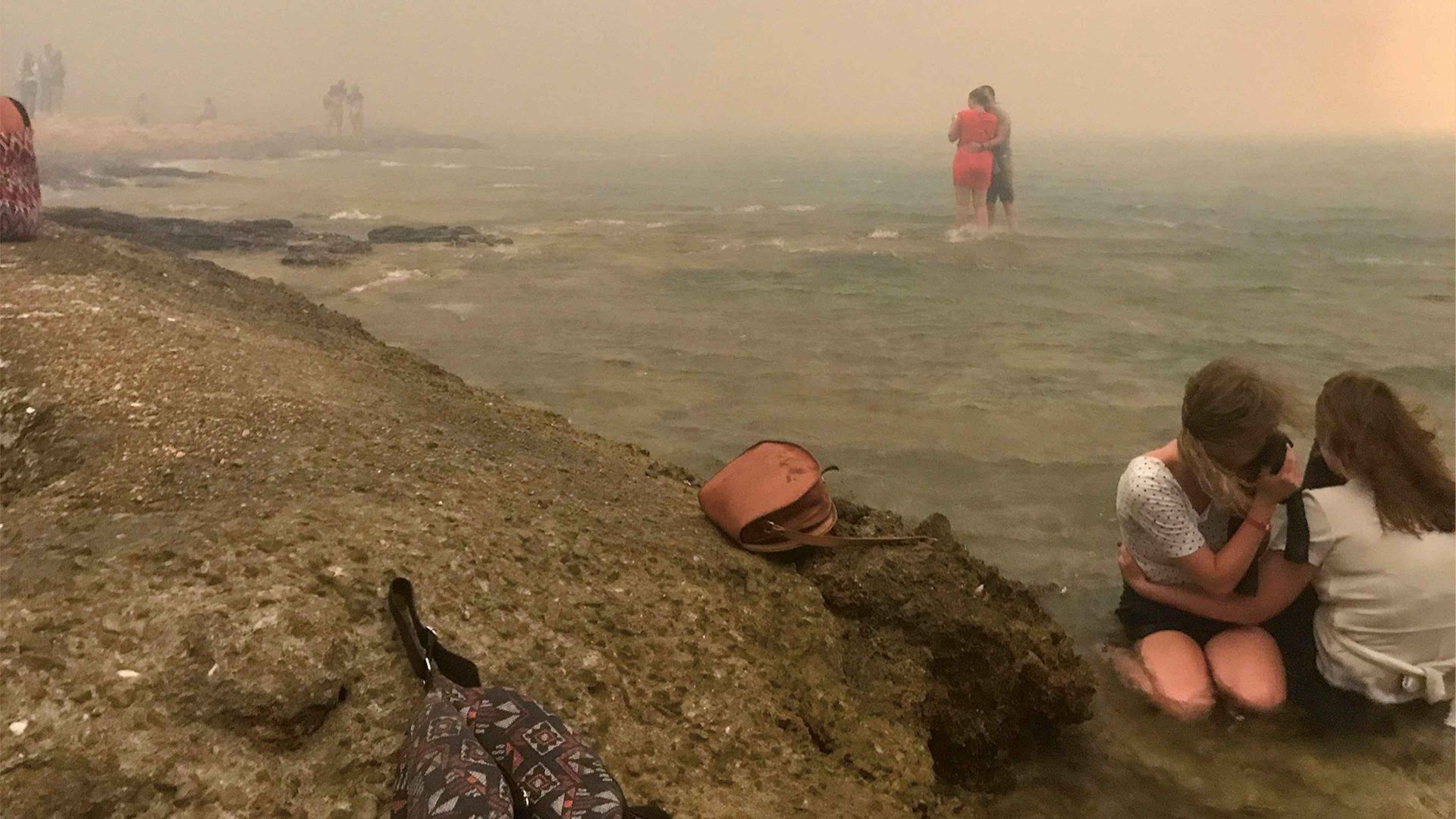
When they reached the shore, they found themselves with scores of others where they wait – and wait – to be rescued.
Her photographs of the day begin at 17.22:49 (she meticulously recorded the time of every photo) with a shot of the blazing sun from the roof. The sequence continues with smoke obscuring the sun and darkening the sky with “a burning cloud moving very fast” until they reach the sepulchral scene on the shore where everything is blotted out by an impenetrable yellow cloud. It is 18.45:35
By 20:50:59 the fire had come to a halt by the sea. “There is absolute darkness, scattered fires burning everywhere, burned cars and rubble—and silence.”
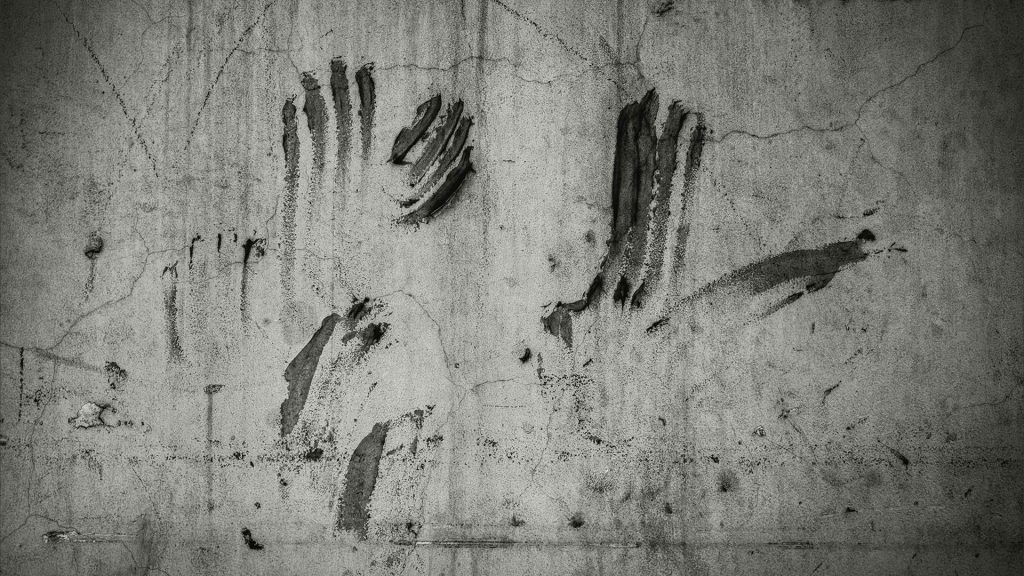
Her photographs are blurry, some shaky as if she is too stressed to grip the camera securely, but what is so striking is that whatever the despair there are no screaming people, no tears, no rage. Couples hold each other, strangers chat, they are wearing shorts and summer clothes, some phone for help or contact friends. Someone has brought a bird cage and another a dog. She and Clio sing nursery rhymes.
In the days after the blaze, she went back to what was now a wasteland. Her stark black and white images emphasise the desolation of the scene; burned-out homes, shattered windows, scorched trees, a landscape covered in ash, and poignantly, a pair of sunglasses trampled into the ground.
She returned to the ruin of her mother’s house where she rescued a trove of sentimental mementos; a crumpled suitcase with her late father’s documents, beads from a necklace bought in London’s Portobello Road, a bracelet of seashells made with Clio, a scrap of paper containing a few lines from Hamlet.
In the two years or so after the fires, while she agonised how best to produce the book, she collated testimony by survivors from newspapers and TV and it is their words which express the horror of the day and its shameful aftermath.
This from someone who took to the sea with a neighbour: “It was hell. A black veil. The sea was very rough. Too much wind, too many waves, too much smoke. We struggled to keep him out of the water. He couldn’t take it anymore. He raised his hands, asked God for forgiveness, ‘thank you for everything you’ve done for me,’ he said and took his last breath.”
Suggested Reading
The tiny dolls with souls at the heart of a museum repatriation debate
With no coastguards coming to their rescue, nine drowned as they tried to swim to safety, including her mother’s dearest friend Aimi whose garden they had been in before the blaze.
One survivor recalled: “When the flames approached, we fell into the water. It was 19.00. The water swept us away. At around 23:00 a trawler picked us up. A woman drowned as well as a young man. For a while I swam next to a floating corpse. She was a woman with white hair.”
A grieving daughter recalled: “My mother was lying on the sidewalk, so burned that she had no hair. She was naked, hairless and screaming. They brought her a tablecloth from the taverna. She was alive for 5–6 hours. As soon as she arrived in the port in Rafina, she died.”
Another spoke for them all: “Why did they forget us? Why did no one come? Why?”
Vangelis Gountoufas, director general of forests in Greece’s environmental ministry, admitted: “In the last decades we have been through a period of complete abandonment”. The number of firefighters has more than halved since 2000 to fewer than 3,000 today, though the forestry service itself has added some 300 staff since 2024 and more than 100 drone surveillance bases have been set up.
Meanwhile, what of the people who survived? Many abandoned their homes because they were too badly damaged, others could not deal with the wreckage of their happy lives.
Angelopoulou’s home was reduced to a shell, and she can scarcely bring herself to return. “All the memories I have of my father are in that house. When I worked abroad, that was the house I came back to. It was home.
“My mother is slowly rebuilding it, infusing it with life again, and that is making her feel more at peace.
“But my daughter does not want to go back. It was only last year that she really understood that people and children had died in the fire.”
Angelopoulou’s emotional response to the tragedy is matched by her anger at the official blame game. She praises the courage of forensic expert Dimitris Liotsios, who exposed the negligence of his superiors and their attempt at a cover-up despite them threatening to “gather and tear you apart” if he refused to back down. As a result, 11 men were brought to justice and five imprisoned.
Surprisingly, it is not one of her photographs which fills the book cover but a drawing by Clio. The 11-year-old cannot bring herself to read the book – too much pain for a child to comprehend – but with an explosion of colour she vigorously expresses the chaos of that fatal day and also, perhaps, reflects the turmoil of her mother for whom the “sounds, images and urgency of that day have never left me.”
 Most popular

Emily Maitlis’s diary: As I was saying to George Clooney just the other day…

Why Slavoj Žižek probably hates you

There’s only one reason Trump went to Ireland – it wasn’t to meet the Taoiseach

A new film about Elon Musk reveals him as so awful it’s almost tragic. Almost