
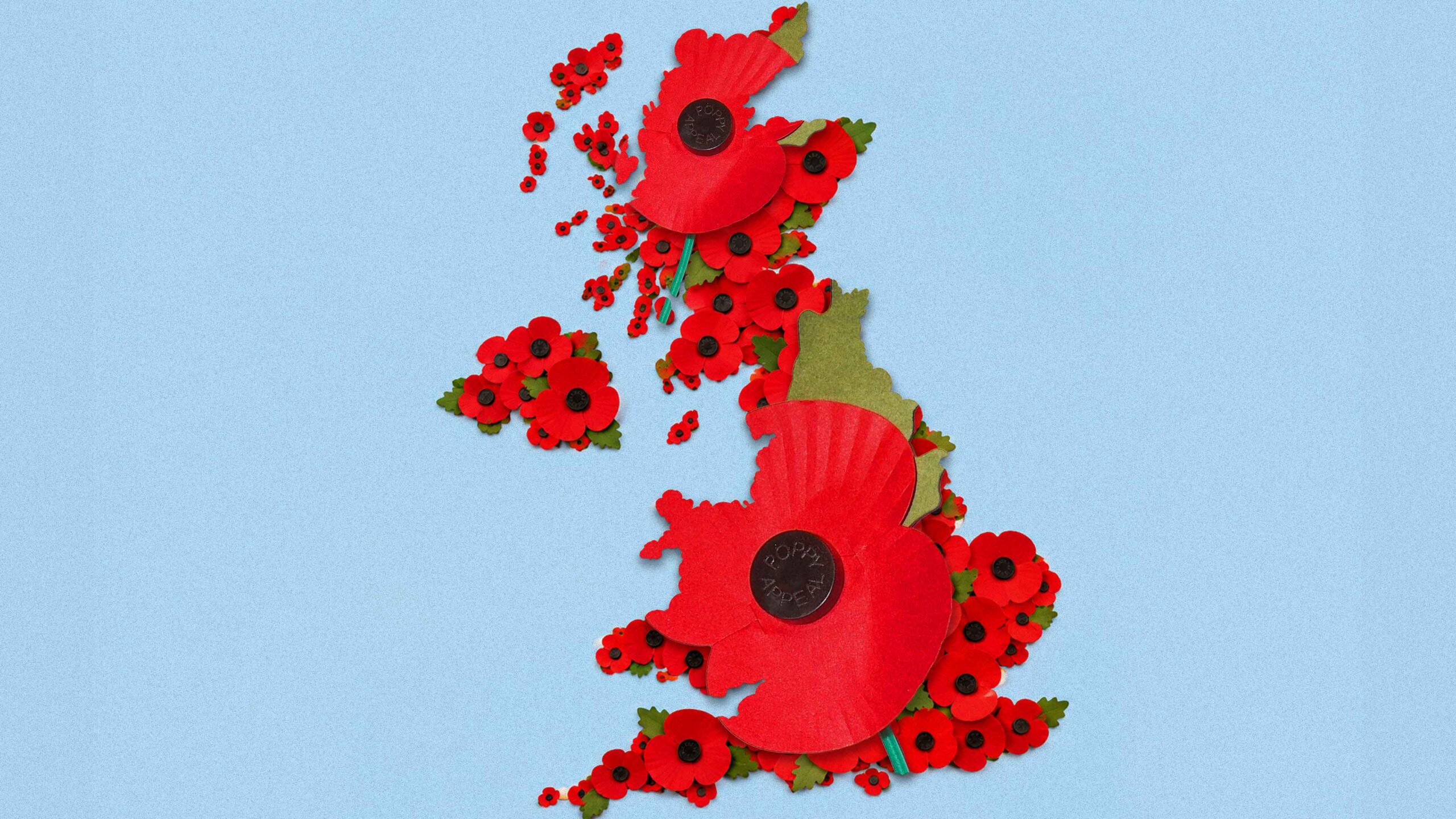
England in autumn is a strange place, where the transatlantic aping of Halloween and the sectarian frivolity of bonfire night is followed by the overexcited wearing of poppies.
Autumn is also the season of harvest thanksgiving, though nobody seems much interested in whether the farmers have salvaged anything from their drought-ravaged crops. Look up and you might notice millions of coloured leaves still clinging to parched trees. But who’s going to do that when there’s plastic to buy?
Whether it is the stretchable cobwebs briefly covering a wheelie bin before being dumped into it, or those LED swivel fans that break before Guy Fawkes’s toes singe, the corporate geniuses ravaging the planet to raise school fees for their own doomed children, have got all your single-use needs covered.
And no sooner are the skeletons binned and sparklers extinguished than the poppies come out. Autumn has acquired a third retail season: Remembrance. Once dedicated to memorialising the nation’s war dead, it has been appropriated by people who see the poppy as a way to advertise their Britishness.
It began modestly enough. In 1921, disabled veterans were employed to make the flowers. Later came solemn widows who sold paper poppies beside supermarket trolleys. These days the supporting cast is rather more colourful, ranging from football fans in ‘Lest we forget’ Adidas Sambas, to men with D-Day frescos tattooed on their pecs.
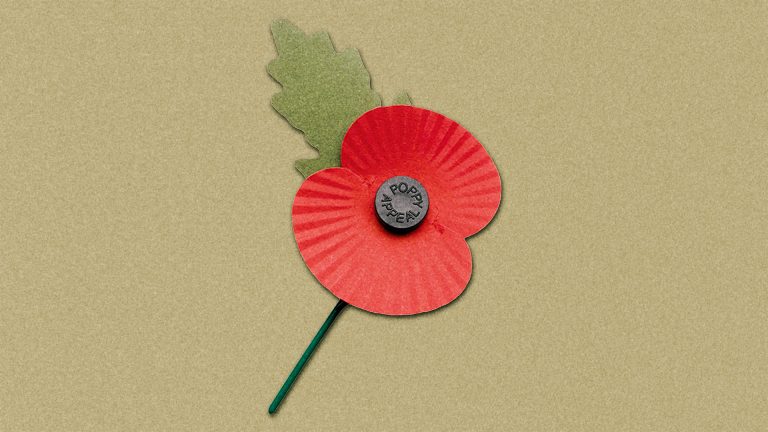
Poppies nowadays are often more brandished than quietly worn; the size of your replica flower signals not only how much you respect the fallen, but also how much you bloody love your country. Motorists with Sombrero-sized poppies attached to their front grilles clearly remember the Gallipoli debacle better than shoppers with plastic ones in their lapels. And both are more committed to their nation’s history than the fifth columnists who haven’t bothered to wear one.
Although, despite what the GBeebies might like you to think, nobody here objects to remembering the dead or to wearing a poppy if you feel so inclined. It’s the increasingly insistent implication that everyone else should do likewise that causes trouble.
Television presenters are lambasted for insufficient floral coverage, Irish footballers for refusing to wear one, and politicians’ poppies are scrutinised for their precise dimensions. Is there any other country in which the content of someone else’s person’s jacket has become a matter of such urgent concern?
The poppy cult has become more emphatic as the wars it memorialises recede. Those who experienced the blood and gore of the trenches were not generally inclined to romanticise the experience, or to reminisce nostalgically about the garlicky scent of mustard gas.
But as ‘we that are left grow old’, folk memory lightens. Eyewitness accounts of men’s body parts spraying in front of them during the battle for Caen have made way for Greenwich Mean Time memes about “turning the clock back to 1940 – when this country had some balls.”
Suggested Reading

First the flag. Now the poppy
The whole business has a mawkish quality which is at odds with the fortitude of the fallen that we’re supposed to be remembering. And as the unpayable national debt to them grows, remembrance has become an increasingly sentimental exercise in which the national response to death is found not in quiet reflection but a sort of school production where everyone is expected to know their lines and cry in the right places.
And all this is before we get to the inanity. Tesco Remembrance Day pizza after watching an 80-foot-high poppy mascot get walked onto the pitch for a minute’s silence before the footy, anyone? Or would you prefer to watch the Cookie Monster wear one on The One Show instead?
It was only because of ‘their’ sacrifice that you have the option not to wear a poppy. So why aren’t you?
Somewhere along the way, foregrounding the horrors of war became indistinguishable from applauding everyone who has ever worn a uniform. Nobody is quite sure how we got here, but it’s a bit like the Royal Family, which over the same period has somehow metamorphosed from a collection of dutiful stoics to a cast of soap opera influencers.
To be fair to the poppyists, there’s not much point in complaining about the evolution of traditions. That’s what they do. Although if the past is a foreign country where they do things differently, you do begin to wonder why we haven’t yet invaded it.
Because whether they went behind enemy lines with a steak knife or stayed behind peeling potatoes, they are all heroes. A limb lost in Afghanistan becomes proof of a noble cause, rather than a reason to question it.
And if the reverence feels like misplaced guilt, it’s because it is easier to applaud those who served than to ask what on earth we sent them to do. Especially when Britain’s most recent overseas adventures may not have been as noble as the commemorative merchandise would have us believe. Starship Troopers understood the trick: wrap militarism in enough hero worship and nobody asks what the heroes were sent to do.
There is something queasy about commemorating a generation who made do and mended by purchasing increasingly elaborate merchandise. The people who endured rationing, recycled their string and kept their bacon rind would, presumably, find the thought of shelling out £12.50 on a Lest We Forget thong a little excessive
They might have also raised an eyebrow at the growing number of people here who seem to think that they actually took part in the second world war. Although their enthusiasm for the period is not always matched by equivalent zest towards its supposed virtues. Self-denial, steel, and endurance are not qualities you associate with people who spend thousands of pounds on vinyl wraps of Somme Tommies for their Ford Focuses.
On Sunday, as we worship before phalluses of Portland stone, maybe we should ask ourselves if the fetishisation of war by people who have only experienced it in a Vue Cinema is an inevitability of the human condition. When Odysseus got home from Troy, were Penelope’s suitors wearing Trojan Horse pin badges the size of a hoplite’s shield? Turning unwilling participants in war into figures of consumerist veneration makes the next one easier to contemplate. Good news for generals. Bad news for everyone else.
No wonder Poppy Day seems to get earlier every year. To wear a symbol of involuntary heroism as a badge to celebrate jingoism is to forget the circumstances that made it necessary in the first place. Perhaps the greatest indignity we can visit upon the dead is to turn their sacrifice into a fancy-dress exercise for the living.
But it’s also worth remembering that while the decomposed are safely beyond disappointment, we’re doing a thoroughly indifferent job of protecting the living. A military is needed to protect a country, and so is a functioning ecosystem. Leaves still clinging to the trees remind us that there is little point in remembering the fallen if we cannot manage to keep the rest of us alive.
Lest we forget.
 Most popular

Watching the fall of Trump with New York’s MAGA hardcore


The uncomfortable truth about Ariana Grande

The John Lewis Christmas advert meltdown is Britain’s most idiotic new tradition

Kid Rock, gold wheelbarrows and a bigger recount: How Trump and his inner circle spent election night in his half-built ballroom