America’s pollsters were no more accurate last week than in other recent elections. The difference is that this time they erred in the opposite direction. How come they underplayed the Democrats’ triumph?
The answer has two parts. The first flows from the national figures. On average, the polls reported a Democrat lead of nine points. In fact, the gap was 13 points. There were too many polls for a four-point average shortfall to be explained by random sampling error.
A major factor was the way young voters move massively to the left. According to a New York Times analysis of 25,000 voters (too many Americans now vote early or by post to rely on traditional exit polls), the Democrats enjoyed a 41-point lead among the under-30s. The main pre-election polls that reported their figures by age showed leads in the range of around 20 points. This gulf between predictions and result explains roughly half the national error.
Suggested Reading

Slavoj Žižek: Beating Trump isn’t the wild triumph you all seem to think
The graphic gives a clue to the second half of the error. It shows the figures for the seven states that have so far been called as Democrat gains in the Senate. The polls for Kansas, Ohio, Maine and Iowa broadly matched the national polls in modestly understating the Democrats’ victories. Their electorates are mainly white.
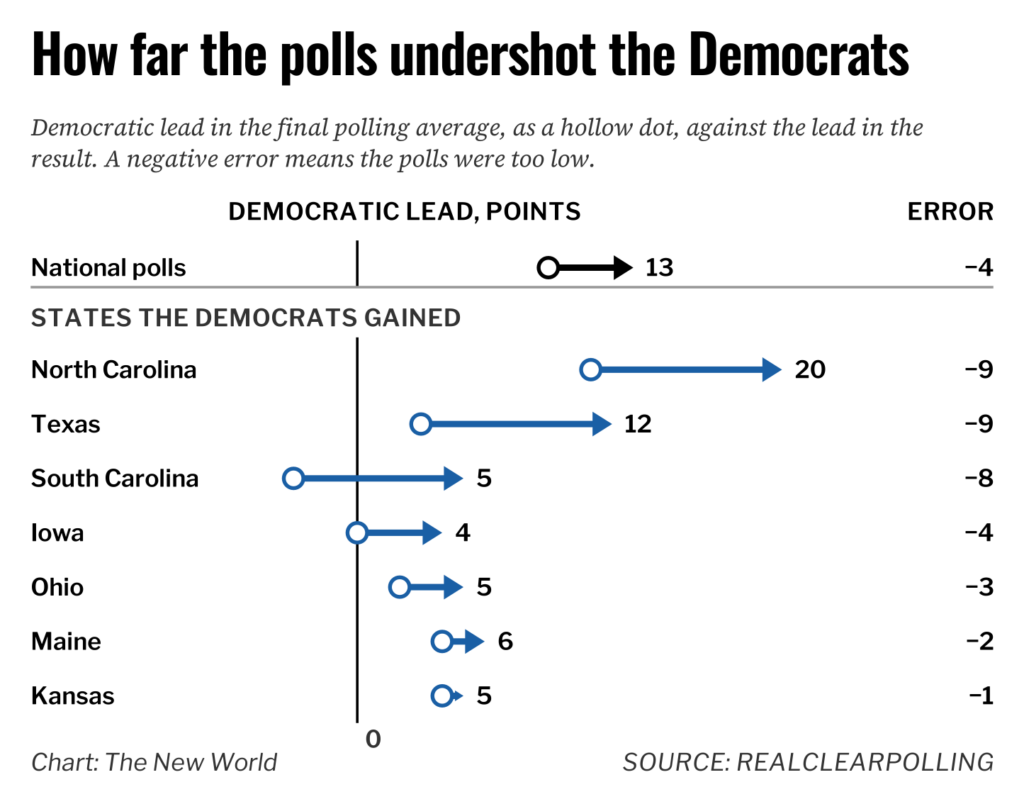
In the other three gains – Texas and the two Carolinas – the Democrats did much better than the polls predicted. What marks them out is the size of their non-white vote. In Texas, 40% of the population is Hispanic; the national figure is 20%. In North and South Carolina, 20% and 28% respectively are black, compared with 12% in America as a whole.
The polls understated the shift to the left of these minorities. They showed the Democrats leading nationally by around 70% among black voters and 20% among Hispanics. The New York Times research found actual leads of 85% and 40%. These polling errors contributed around two points to the understatement of the Democrats’ national lead, but far more to their greater errors in Texas and the two Carolinas.
Following these results, America’s pollsters need to look hard at whether they find the right mix of younger voters, and at their ability to measure accurately the views of black and Asian voters.
 Most popular
Slavoj Žižek: Beating Trump isn’t the wild triumph you all seem to think

How Trump stole Venezuela’s oil money

Britain’s poppy day cult has gone too far


The uncomfortable truth about Ariana Grande