You know the routine by now. Be prepared to be shocked, annoyed, bored, and mystified. Maybe even impressed. Yes, it’s the Turner Prize 2026.
The four finalists have been chosen and are on show at the Middlesbrough Institute of Modern Art (MIMA) – a bold edifice in glass and steel whose very presence is an optimistic counter to the unrelenting bad news which overwhelmed the town after the recent killings of two policemen by “joyriders” driving the wrong way down a dual carriageway.
On the morning of the visit to the opening of the Prize exhibition, the local headlines were about drug gangs being busted in police raids. But that’s a world away from the cheerful optimism of the gallery, its staff and its director Laura Sillars, who celebrated the “power of art” or jury chair Alex Farquharson, director of Tate Britain, who reckons the shortlist offers “a compelling reflection of the breadth and vitality of contemporary British art.”
This year that means works which are safe and serious and unlikely to engender the kind of furore which greeted Damien Hirst and his pickled cow, Martin Creed’s light switch and Fiona Banner’s no-holds-barred exploration of sexuality, which Kim Howells, the culture secretary of the day (2002) dismissed as “conceptual bullshit”.
This year, the only controversy will be if Unspeak the Chorus by Kira Freije does not win the first prize of £25,000. (A rash prediction, perhaps).
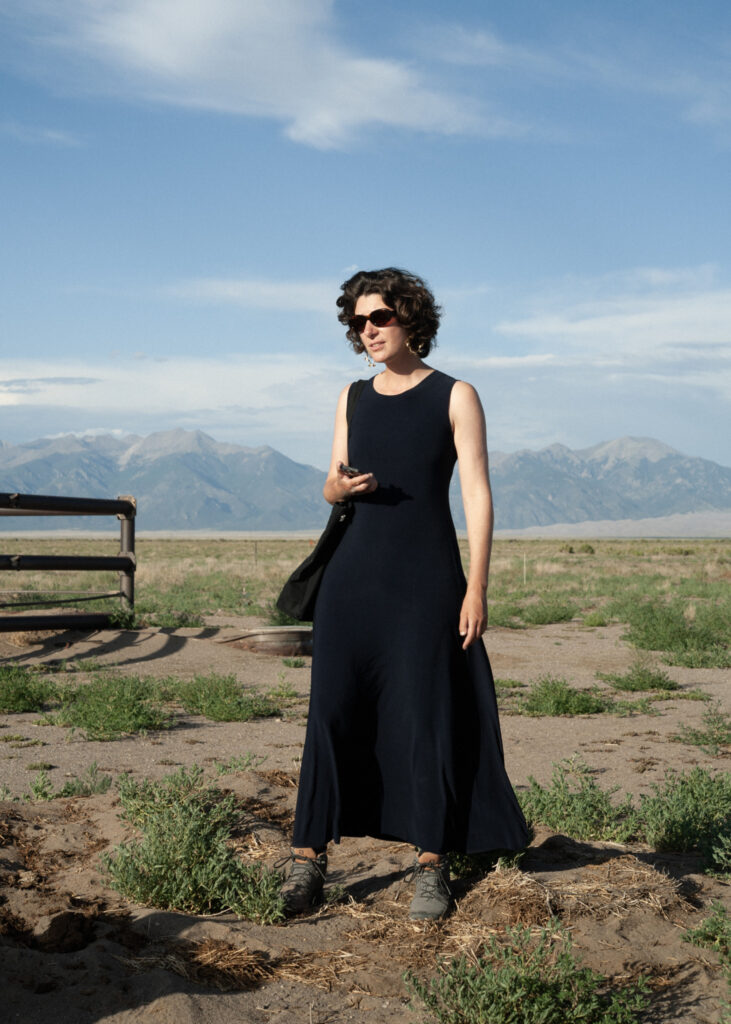
Her entry is proof, if needed, that art has to be seen in the flesh – or in this case, welded steel. However many sophisticated photographs and videos, however many words of explanation, nothing captures the impact of her work which, put over-simply, is a collection of skeletal figures made of steel, scraps of fabric, with faces made from stone casts of people she knows, and of her own hands and feet.
The jury recognised “the emotional depth of Freije’s work, highlighting its unique sculptural vocabulary of materials and forms, as well as the haunting, expressive way she transformed the space through her arrangement of figures.”
And what a space. Freije has lined the walls in silver, creating an uneven glow like ripples of water into which crowd her evanescent figures. Couples embrace, cry with despair, a figure huddles on the ground with a sheep. One lies recumbent on a dilapidated sofa with a metallic bird of prey in his hand; another seems to be whispering a secret into an accomplice’s ears. The effect is tender, emotionally charged, and intimate.
And the joy of it all is that Freije is not trying to tell us what to think or worry about. There are no geopolitical arguments here, no diatribes, no angst-ridden confessional.
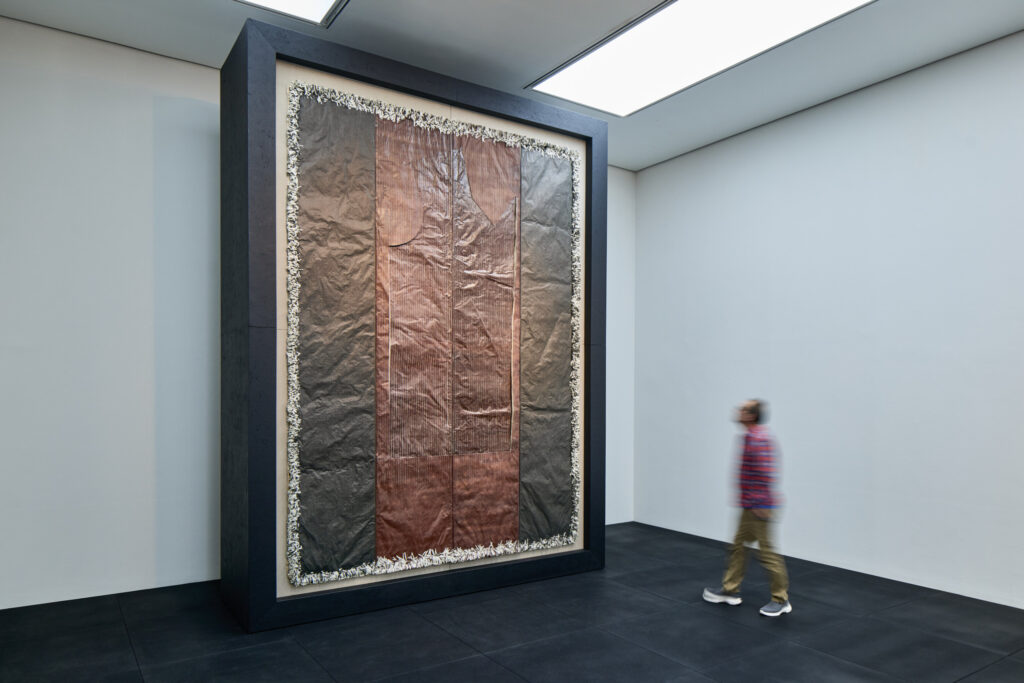
In Morale Patch, Tanoa Sasraku, on the other hand, exposes the depredations of the oil industry – a worthy target and a timely one, given the energy crisis caused by Donald Trump’s war in Iran. The jury praised “the precision and sophistication” of the installation, saying it “addresses complex historical issues with strong contemporary resonance, and its use of a clinical, minimalist display that conveys both irony and seriousness”.
The centrepiece, Watchlist 2025, is an expanse of velvet like a chessboard in grey, brown and white with a paperweight on each square containing a drop of crude oil. Her paperweights, nicknamed tombstones when presented as retirement gifts to oil industry executives, celebrate achievements like “1990: A whale of a year”, with six discoveries and 38% success.
The work is minimalist and clinical, but it lacks the fierce expression of the anger Sasraku clearly feels about the effects of big oil on a world faced with the armageddon of global warming.
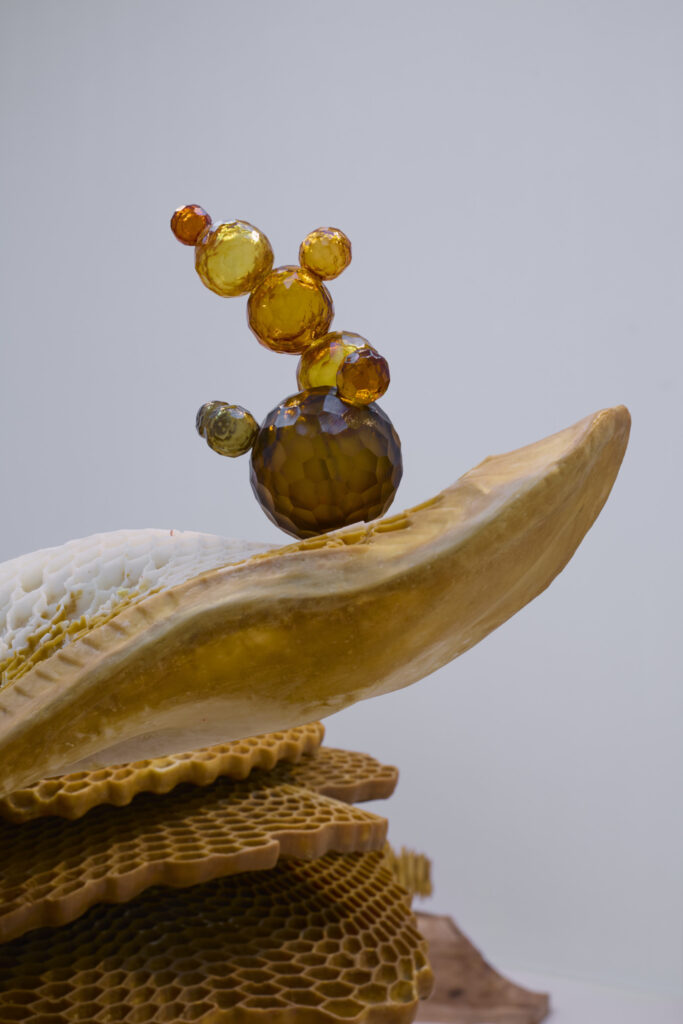
If Sasraku brings a simple symbolism to a complex political problem, Marguerite Humeau talks vividly, almost mystically, about the “metamorphoses and transformation” she is trying to express in Torches. Humeau investigates whether humans can be reintegrated within ecosystems, merge with other species such as bees or termites and she suggests that her pieces have grown “as if they haven’t really been designed or carved, like organic structures.’
The jury were impressed by Humeau’s ‘cinematic exhibition and its engagement with ecological and existential themes through inventive forms, speculative scenarios and dynamic shifts in scale.” However, the results do not quite recreate this metaphysical universe.
The Holder of Wasp Venom 2023 is a substantial sculpture in tiers like a giant fungus, enhanced with bubbles of handblown glass and sculpted out of the very natural ingredients of beeswax – 150-year-old walnut wood which has been eaten by termites and containing actual wasp venom.
Yet there is nothing particularly cinematic about the works despite the background noise of drums and birdsong and the result is too solid, looking more as if it has been made of plastic than the natural ingredients she has so appropriately used.
Her sense that many of the secrets of the universe can be found in the relationship between man and the natural world is exemplified by A Matriarch Engineered to Die. A smooth, white elephant lies dying, her heartbeat fading as death approaches, her plaintive trumpet call, more a groan of pain.
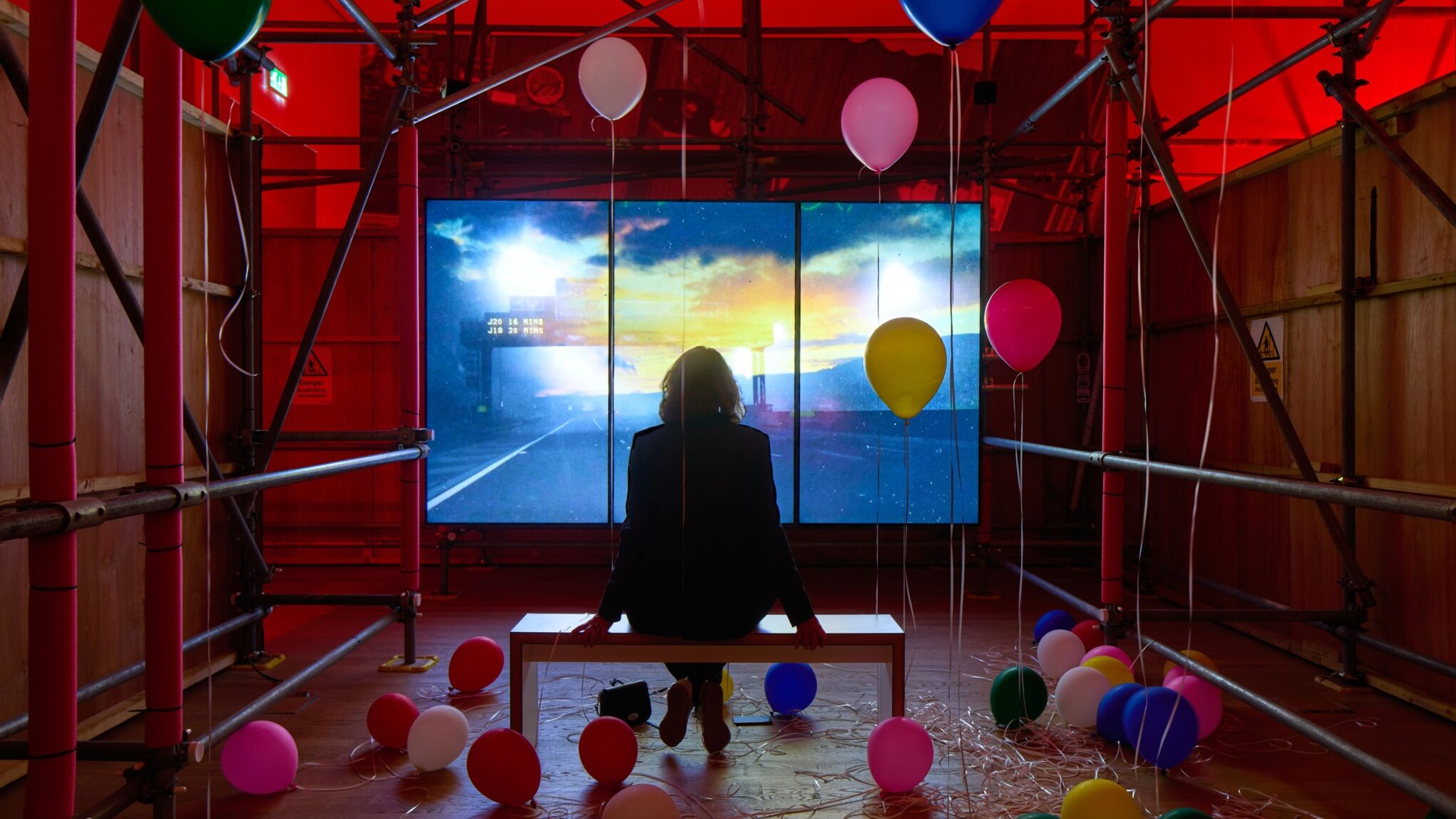
Humeau suggests that the elephant is one of the most highly evolved creatures on earth, asking what if they had developed to be the dominant species instead of humans. Which brings us to the artistic elephant in the room, a monologue by Simeon Barclay, better known for sculpture, collage, neon, and video about growing up in Huddersfield through the perspective of a car journey along the M62.
There were murmurs that this did not meet the criteria of the Prize for the entrant to be an artist – a sculptor, an installation artist, even a painter – for Barclay’s entry The Ruin is a long poem, albeit set against video and imagery drawn from his childhood.
The jury hailed his performance for its “exploration of Britishness, class, race and masculine identity”, and it takes the form of a voiceover, with indistinct, black and white images of traffic whizzing by, road signs and flashing lights.
For the young Barclay, the motorway, built in the 1970s and which now stretches from Hull to Liverpool via Huddersfield, was a lifeline, “an escape route to new frontiers” but his words are resolutely downbeat, describing a world which he considers has turned out to be one of degenerates, porn artists and rogue traders, to name but a few dystopian characteristics.
“Down the M62,” he intones. “In a tin can deliverance Buffeted/ In darkness… Hidden/ In dank fog,/ Battered/ In driving wind / Obscured/ In driving Snow / Pissed on/ In driving rain…”
And later, in a requiem to the workers who built the motorway: “In mud, they walked in mud / In mud, They slept in mud / In mud, they in ate in mud… They relish the break for pickled mud sandwiches.”
Even when he leaves the motorway for a digression on his childhood with postcards from Grenada, porcelain figurines and celebrity snaps of the Beckhams, the snooker player, Alex Higgins, the actor James Mason, his pessimism pervades. The description of the “man of the house” on his sofa, as an “old saggy scrotum sleeping under its own duress” is a memorable phrase delivered with an air of deep melancholy.
The Ruin lasts for about 35 minutes. The M62 is 107 miles long. It’s a long haul. Roundabout the Burtonwood Services near Warrington, one needs a break – a Welcome Break, in fact.
The Turner Prize 2026 exhibition is at the Middlesbrough Institute of Modern Art (MIMA) from September 26, 2026, to March 29, 2027
 Most popular

If Burnham held a snap election, he’d win – but there’s a catch

Yes, there must be another EU referendum. So let’s win it

What happens to Trump if he loses the midterms?
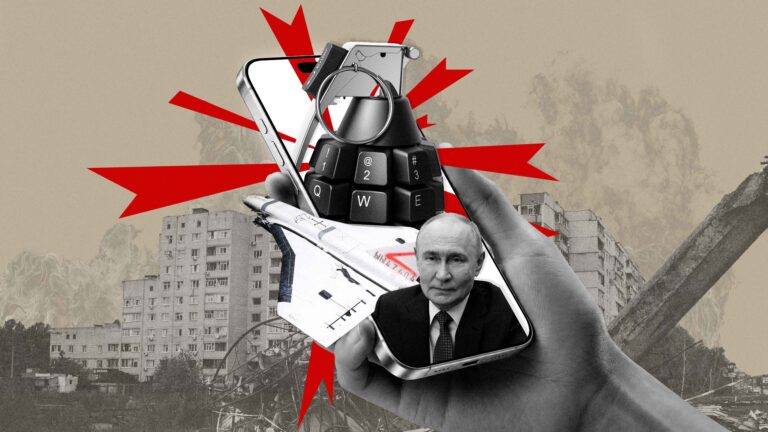
The frontline of our war with Putin is the phone in your pocket