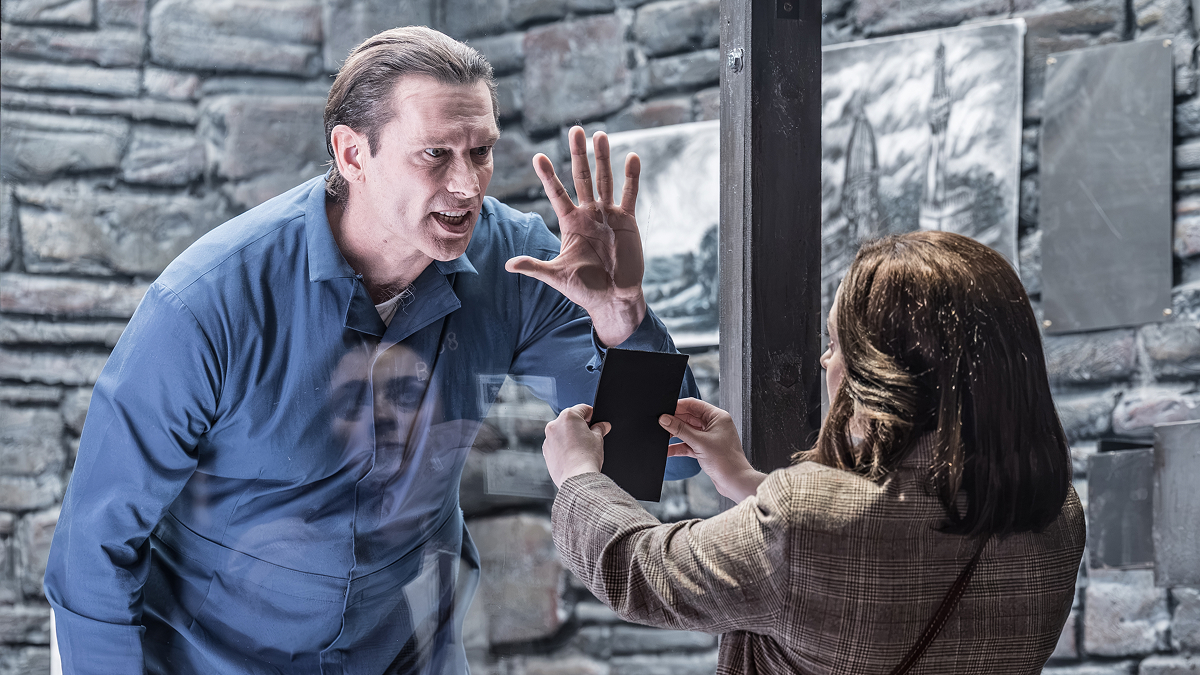
Hannibal Lecter, the cultured, sophisticated psychologist and gourmand, continues to capture the public’s imagination 45 years since he first appeared in the Thomas Harris novel Red Dragon. He appeared in three subsequent books, The Silence of the Lambs, Hannibal and Hannibal Rising; on film five times, portrayed by three different actors, and on TV in the series Hannibal. His latest incarnation is in the stage version of The Silence of the Lambs, adapted by Gina Gionfriddo, which is currently on tour in the UK, and which I caught recently at the Lowry in Salford.
Given what he gets up to, it’s a testament to how good the character is that he remains so popular, despite, it sometimes seems, his original author’s best efforts. The great thing about Lecter was always that no-one could explain why he was what he was – attempts to dissect his psyche always failed because he had no precedents.
But after the film of Silence of the Lambs was such a phenomenal success, there were the inevitable clamours from fans for his origin story, and in his final Lecter book, Harris provided just that, surely beyond his better reasoning. In Hannibal Rising, we get to see the traumatic experiences that provide the ludicrous, Freud-on-steroids source of Lecter’s carnivorous tendencies (spoiler): Cannibal Nazis ate his sister. I can’t believe he didn’t go with that for the title.

Very sensibly, the new play chooses to ignore the worst origin story since superhero The Whizzer gained superspeed by accepting a blood transfusion from a mongoose. Instead, Lecter himself states that evil is as good an explanation for his actions as trauma, though he believes both concepts are ultimately man-made and reductive. Thus restored, we can enjoy Hannibal the Cannibal for what he is, not what made him thus.
The play also manages to deftly sidestep another, more controversial, aspect of the original book by giving serial killer Buffalo Bill a Norman Batesish mother fixation, rather than any hint of a trans agenda, so we can only applaud Gionfriddo’s commitment to restoring the good doctor’s reputation.
For even more perfect proof that authors and creators aren’t always the best judges of what to do with their franchises, one needs only to look at what George Lucas did with the Star Wars franchise post The Empire Strikes Back. As well as ruining Darth Vader with a plodding three-film exposition-fest that left no aspect of his childhood on the cutting room floor, Lucas also managed to turn a fun throwaway mention of the Clone Wars in A New Hope into Attack of the Clones, a movie so far from fun it makes Eraserhead look like Toy Story 3.
But he wasn’t finished there: for absolutely no reason whatsoever, other than he could, Lucas also embarked on an insane program of incredibly annoying tinkering with scenes from the original trilogy. Incidentally, I don’t care what changes he makes, Han shot first.
Having thus successfully trashed the brand with three all-but-pointless and vastly lukewarm prequels (pun intended), in 2012 Lucas offloaded the whole thing to Disney. Surely the House of the Mouse could rescue the franchise from its prequel hell?
Well, not so much – their own three dismal sequels culminated in 2019 with The Rise of Skywalker, which proved that giving people what they want isn’t always what they want, as it managed to tick every fan service box it was possible to tick while simultaneously being the worst film ever made.
Similarly, JK Rowling’s post-books projects for Harry Potter seem to take an undue pleasure in messing with the originals for no good reason – The Cursed Child’s sliding-doors moments fundamentally alter the characters – Harry in particular comes across as both a bad father and, for want of a better word, a bit of a dick; and the Pottermore website seems to exist mainly to annoy her avid readers by adding more and more unearned character details for no good reason whatsoever. I bet you didn’t know Rowling was so good at pissing people off, did you?
Suggested Reading
Why are ‘serious’ music fans so snobbish about tribute acts?
There are plenty more examples. Having created a perfect ending for Only Fools and Horses, John Sullivan caved in to pressure from The Sun to write what amounted to three episodes of fan fiction for his own creation. If nothing else, they killed all enthusiasm for the programme, so at least he didn’t get pestered to write any more.
Surely there must be a process for intervention in such circumstances? “Please put the pen down, Mr Conan Doyle, bringing Holmes back from the dead is clearly a terrible idea” would have meant that the franchise finished on a perfect note – though carrying on didn’t exactly spoil the brand, did it?
And it’s a brave editor who doesn’t publish the latest in a successful franchise just because it’s no good. Thankfully, George RR Martin let HBO blow the ending of Game of Thrones so he doesn’t have to, which isn’t to say he won’t, of course. Writers – you can’t trust ‘em.
 Most popular

What happens to Trump if he loses the midterms?

It might not look like it, but a motoring miracle has now happened

It’s time for Burnham to kill off old Labour

18 things that will absolutely, definitely happen if Trump gets whopped in the midterms