
Britain is criss-crossed with legacies of greatness, cities connected by railway lines, trading hubs linked by canals, rivers spanned by bridges. What were the fundamental principles that enabled these engineering marvels, peaking with the astonishing Victorian construction of great public works that so overshadows our own era? How did they do what we apparently cannot?
The foundations were laid in the 1700s where the stability of British society, compared to much of Europe, gave the confidence to invest and progress. By the middle of the century, the concept of social capital had developed, which included the emergence of philanthropy, Sunday schools, trade bodies and coffee shop meetings. By 1800 there were over 700,000 friendly societies, offering mutual support and common purpose.
This social contract grew with the Industrial Revolution, building infrastructure for both profit and the advancement of society. It was the antithesis of Zuckerberg strip-mining attention with algorithms, of Bezos eradicating business from high streets, or Musk’s belief that the ideal society should be authoritarian. But it was the absence of authoritarianism that allowed British businesses to flourish. It turned out that the rule of law and societal expectation were part of the solution, not part of the problem.
Industry required physical infrastructure that allowed raw materials to be transported to factories, finished items to be exported and fuel moved to where it was needed. Projects were funded by new types of sophisticated banking structures that were refined during the Napoleonic wars. Britain fought with money from taxation and bank loans. Napoleon funded his wars with plunder.
When the wars ended, those same financial systems remained available for peacetime projects and for the government to build secure maritime trade routes. It was the start of the Pax Britannica, a time during which the state provided a structure so that private enterprise could develop.
Simply, Britain did it differently. It was a country in pursuit of success, a mercantile nation where labourers left the land for higher factory wages, traders sought new markets, industrialists made products and vital infrastructure was built.
Suggested Reading


The shocking lesson of the BBC’s Brexit: A Very British Civil War
There was a kickback against inequality, but despite the grinding conditions of the workforce, Britain in the 18th and 19th centuries remained politically conservative and stable, as wealth moved gradually from the landed aristocracy to an industrial meritocracy. It avoided revolution and the later disruptive thrills of the far right and the far left.
In its way, the Britain of that period was a forerunner of Silicon Valley. It assembled an infrastructure of technical entrepreneurs and risk-taking capital, followed by institutional investment.
Finance was the enabler of the great nineteenth century projects, driven by focused private individuals. The attitude was if it could be done, then it should be done. Progress was part of the social contract, and there was almost a national duty to support enterprise and to follow through on commitments. As such, many inventors, such as Faraday, did not file patents, believing they were part of a greater movement. Most scientists felt they were on a journey of discovery and societal advancement, not of personal wealth creation.
Today, protecting IP is essential, but so too is public recognition of great achievement. Reform of the current honours system might be a good way to help on that front. But in these periods of advancement there is also a crucial element of verve. So, for example, when Charles Parsons was working on his maritime turbine engine, the River Tyne authorities looked away when his time trials broke the speed limit. The Admiralty quietly encouraged him.
At Queen Victoria’s 1897 Diamond Jubilee fleet review, Parsons’s ship Turbina appeared, racing down the line of battleships, a naval picket in hapless pursuit. Soon the great transatlantic ocean liners adopted his new engines and the navy committed to the technology. Dreadnought was the first turbine powered battleship. All the power came from coal and the supply expanded to feed industry, while also providing the imperative for finding better ways to transport it.
Suggested Reading


The Brexit Kray Twins are back – and so are their lies
Where has all that verve gone? Modern Britain has failed to provide scalable power for transport, industry, homes and the immense hunger of data centres. It has also failed to provide affordable energy to industry, with costs four times greater than the US and one and half times that of key European competitors. Until our power supply is solved, we will stagnate, remaining vulnerable to overseas competition and to the supply of hydrocarbons from sources we do not control.
In short, it is pointless to reduce the carbon footprint of our industry and agriculture, if all we do is import overseas manufactured goods and food containing all those embedded carbon emissions. At the same time, the new Industrial Revolution is AI, so virtuous preening about lowering our emissions is meaningless if we simply use other countries’ data centres. We need to be at the centre of that revolution, not on its periphery.
Irrespective of the profitability of the British Empire, it traded on an epic scale. With trade came a need for infrastructure to service the flow of goods. Between 1815 and 1835, Liverpool alone built eight new docks. When Birmingham doubled in size by 1851, a rail line to London was quickly built. There was a clear understanding that for the country to succeed, it needed infrastructure.
Britain’s vast trading empire became self-generating. Industry created trade, which needed infrastructure, in turn making it easier to sell, which demanded manufacturing: and all these businesses paid tax.
A modern example is Britain’s dominance of Formula 1, a sport that draws in engineers, finance and development expertise. Of the eleven teams on the grid, only Ferrari does not have a base in the UK. Scale has its own dynamic.
Britain has always been an outward looking nation, an island surrounded by challenges and opportunities, trading with the world – a major reason Napoleon invaded Russia was to force Tsar Alexander to stop trading with Britain. With the dividends of Brexit less than obvious, and in an increasingly friable world, our trading links need to be rebuilt.
Population growth also played a major role in Britain’s industrial expansion, supplying manpower for factories and infrastructure construction. From 1700 to 1810, the population doubled to 10m – from 1810 to 1870 it doubled again. When Queen Victoria died in 1901, the population was 40m.
Today, population is a challenge for infrastructure projects. In the last twenty-five years, the UK has, officially, expanded by ten million to 67m people. However, it is where they are located that matters. England now has the highest population density of any major European country, almost twice Germany’s, 3.5 times France’s and 4.5 times Spain’s.
It is hard to build connecting infrastructure where a lot of people live, so big projects need a high degree of commitment. Judicial review must be streamlined, and projects need to be seen through to completion. Only then will we avoid the insanity of the traffic jams, the delayed trains and the embarrassing failures such as HS2.
The democratisation of education and the desire for greater access to knowledge, despite the lack of a universal education system, was also a driver for industry. Ephraim Chambers’s 1728 Cyclopædia: An Universal Dictionary of Arts and Sciences revolutionised the presentation of information with its “knowledge tree” and topic links, the internet hyperlinks of their day.

The Encyclopédie adapted the idea, as did the Society of gentlemen in Scotland, who created the first Encyclopaedia Britannica in 1768. Knowledge was migrating from the elites to the growing middle class.
The Times newspaper launched subscription sales for the 1875 Ninth Edition of Britannica, allowing people to spread the cost, and their discount book club was overwhelmed by buyers. The Tenth Edition repeated the success, so thousands of people now held the world in their hands, without the distraction of notifications.
Cambridge University Press were the publishers of the majestic Eleventh Edition of 1911, meaning that the world’s greatest encyclopaedia could now be owned by thousands of families for a simple monthly payment. Then the world fell apart.
It was the culmination of two centuries spent cultivating a national educational hinterland, out of which stepped curious, inventive minds with an understanding of commerce, science, natural history, geography and philosophy.
True, not everyone had the ability to become a Humphry Davy (son of a woodcarver), or an Isaac Newton (whose mother was twice widowed) or an Isambard Kingdom Brunel (whose parents went to debtor’s prison). Nevertheless, a mobilisation of less well-known scientists, inventors and businessmen built a practical knowledge base that could be applied to industry.
Advanced education is now one of the UK’s strongest assets and its involvement in the technology sector has been remarkable. We were the only European country in 2021 to have a hundred “unicorns”: technology companies worth more than $bn. The following year the collective value exceeded $1trillion, third after the US and China.
In 1821, when Marc Isambard Brunel (father of Isambard Kingdom) was sent to debtors’ prison, the Duke of Wellington arranged for the state to pay his debts, recognising the value to the country of this brilliant engineer. His tunnelling technology created the London Underground, and his son’s achievements are legendary. It is easy to lose generations of talent through inattention.
As the old global alliances pull apart, new ones are forming. We must move swiftly into lock step with our allies, forming new trade links and cooperative opportunities. In the past, our military kept us secure, giving confidence to businesses and keeping trade routes open. Its long, slow, miserable decline is now exposing our vulnerabilities, and must be reversed.
Robust decisions are needed to regain our strength, resilience and dynamism. Every part of society must contribute, in money, work and commitment, because the future is carried by everyone. And we must create the conditions for optimism, the fuel of entrepreneurs and the self-belief of a nation. Finally, we need a stable political system that favours progress, without the excitement of radical leaders. Can we do it? Yes. Moreover, it is essential to our survival.
 Most popular


My truly deranged encounter with Trump apologist Kellyanne Conway
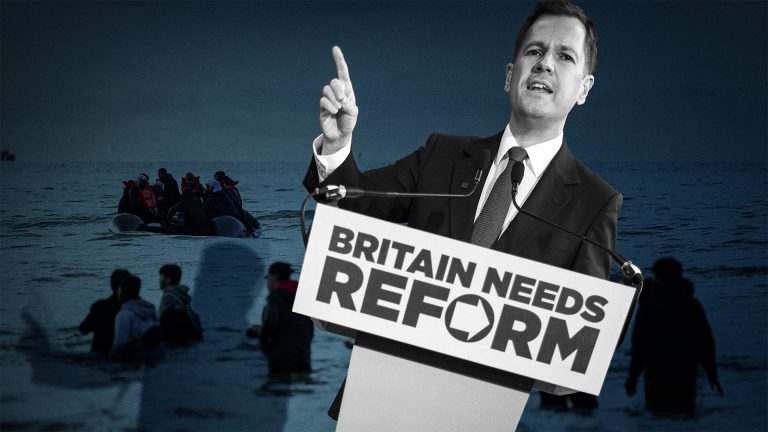

The moral depravity of Robert Jenrick


Is this the real reason Trump keeps falling asleep in public?


Suella Braverman’s book has sold only 106 copies. This is why